Ulaanbaatar, MONGOLIA – I traveled with a group of 30 other teenagers to Ulaanbaatar, Mongolia, for one week. We were there to participate in service work and learn more about Mongolian culture – at least that’s what the itinerary said.
Listen to the author read this article:
Before the trip, Mongolia was just an idea to me. Grasslands. Horses. Chingghis Khan.* Snow.
I didn’t think I had strong opinions about it, but I also hadn’t questioned the subtle stereotypes I’d grown up hearing that Mongolians were rural, rough, “grassland people.”
There was always an undertone that they were somehow less developed and less modern, and I had never made an effort to learn more about what Mongolia was truly like.
I didn’t realize how much of that paradigm I had absorbed until I arrived.
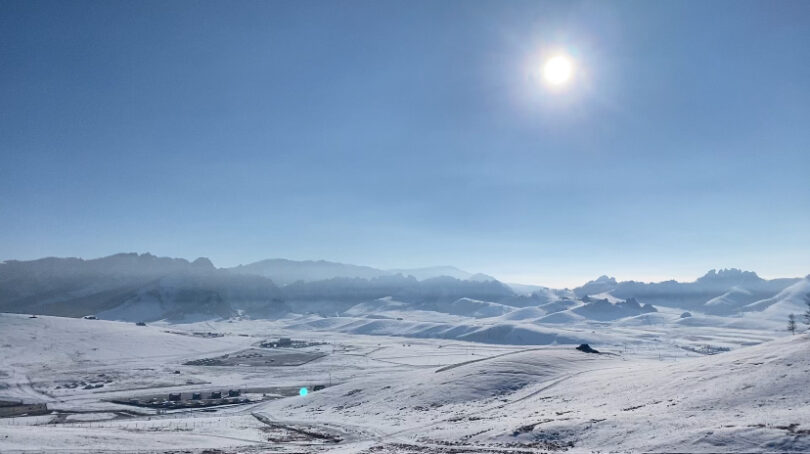
The first thing that shocked me immediately was purely physical. Growing up in a city where temperatures are rarely below 20°C, snow was something I only encountered through TV shows. I remember feeling the awe of seeing the white blanket that enveloped the vast, borderless land from up above and wondering what it would feel like to leave deep prints of my boots sinking into the powdery whiteness.

I crouched down the next morning outside our hostel, wrapped up in more layers than I needed, just to touch it properly, pressing my fingers into the fragile crust and watching it collapse into powder.
It wasn’t soft and fluffy like I had imagined it, but thin, fragile and almost crusty. But I couldn’t stop smiling.
There was something strange about experiencing something so ordinary for other people and so new for me. It was a subtle reminder to me that I was the outsider here.
After a long hike in the humid cold to learn more about the history of Mongolia, we visited a local public school in the suburbs of Ulaanbaatar. I was curious about how different local Mongolian students would be and wanted to ask thoughtful questions.

Instead, the first question I asked the girl I was paired up with was, “Do you live in a Ger?”
Gers are traditional, portable round tents used by nomadic families, and they were often depicted on covers of travel brochures for Mongolia.
“No,” she said with a laugh, amused by my question. “I live in an apartment.”
I felt my face get warm. Of course she lived in an apartment. We were in the capital city. There were traffic jams, high-rises, cafés.
But somewhere in my mind, I had reduced Mongolia to one image: circular tents in the middle of the steppe.
“Many people assume that about us,” she told me, “but Mongolia has changed since. More people have moved to the city to pursue a better life. Some still live in Gers due to the high housing prices in Ulaanbaatar, but do not relocate based on the season anymore. Nomads are rare now – foreigners don’t realize that.”
She told me the Ger districts’ coal stoves, built for the open steppe and now packed close together, produce most of the city’s winter smog.
Roughly 60% of Ulaanbaatar lives in these districts, and the World Health Organization estimates they generate close to 80% of the pollution.
The more we talked, the more alike we turned out to be. We read the same books, listened to the same music and watched the same TV shows. And, the more embarrassed I felt. It wasn’t because she judged me, but because I was very wrong about her.
It wasn’t just about the people, though.

At Terelj National Park, my first reaction to the Ger we’d sleep in was complaint: the coal stove in the middle, the thin walls, the cold.
I remember thinking, slightly dramatically, We’re really living like this? I missed central heating. I missed long hot showers. I missed comfort.
That thought embarrasses me now because of how spoiled I sounded, but it was real.
That first night, a few of us took over feeding the stove ourselves, badly, adding too much coal at once and scrambling back from the heat. It was clumsy, but somehow, tending that stove made the space feel ours. It was the first step of learning to live with the cold and appreciate its beauty.
And then there were the stars.
In Hong Kong, the sky is washed out by light pollution: buildings, street lamps, screens. Here, we could see the Milky Way stretching clearly across the sky.

We stood there shivering, unwilling to go back inside. It felt overwhelming in the best way.
For the first time in a long time, my mind was quiet.
The same thing happened with my roommate. I hadn’t been close with her before the trip and was quietly disappointed to be paired with her, but a shared Ger in freezing weather closes distance fast. We laughed about slipping on ice; she admitted she was homesick. Without WiFi, we talked honestly.
By the end of the week, the version of her I had constructed in my head had completely dissolved.
Distance makes it easy to simplify people into assumptions, but proximity makes it impossible, whether that’s a stranger, a roommate, or a country.
By the end of the week, something in me had softened.
I had arrived slightly spoiled and quietly judgmental. I was annoyed at “bad” living conditions, subconsciously holding on to stereotypes about what rural meant.
I left with coal-smudged hands, a newfound appreciation for heating and warm weather, and a deeper respect for simplicity.
The snow I touched on the first day melted almost instantly in my hand. And so did my assumptions.

Mongolia didn’t feel empty anymore. It felt expansive: not lacking, but spacious enough to force you to confront yourself.
Under the eternal blue sky, without WiFi, without excess comfort, I started noticing smaller beauties: warmth shared in a cold Ger, ramen cooked over coal, stars bright enough to enclose you, laughter echoing inside a circular tent.
I arrived with narratives about history, about civilization, about who is “advanced” and who is not. I didn’t consciously think Mongolians were lesser, but I had internalized that idea.
Mongolia did not confront my paradigm of it aggressively. It simply existed and let me feel its culture first-hand until my assumptions felt embarrassingly small beneath its sky.
I went to Mongolia expecting to learn about another culture.
I didn’t expect to learn so much about myself.
Sophia Ling is a Reporter with Youth Journalism International.
*This article uses the preferred Mongolian spelling of the ancient warrior and leader’s name, Chingghis Khan. Western publications often spell it ‘Genghis Khan.’