This year alone, Youth Journalism International published more than 200 pieces from young people in 36 countries on subjects ranging from the Northern Lights in Norway to the restrictions girls face in Afghanistan.
Listen to an audio recording of this article:
“It’s like being in a cage,” wrote Nazanin Boniadi, a YJI student in Kabul. “Life for girls is like hell.”
The regime aims to hide and silence them.
But thanks to YJI, Nazanin’s voice carries around the globe because (1) she is brave, and (2) she is part of the world’s best journalism training program.
During 2025, YJI published pieces by 65 students from every continent except Antarctica – from a quiet village in Madagascar to war-torn Ukraine.

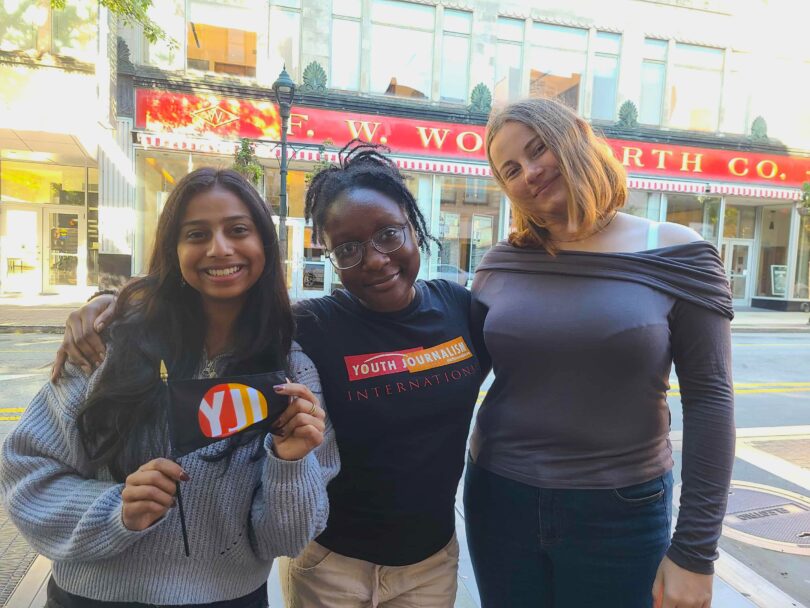
Our students, who participate for free, learned how to write a story and had at least one of them published. They also made friends with each other during Zoom meetings, online chats, phone calls and in-person gatherings that included a global conference in South Africa that brought together students from eight nations for nearly two weeks.
Even for YJI, a 32-year-old charity with no paid staff, it was a remarkable 12 months.
One major initiative, suggested by students, began last spring and never faltered. Every story by YJI now includes an audio version as well as the written text. In most cases, the student who wrote the piece also read it.
What that means is that YJI’s stories are available for free for anyone in the world to listen to, read and share.
The Royal Society for Blind Children in the United Kingdom said it welcomed YJI’s project. “It’s incredibly important that blind and partially sighted young people can stay informed, and by providing audio, YJI will give them more independence through being able to control how and when they consume its content,” the society said.
It’s just one more way that YJI sought to further its mission to connect student writers, artists and photographers with peers around the globe, teach journalism, foster cross-cultural understanding, and promote and defend a free youth press.
In the spring, YJI editors talked with students interested in journalism at Johns Hopkins School of Advanced International Studies center in Nanjing, China.
In October, YJI sponsored a forum on the future of the press in Chapel Hill, North Carolina in which two students moderated a panel that included four industry professionals, including a Pulitzer Prize winner.

A YJI student from Germany even got the chance to cover the popular Eurovision song contest — and talk to the winning singer, too!
Also worth noting is that YJI achieved platinum status on the charity rating site Candid and earned a top-rated charity designation from GreatNonprofits.com, a listing it’s had since 2010.
YJI is committed to helping young people achieve their dreams and to take their ideas and suggestions seriously. That’s why our board of directors includes two student representatives who are always ready to weigh in: Sreehitha Gandluri, a college student at the University of North Carolina, and Noah Haynes, a high school student in Denmark.
This year, too, YJI sought to bolster its social media presence, with a team of students taking on the challenge. You can find YJI on Instagram, Facebook, LinkedIn and more.

YJI also concluded another successful contest honoring some of the best work by teen journalists around the world.
Though YJI has no employees, it does have expenses. None of this would have been possible without the generous support of many people and organizations that believe in the future of journalism.
Here’s just a sampling of some of the work done by YJI’s talented students this year:
Rosca, the cake of kings by Samantha Esquivel in Mexico.
Greenland leaders, Arctic expert weigh in on Trump threat by Noah Haynes in Denmark.
Being an American is my birthright by Malaika Brefo in Connecticut.
Ukraine marks three years of war since Russia’s invasion by Daria Prymak and Ann Tsyhanok in Ukraine.
Lack of reading poses dangerous risks by Nicole Luna in Brazil.
Sri Lankan school focuses on special needs students by Shanish Fernando in Sri Lanka.
To know Sétif, Algeria, you need all your senses by Abdellah Bouberima in Algeria.
Turkish footballers think they know about giving birth. They don’t. by Naz Mergen in Turkiye.
In Pakistan’s conflict with India, the history lessons are getting too real by Anya Farooqui in Pakistan.
New phone pouch policy divides Scottish high school by Leila Koita in Scotland.
Bulgaria considers grading student behavior – and fines for parents by Kornelia Tomaszewicz in Bulgaria.
China’s soft diplomacy: Pandas win hearts and minds without even trying by Annamika Konkola in China.
Feeling at home at his university by Chibuike Chukwuka in Nigeria.
Sicily’s best – the Festival of Santa Rosalía in Palermo by Owen Ferguson in Italy.
Haiti’s new leader is an unknown from the business elite by Naïka Jean in Haiti.
Learning the world of fashion from the inside by Mayama Opare in Ghana.
My bubble-wrapped boarding school feels like home by Lelna Mengesha in Ethiopia.
Once an ancient Portuguese war game, bullfights now entertain the public by Manuel Bernardo Tavares Moreira Belo Carmona in Portugal.
Futuristic ideas on display at Expo in Osaka by Nanaka Takahashi in Japan.
Living the lobster life by Carlos Fra-Nero in Maine.
Museum shows the brutality of the American Civil Rights struggle by Dorothy Quanteh, Lina Marie Schulenkorf and Sreehitha Gandluri in North Carolina.
FIFA futsal Women’s World Cup is an imperfect but important advance by Isla Giron in the Philippines.
Screenwriter shares stories of career in Egyptian film and TV by Jana Salama in Egypt.
For more information about YJI, check out its website at www.YouthJournalism.org.