Sofia, BULGARIA – Big changes are ahead in Bulgaria this year with recent resignations of both the prime minister and president and collapse of the government coming just as the country enters the Eurozone.
Listen to the author read this story:
“Today is the last time I’ll address you as the president of our country,” Bulgarian President Rumen Radev said January 19 on live television. According to Bulgarian media, Radev’s resignation was the first time a president left office in modern history.
It also marks the first time that Bulgaria will have a woman leader.
Iliyana Yotova, who was vice-president under Radev, has been sworn in as Bulgaria’s president. She will serve until the next presidential election, expected to be held in late autumn this year.
Last month, after nationwide protests, Rosen Zhelyaskov, Bulgaria’s former prime minister, publicly resigned, causing the government to collapse. Bulgarian and international media, including The New York Times, noted that this was the first European government to be unseated by Gen-Z.
Snap elections for prime minister are now expected to take place between the end of March and the beginning of April.
The year 2026 began with Bulgaria officially joining the Eurozone, or the nations that use the euro as currency. Bulgaria will use both the original Bulgarian currency called the leva and the euro until the end of January. After this, Bulgaria will solely use the euro.
The changes are unfolding in front of a backdrop of regular public protests in Bulgarian cities.
Political tensions have been rising, with new protests demanding the use of voting machines instead of paper ballots in order to minimize the risk of corruption and falsified results. As of now, this remains an ongoing debate.
Questions remain over whether Radev, the former president, will form his own political party and enter the upcoming elections.
When he addressed the nation, Radev offered his reasoning for leaving office. From Radev’s standpoint, two thirds of Bulgarians do not vote and do not trust the media or the rule of law. He mentioned national protests in 2020 over corruption and demonstrations in December that led to the government’s collapse.
Radev blamed the country’s oligarchs for the December protests.
It all started with the national budget for 2026 under former prime minister Zhelyaskov. The budget included changes that would directly affect everyday people and businesses, including a 2 % hike in social security payments and a 5-10% increase in dividend taxes paid by people who own shares in a company, according to Active Politics, a non-governmental organization.
The proposed increases would have meant that workers would take home less money each month and employers would have to pay for every employee, the NGO said.
All of this led the centrist political party Produlzhavame Promyanata to encourage Bulgarians to protest on December 1 and 10.

The protest used the slogan, “Don’t Feed The Pig,” and seas of Gen-Z protesters used social media to update one another on political decisions being made about their future. Later, those became invitations and advice on how to stay safe and protest peacefully. Demonstrations in front of municipal buildings and courthouses took place across more than 10 Bulgarian cities, including the capital Sofia, Varna, Plovdiv, Veliko Tarnovo, Shumen and others.
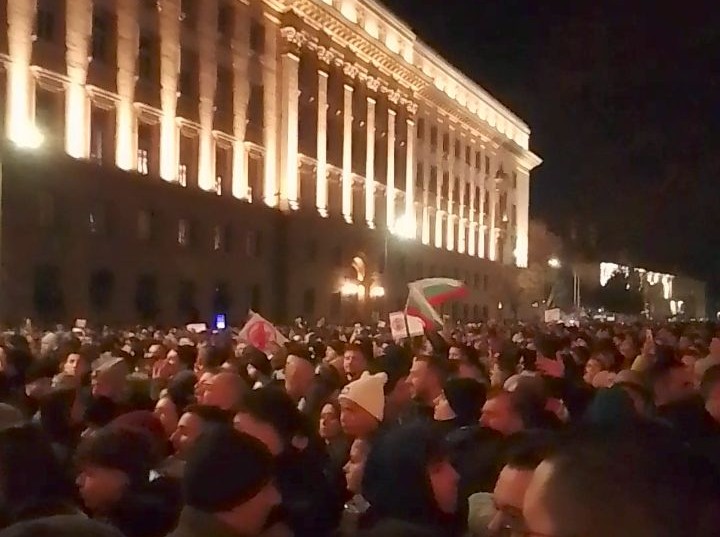
On December 1, thousands of people flooded the streets in Sofia, Bulgaria’s capital city, to gather in front of the National Assembly in protest of the government and its budget plans.
Protesters carried posters of pigs and pumpkins meant to represent two of the most notorious oligarchs in Bulgaria – Boyko Borisov and Delyan Peevski, the faces of two major right-wing political parties.
Paper sausages and Peppa Pig balloons could be seen throughout the crowd and a large pig statue was placed in front of the National Assembly, becoming a symbolic figure during the protests.
Handwritten slogans and laser projections lit up the facade of the National Assembly reading “Mafia out” and “Resignation,” which protesters continuously shouted in unison as whistles echoed through the streets.
Protesters could also be heard chanting a song they created about the political situation: “When Delyan Peevski falls, I don’t want to be under him, so he doesn’t fall on top of me!” a chant that quickly turned into an anthem.
Demonstrators also jumped while chanting “whoever doesn’t jump is fat,” taking a direct jab at Peevski.
Later, Bulgarian singer Mila Roberts dedicated the song “Svoboda,” which means “Freedom” to the movement, singing that freedom was coming to lift the spirits of Bulgarians, a message many used to symbolize the protests.
Kornelia Tomaszewicz is a Reporter with Youth Journalism International.