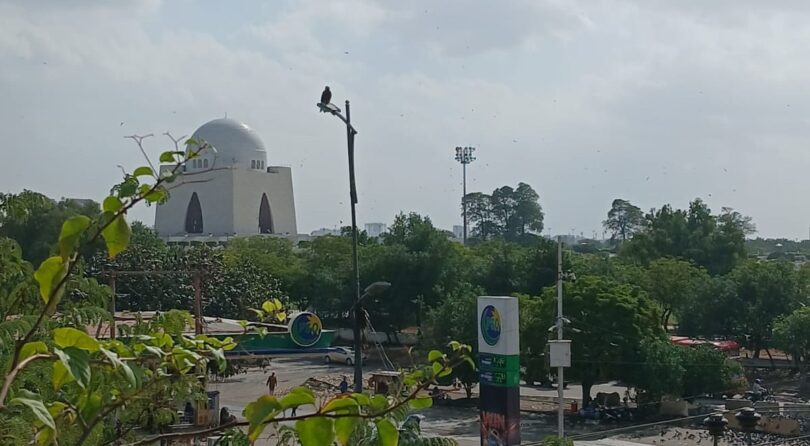
Karachi, PAKISTAN – Since waking up Friday to news that the country was at war with neighboring Afghanistan, Pakistanis are on high alert, with changes already impacting everyday lives.
Listen to the author read this article:
Citizens are being told to carry their ID cards with them, in case of need for verification. The fear of an ‘enemy within’ is strong, and tensions are sky-high.
Students are worried for their exams, with some netizens jokingly saying that war only breaks out in exam season, remembering last year when conflicts between India and Pakistan erupted at a similar time.
But not everyone is so casual about the war. A 17-year-old student in Karachi, Zoya Asad Ali, said that she was afraid.
The conflict, Asad Ali said, is “escalating really quickly. It’s concerning how quickly this is expanding.” She added that she feels helpless.
“It’s really sad to just be watching, and to know that you can’t have any sort of impact,” said Asad Ali.
She is not alone in this worry and fear. Another student, Inaya Aly Khan, also 17 from Karachi, said she doesn’t see this as a new issue, but rather as “a continuation of an old one.”
Khan added that “a military solution is a really bad way to resolve this. I don’t think it is going to be solved this way. All this is going to do is create more loss on both sides.”
The unease between the two countries escalated into an “open war,” said Pakistani Defense Minister Khwaja Asif in an X post at 3 a.m. on February 27.
Tensions have been simmering since early October with frequent border clashes. This finally came to a head after Pakistani air strikes led to retaliation from Afghanistan, with attacks on Thursday spreading across six districts, according to Al-Jazeera.

This was followed by Pakistani aerial strikes continuing against the Afghan capital of Kabul, as well as Paktia and Kandahar, on Friday.
Pakistan has termed this latest conflict as “Operation Ghazab lil-Haq,” meaning Righteous Fury. Many residents feel this is a conflict many months in the making, a repetition of the conflicts in the past. Once more, nothing has changed, but innocent people are still affected.
Students aren’t the only ones who are concerned.
Zeeshan Amin, a Pakistani living in Iraq, feels this is a grim sign, saying that “dependence on violence and armed forces to settle disputes is definitely a very dangerous direction that we’re headed in.”
Conflicts like these “essentially go back to countries resorting to imperial means and imperial ideologies. There is now a higher tendency for countries to start dominating, to reduce their opponents,” said Amin in response to a Youth Journalism International query.
He added that Pakistan is sending a signal to Afghanistan to cement themselves as the ones in control.
This conflict is one that is unfortunately familiar to those living in the Middle East and Global South. While the reasoning may be different, it is ordinary people who pay the same price each time. Over and over again, violence and instability in this area has wrecked both lives and homes, creating havoc.
All people can truly do is hope that this is resolved quickly, and that more lives are not lost.
Anya Farooqui is a Senior Reporter with Youth Journalism International.