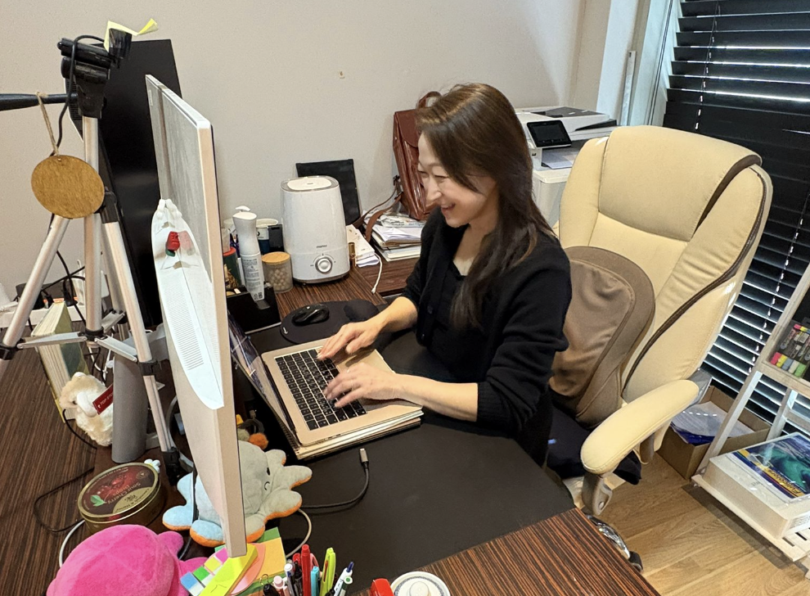
Seoul, SOUTH KOREA – There is a stuffed octopus on Professor Sangah Lee’s desk. She points to it mid-conversation, not as a decoration but as a teaching tool – a quick way of explaining how the hippocampus works.
Listen to the author read this story:
“Let’s say you see a picture of an octopus somewhere as you’re scrolling through social media,” she said. “Then you’ll be like, oh, I remember seeing that octopus. It was in this room, in this office. Then you’ll remember your conversation with me.”
“There’s a little cue, there’s a partial cue,” she says, “and then your brain says, oh, I’ve seen that before.” She paused. “But here’s the thing. Your memory is not anything about what you’ve exactly seen, but something that you’ve created based on all of the past experiences you’ve had.”
Lee is an associate professor at the Department of Brain and Cognitive Sciences at Seoul National University, where she leads the Developmental Cognitive Neuroscience Laboratory.
Her research spans episodic memory, spatial navigation, and how cognitive abilities develop across the entire human lifespan. Named a Young Scientist by the World Economic Forum in 2018, she is one of Korea’s most prominent figures in cognitive neuroscience.
“The true nature of humans and the true nature of minds is absolutely fascinating,” she said. “The fact that we can study it is in itself like a gift.”
Lee did not originally begin her career thinking about brains. She began thinking about stars. As a high schooler, she was captivated by basic questions about existence, which carried her to Caltech to study astronomy and physics.
But in her third year, something shifted. She noticed that even Nobel Prize-winning physicists couldn’t truly picture what a Big Bang looked like.
“I began thinking: what is it about our minds that some things seem so intuitive and easy to think about, and some things seem very difficult?”
She transferred to Harvard for graduate school to pursue psychology. Friends tell her she once studied “outer space,” but now she studies “inner space.”
Most people think of memory the way they think of a video file – something either saved or lost. Lee says that’s almost entirely wrong. Memory is a construction.
When we experience something, neurons form a pattern representing that moment. Later, something similar activates a portion of that pattern and the hippocampus fills in the rest.
“It’s like I just see the tail of the cat, but I infer that the rest of the cat is there based on the memory of the cat. That process is a creative process in your brain.”
Every time you recall something, you are rebuilding a scene from incomplete fragments, she said, filling gaps with what you know, what you expect and what you’ve experienced before.
Among the components of episodic memory, one is far more fragile in early Alzheimer’s: the when.
“The spatial aspect of memory is well-known to decline early,” Lee said, “but what our research has shown is that organizing information in time seems to be even more vulnerable than space.”
The reason may lie in the cellular machinery of the hippocampus. Place cells fire in precise temporal sequences within a brain rhythm called the theta wave.
“When things start breaking down, that fine timing mechanism will start getting weaker first.”
The human brain develops over an unusually long period, which means it remains unusually changeable. Early hardship leaves marks, according to Lee, but they are not sentences.
“You’re growing your own brain,” Lee said, “to give yourself experiences. And you have time to change.”
When asked what she’d leave readers with, she didn’t hesitate.
“Sculpt your own life,” she said. “Take care of yourself and sculpt your own life. It’s possible to do so.”
Josephine Yein Lee is a Senior Reporter with Youth Journalism International.