
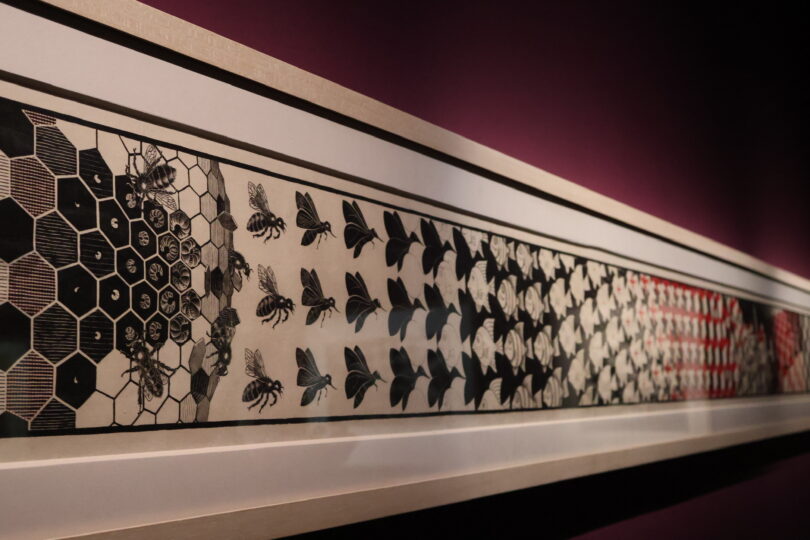
Padua, ITALY – The Cultural Center Altinate San Gaetano in Padua is hosting an exhibition dedicated to the famous Dutch graphic artist, M.C. Escher.
Listen to the author read this article:
This five-month exhibition, which opened in February and is closing on Sunday, includes both Escher’s early works and his most famous masterpieces.

The series of woodcuts called “XXIV Emblems” caught my eye in Escher’s early work section.
These are 24 illustrated maxims in verse, featuring a Dutch epigram at the bottom introduced by a Latin motto at the top.
I especially liked the woodcut called “Beehive.” It shows a hive in the rain and goes like this:

In adversity, diligence is useless.
Diligence finds comfort,
laboring without pause,
provided the violence of the sky
does not rage over our work.
As it turns out, Escher spent a significant amount of time in Rome from 1923 till 1935 and also traveled during his stay to Italian towns ranging from Venice in the North to Catania in the South.


His life in Italy inspired him to create some beautiful artworks depicting the landscapes and towns of this country.
In the next room, the original block of wood was displayed alongside the finished woodcut of St Peter’s Basilica in Rome to illustrate the creation.
A woodcut is made by first engraving the wood. The wood block is then covered with ink, and a piece of paper is pressed on top so that the ink passes onto it.
After his trip to Southern Spain in 1936, Escher was inspired by the ornaments used to decorate the local arches and walls and decided to explore tessellations, which are geometric decorations created by filling a plane with various shapes without leaving empty spaces.
He got really creative with it, going beyond simple geometric figures and designing tessellations of various subjects, including animals and human figures.
The exhibition also contained the woodcut called “Metamorphosis II,” a 389.5 cm-long horizontal piece depicting the transformation of geometric figures into animals and architecture and vice versa, eventually pouring into an ornament identical to the one at the beginning.
And, of course, the collection of Escher’s works would not have been complete without some of his greatest masterpieces.


The exhibition featured his piece “Drawing hands” and his series of paradoxical architectures, including probably his most renowned work “Relativity,” featuring an impossible staircase.
Escher’s other famous work, the self-portrait “Hand with Reflecting Sphere,” is also on display alongside an interactive installation. The visitors were invited to step in front of a camera and take Escher’s place inside the sphere.


But my favorite work in the whole exhibition is probably “Magic Mirror,” depicting an intricate procession of griffins, or small lions. It is captivating and perfectly merges tessellation and entangled composition of his architectural works.

The last exhibition space featured the products of the so-called Eschermania, a tendency to draw inspiration from Escher’s works in pop culture, design and modern art.
It contained album and comic covers, photographs, and even IKEA advertisements referring to the Dutch graphic artist, showing the role that Escher continues to play in shaping modern culture.

The exhibition exceeded my expectations, being not just a boring sequence of traditional artworks, but an interactive space that challenged my perception of reality and left a lasting impression.
Sofia Yakymenko is a Junior Reporter with Youth Journalism International.

Such a great one, Sofiia!!