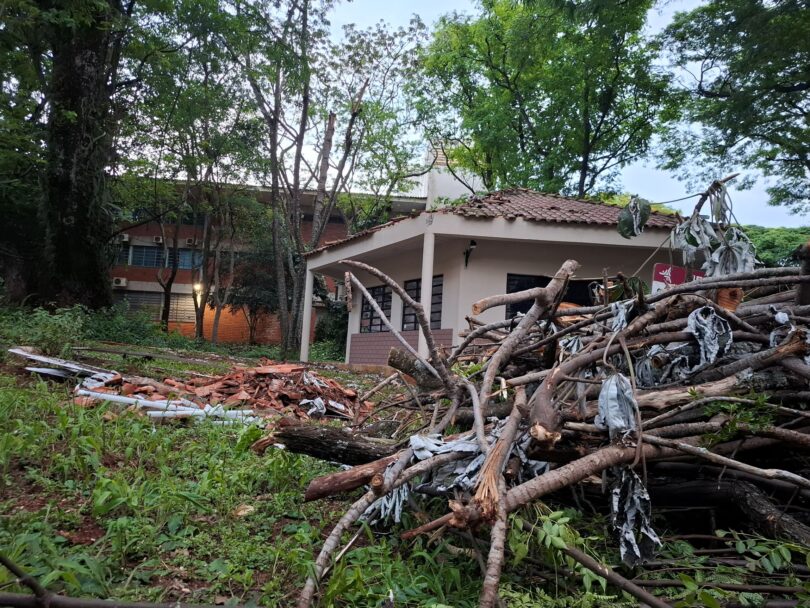
Maringá, BRAZIL – Heavy rains that came early this month damaged 21 municipalities in Paraná state and the city of Maringá faced one of the hardest natural disasters ever registered.
Listen to the author read this story:
The storm affected 4,000 people in Paraná, with the cities of Maringá in the Northern region and Marquinho in the Central-South the most affected.
According to the Weather and Environmental Monitoring of Paraná, in Maringá the phenomenon was classified as a tornado type F2 on the Fujita scale, with winds estimated between 180 km/h and 250 km/h, or 112 to 155 mph.
This is the first time that Maringá – a city in northern Paraná – has been struck by a tornado. The Municipal Civil Defense reports that 40% of the city was affected by the storm.

Renato Alexandre, 24, is a Communication and Media student at State University of Maringá. He was one of the people affected by the tornado in the city.
Before the natural disaster started, he was away from home and could already see very intense lightning in the sky, an atmospheric discharge far beyond the usual pattern he’s used to.
“Arriving home, I went to sleep, and around 3 in the morning I heard my brother closing the windows and a very loud wind noise outside,“ said Alexandre.
“It was an absurd wind; you could see branches and trees almost falling over, you could see and feel afraid of whether the utility poles were going to explode,” Alexandre said. “I remember being able to hear some power poles blowing up near my house, because in my neighborhood many trees fell and pulled the poles down, so you could hear the explosions.”
To reach this assessment, experts analyzed both the behavior of the storm and the traces left in the city by the passage of the winds. Authorities estimate that this type of phenomenon is becoming more frequent in the southern part of the state.
For a city nationally renowned as the greenest in the country, the loss of so many trees is particularly concerning. Some were uprooted entirely, striking structures and destroying homes.

“Worse than that moment was waking up the next day, because then you face a neighborhood that is completely transformed and destroyed, with public roads blocked due to trees. You could see the uncertainty of people walking down the street, not knowing what was going to happen or when it would be repaired, because it’s not the first time trees have fallen. In my neighborhood, just this year, two to three trees have already fallen due to storms,” said Alexandre.
According to the Paraná State Energy Company, more than 113,000 properties had power service interrupted.
The City Hall reported that until Nov. 4, two days after the storm hit, 35,000 properties remained without power or internet access, and some buildings were experiencing water outages. More than 1,000 workers and volunteers engaged in recovery efforts across the city.

“We were left without power for more than a day. When darkness falls, when night comes, we are left in the dark and there isn’t much to do, but we keep waiting in the expectation that everything will be resolved, hopefully in less than a week, but we carry on like this,” said Alexandre.
Several industrial warehouses and businesses had their roofs torn off by the winds, with windows shattered. An assessment has identified a path of destruction spanning approximately 15 kilometers, or more than nine miles.
Alexandre offered a solution for this catastrophe.

“I think the best form of prevention is not eliminating the trees, but having regular pruning, organizing it properly, keeping control over it, and declaring a state of emergency as soon as possible. It took too long to declare it, they didn’t publish the public calamity in the Official Gazette in time, so I don’t think you can keep postponing things,” said Alexandre, “Higher-level help must be requested immediately so as not to depend solely on the municipality, but also on the state and federal government.”
Despite the damage, there were no reported injuries in Maringá.
The Public Security Secretary, Luiz Alves, reported to the radio CBN Maringá, that even with the blackouts around the city, there was no increase in criminality reported to the authorities. But they received more occurrences of scamming and fraud.
“We must be more aware. If there’s something really attractive for one side, be careful because no one is here to benefit anyone. Those scammers take advantage from any moment, especially chaotic situations,” said Alves.
According to the Weather and Environmental Monitoring of Paraná, in Altônia wind gusts reached 109.1 km/h, or more than 67 mph, and in Marquinho, in the central region of the state, news reports told of hailstones damaging roofs of houses, schools, health clinics, and other municipal buildings, in addition to commercial establishments.
In the entire state, 4,000 people were impacted and 28 needed to be taken to shelters. Furthermore, 456 residences were damaged and one was destroyed.
A heavy storm with hail and gale-force winds also hit the neighboring state of Santa Catarina.
The Civil Defense of Santa Catarina confirmed the occurrence of three tornados. They are associated with the intense line of instability that crossed Santa Catarina on November 4th, causing wind gusts above 100 km/h in different regions.
The phenomenon was recorded in the municipality of Rio Negrinho, in the Northern Plateau, Chapecó and Xanxerê, in the West of Santa Catarina. Around 32 cities were in emergency conditions.
Officials there estimated that around 5,350 homes were damaged or affected. Two people died and 252 people were displaced and staying in the homes of relatives or friends. Another 56 people were left homeless in public shelters.
Nicole Luna is a Senior Correspondent with Youth Journalism International.