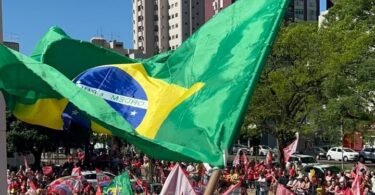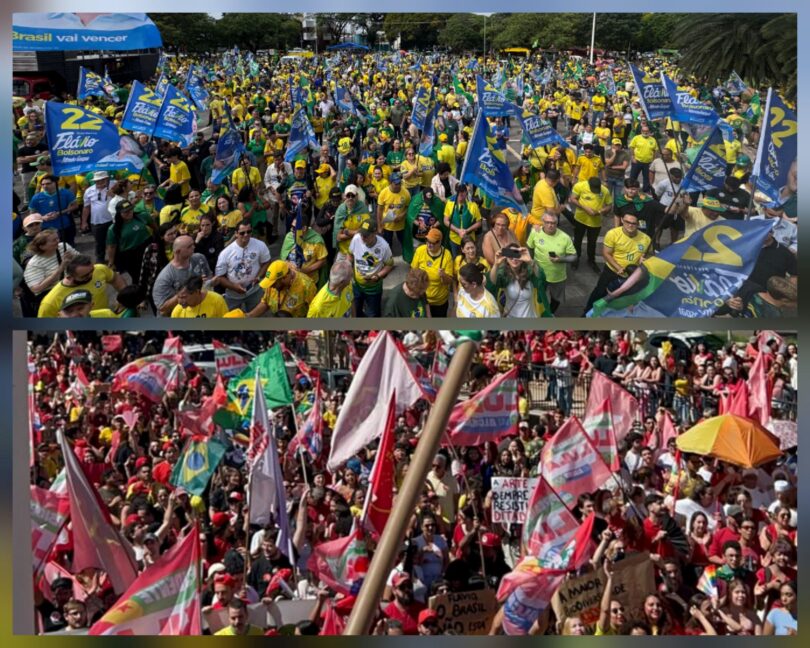
Maringa, BRAZIL –The Cambridge Dictionary defines polarization as the act of dividing something, especially something that contains different people or opinions, into two completely opposing groups.
Listen to the author read this article:
According to the Instituto Liberal (Liberal Institute), there are three phases of polarization in Brazil. The first phase (1994-2002) is characterized by the political opposition between two main parties, the Brazilian right wing Social Democratic Party and the leftist Workers’ Party, with only divergence in projects.
It started to change after 2006, when the second phase of this polarization showed another face: political parties shaping social and economic identity.
The Institute pointed out that the third phase, called affective polarization, began in 2018. In this stage, the rivalry surpassed political and social fields and impacted how individuals relate to others.
“The prospect of one side winning is perceived by the other as an existential threat. Voting is no longer based on policy proposals; instead, it is shaped by factors such as income, region of residence, age group, gender, sexual orientation, race, and religion,” the Institute wrote, “For many Brazilians, their electoral choice becomes almost an extension of their own identity, reflecting a binary scenario of good versus evil, life versus death.”
This split has significantly impacted human relations across the nation. Many people cut social ties due to their political differences.
It became more common to hear someone say they weren’t talking to a family member or friend.
Extremist polarization is dangerous to democracy and freedom of speech.
In the recent presidential election, some companies promoted a campaign entitled “Fire a PT [left-wing party] supporter.” The goal of the movement was to expose and fire those who didn’t support the right-wing candidate, Flávio Bolsonaro.
According to the Brazilian Ministry of Labour and Employment, on October 31st, they received approximately 4,305 complaints of electoral harassment in the workplace in the first three days that the channel was open to file complaints of this specific type of harassment.
Over the course of two decades, Brazil recorded 760 deaths resulting from this form of violence, according to a study by the University of São Paulo and the Brazilian Center for Analysis and Planning.
The survey accounted for violence committed against professional politicians – including incumbents, candidates, and those who had held office or run for office within the five years prior to the crime – as well as activists (such as labor union members, participants in social movements, and members of various organizations and civil associations).
When polarization affects human rights
In Maringá in southern Brazil, polarization escalated to a serious level.

Some medical school students at the private university, UniCesumar, targeted scholarship recipients and made references to Nazism in a messaging group.
According to the Brazilian newspaper G1, images and expressions associated with Nazism were also shared within the student’s groups. In one message, a student posted a photo of the Nazi army accompanied by references to “raw milk” – a term that has become common among online groups advocating white supremacy. The students posted those messages after the Oct. 25 re-election of President Luiz Inácio Lula da Silva.
In one of the messages, they attacked the institution’s scholarship recipients.
“Those who pay [tuition] have worked and have 15,000 [reais] a month to pay [in comparison to] Those who just passed a silly test,” someone wrote.
An official statement published on UniCesumar’s Instagram responded: “Disciplinary measures included expulsion from the institution, as well as formal warnings and suspensions, depending on the severity of each individual case of misconduct.”
The university didn’t reveal the number of suspended students.
After the elections, a boycott list started to circulate in WhatsApp groups. The list identifies more than 45 alleged left-wing supporters, including entrepreneurs, digital influencers and liberal professionals. It promotes economic boycotts against those “supporters.”
Responding to polarization
The journalist Thiago Danezi wrote for the local newspaper GMC Online that an individual may choose not to patronize a business or engage the services of a particular professional due to a disagreement with their political stance.
But for him, the situation changes when such public expression involves abusive exposure, insults, the improper handling of personal data or other conduct that may infringe upon the rights of others.
“Freedom of expression does not constitute an unrestricted license to cause harm to the reputation or professional livelihood of third parties,” wrote Danezi.
Three years ago, I published the piece “Brazilian democracy is under attack.“
I wrote: “We’re living through the worst type of dictatorship, the kind I’ve only read about in the dystopia of George Orwell’s novel 1984, which closed characters’ minds and created truly devoted robots who served a leader they had never seen in person.”
Unfortunately, we still are facing the worsening effects of this polarization. But, as a young Brazilian, I hope that we can overcome this culture of labeling and learn the way back to tolerance and respect.
We cannot limit people’s character to only who they vote for.
We all are made of a unique story, context, dreams, fears, values, goals and experiences. It’s irrational to squeeze all this complex inner world into one single box with a political label.
Undoubtedly, as disagreement is an essential part of our democracy, empathy is the essence of our humanity. We can’t lose it for any party or ideology.
Nicole Luna is a Senior Correspondent with Youth Journalism International.