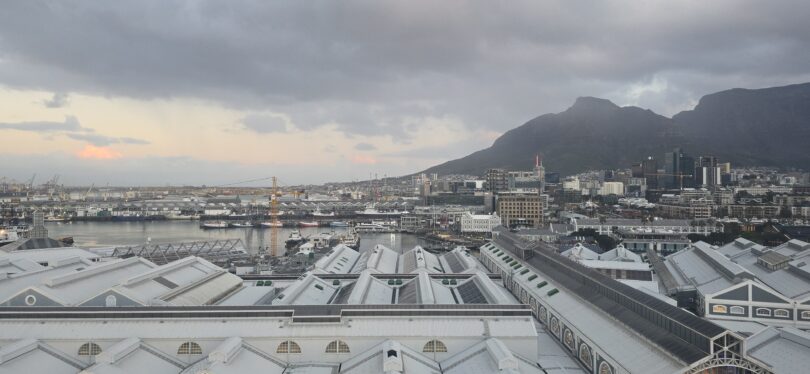

Cape Town, SOUTH AFRICA – For a view that unites Cape Town’s lively harbor atmosphere with the breathtaking presence of Table Mountain, the Cape Wheel is often described as hard to beat.
Situated at the iconic Victoria & Albert Waterfront, one of the city’s ‘Big 6’ attractions, this 40-meter-tall observation wheel is a must-do for locals and visitors alike.
Listen to an audio recording of this article:
Its elevated experience brings the city’s natural beauty and urban energy into a single panoramic moment.
Every one of its 30 fully enclosed cabins frame postcard-worthy angles of Table Mountain, Signal Hill, the Cape Town Stadium and Robben Island. It is certainly a chance to see the Mother City from a whole new perspective.
But a ride on the Cape Wheel offers more than just scenic views. It also lays bare the striking juxtaposition of Cape Town’s wealth and poverty, nestled side by side beneath its famous peaks.

The higher you go, the more the city reveals itself.
The V&A Waterfront is polished and cosmopolitan. There are high-end boutiques, street musicians and glossy restaurants. From this vantage point, it is easy to feel like you are in a wealthy city at peace with itself.
Yet as your cabin continues to rotate around the wheel, the view shifts. Beyond the container terminals and the grid of suburban roads, the plains of the Cape Flats appear.
The Cape Flats are an expanse of informal settlements, townships and industrial zones that are largely home to the city’s Black and working-class communities.
This contrast is not incidental, but foundational.
Cape Town remains one of the most unequal cities in the world. Access to housing, clean water, education and opportunity is still shaped by the history of the apartheid.
And from above, the physical layout clearly tells this story. The spacious, rich suburbs climb up the mountain’s lower slopes while densely packed shacks stretch far into the distance in the other direction.
Yes, the view is panoramic. But it is also political.
The Cape Wheel quietly illuminates these tensions. In the 12 slow minutes, you are offered not just a tourist’s-eye view, but a moment to sit with both the city’s beauty and its brokenness. While the ride is smooth and still, the discomfort of the view is not easily shaken off.
It is a reminder that Cape Town, like many cities shaped by colonial legacies, performs its progress in one half of the skyline. The other half bears the cost.
From the Cape Wheel, these injustices become visual and impossible to ignore. The new perspective of the Mother City that it offers is a rare chance to see the whole city at once.
Not just as a postcard.
Holly Hostettler-Davies is an Associate Editor with Youth Journalism International from Wales. She wrote this analysis, contributed photos and made the audio recording.
Anjola Fashawe is a Senior Correspondent with Youth Journalism International from London. She contributed a photo to this article.

Click on the logo below for more from YJI’s 2025 Global Conference in Cape Town: