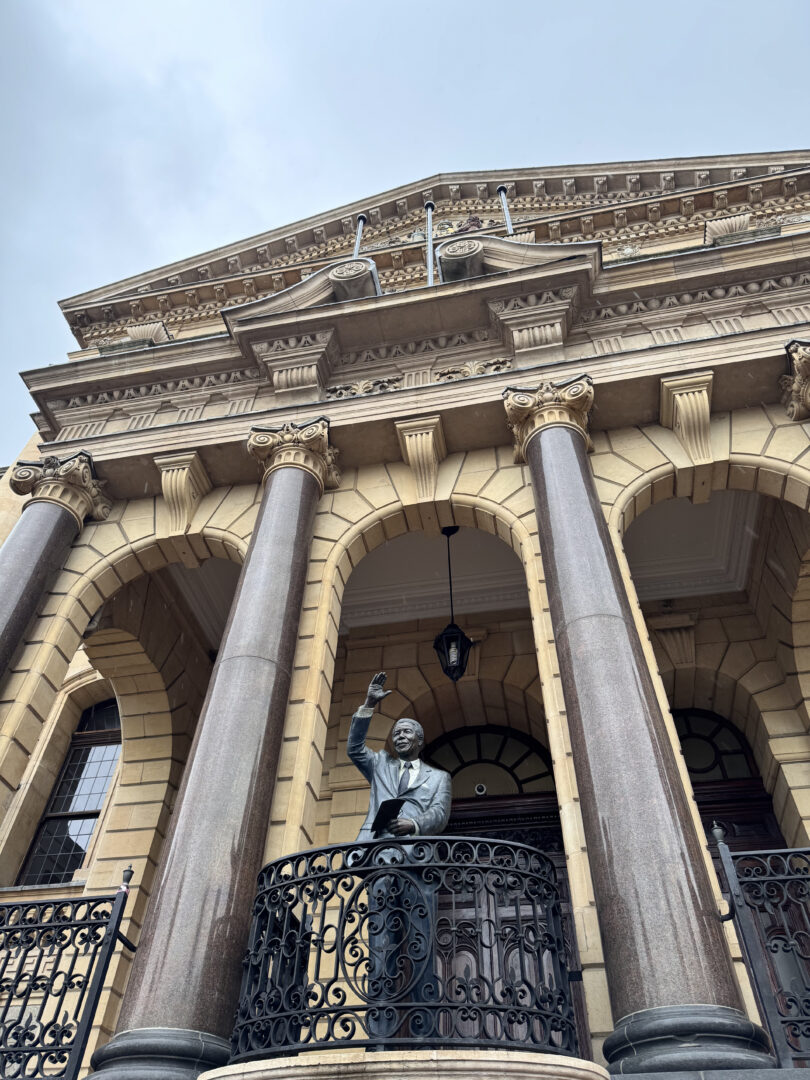

Cape Town, SOUTH AFRICA – To comprehend the significance of Cape Town’s historical narrative, a visit to the City Hall is a must.
This excursion is not one of leisure or sightseeing but rather a reminder of South Africa’s heavy political unrest and struggles.
Listen to an audio recording of this article:
On the outside, the City Hall is a traditional well-preserved white building. Many political buildings take the color of white, symbolizing grandeur and political permanence.
At the top stands a domed clock tower representing a municipal building in action and its all-encompassing civic purpose.
The mighty Table Mountain stands behind City Hall.
Without second-guessing, this building appears ordinarily civic. A City Hall stands to represent the local government, political operations and community objectives. The city’s mayor, council members and political stakeholders conduct business inside the building.
City Halls tend to represent a “city.” Within Cape Town, this City Hall is significant to the whole nation of South Africa.
The City Hall has stood through many major national changes. Ironically, Cape Town’s City Hall has not always been a symbol of democratic participation.
On February 11, 1990, on the balcony of City Hall, Nelson Mandela delivered his first public speech after being released from spending 27 years in prison. Mandela was known for his anti-apartheid activism and his work against racial oppression.

Addressing over 100,000 people outside City Hall, Mandela called all to continue to fight for human rights and to end white domination.
The speech marked a new era for South Africa of laying the foundations for democracy and calling out to the world for international support against apartheid.
Mandela went on to become South Africa’s first post-apartheid president.
Today, a bronze, life-size statue of Mandela stands on the balcony of City Hall. This exact spot is where Mandela made his first public speech after prison release and as a free man.
Created by artists Xhanti Mpakama and Barry Jackson, the statue was unveiled in 2018 to mark what would have been Mandela’s 100th birthday.
Inside City Hall, an exhibit on Mandela with interactive displays reveals his legacy.
Cape Town’s City Hall is not just a majestic building but a pivotal landmark to Mandela’s South African history.
Norah Springborn is a Senior Correspondent with Youth Journalism International from the United States. She wrote this article and made the audio recording.

Click on the logo below for more from YJI’s 2025 Global Conference in Cape Town: