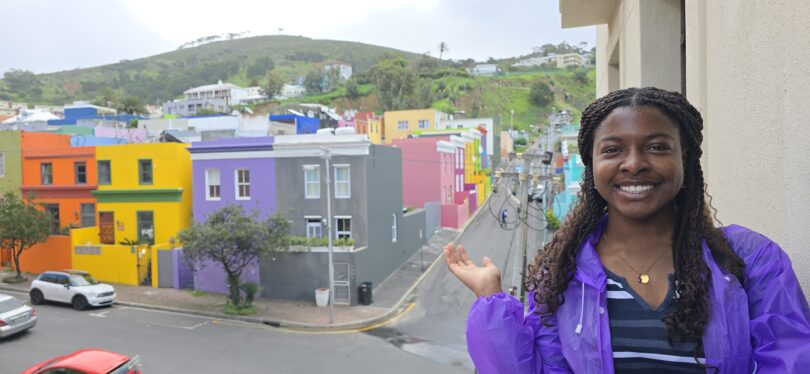

Cape Town, SOUTH AFRICA – Coming from London, one of the most diverse capitals in the world, to Cape Town for Youth Journalism International’s 2025 Global Conference, I was excited to learn new words and immerse myself in a different cultural landscape.
Listen to an audio recording of this article:
I think it’s important to learn to speak like locals when in their country, so I tasked myself with picking up as many new words as I could.
Afrikaans, one of the languages spoken in South Africa, was developed during colonial occupation, with roots in Dutch. It has influences from Malay, Indian and indigenous African languages.
It’s one of South Africa’s 11 official languages, alongside Zulu, Xhosa and Sesotho, to name a few. Each language comes with its own accent, rhythm and history, reflecting the country’s complex and layered cultural makeup.
The London accent, in its own way, is just as multi-layered, with a blend of influences from all over the world. Jamaican Patois, brought over during the Windrush generation, has mixed with traditional English dialects like Cockney to create a unique accent that reflects the diversity of the capital.
One of the first words I learned in Cape Town was jol, an Afrikaans word meaning “party.”
I came across it in a Top 10 Cape Town guide I read at the YJI Sea Shack, our nickname for the house we stayed in. Although I didn’t get the chance to use the word in any serious context, every day with the YJI crew truly felt like a jol – from our chaotic Yankee Swap game to our conversations around shared meals, there was constant laughter and joy.
Lekker — meaning “nice” or “good” in Afrikaans — is a word I heard a lot from Megz and Angela Puchert, two South African locals who joined us at the conference with their adorable baby boy, Levi.
I remember them using it when they discovered we had a coffee machine at the house capable of producing seemingly endless coffees – from cappuccinos to espressos.

Lekker, pronounced “Lek-AH”, quickly became one of my favorites. It slips off the tongue and carries such positive energy.
Naturally, where there’s good, there’s bad – and lekker’s not-so-nice counterpart is lelik, which means “ugly” in Afrikaans. I didn’t have any reason to use this one at the conference, but if I had to describe anything as lelik, it would be the fact that the conference had to end!
In London, traffic is relentless, especially in central areas, so it’s common to be stuck at red lights during rush hour. I was amused to find out that South Africans call traffic lights robots. It’s such a random, yet endearing word. I can already imagine the confused looks I’d get if I used it back home, but I love it all the same.
At our conference, Akhona Alwar, a fellow student from the Durban area in South Africa, was instrumental in helping me develop a more authentic South African accent.
One word she used often was eish, an expression of disbelief or shock. She said it a lot when I completely butchered the words I was practicing and asked her for feedback. That word definitely came home with me.
Also expressing disbelief or surprise is hayibo, derived from the Zulu root meaning “definitely not!” It has such flair, being one of those words that communicates both sound and emotion all in one breath.
I had my first braai – the South African version of a barbecue – in the second week of the conference. I ate delicious grilled chicken skewers cooked over an open flame, paired with toppings like sweetcorn.
I love the word braai because it’s simple, direct and captures the whole experience perfectly. I’m hoping to try more South African-inspired braais in London, when the weather allows.
I learned so many new words – some I’ve managed to master, others I still can’t pronounce – but I was excited to take them back to London with me.
Hopefully, I’ll return to vibrant Cape Town one day, with an even better grasp of the language and a heart full of lekker memories.
Anjola Fashawe is a Senior Correspondent with Youth Journalism International from London. She wrote this commentary and made the audio recording.
Gemma Christie is a Correspondent with Youth Journalism International from England. She contributed a photo to this article.

Click on the logo below for more from YJI’s 2025 Global Conference in Cape Town: