
Cape Town, SOUTH AFRICA – As I was dropping off my suitcase at a check-in desk at Cape Town International Airport, ready for my flight home from Youth Journalism International’s Global Conference, the man behind the desk took one look at my passport and inquired about if my middle name was a surname.
Listen to an audio recording of this article:
Fumbling with my rucksack, I asked him to repeat his question, and when I had heard properly, I was caught off guard and even felt my cheeks getting hot.
I have often glazed over my middle name if it ever came up in conversation, as it often causes confusion whenever I am asked about it. I hastily, matter-of-factly added, “It’s Cantonese; my mum is Chinese. I’m mixed.”
The man finished processing my suitcase and handed me a boarding pass, smiling slightly. He asked if my surname was from my dad’s side, to which I confirmed, and he then replied, “Well you are in Cape Town, the land of the mixed.”

I was a little slow on the uptake, briefly thinking, What does that even mean?
With it being a late-night flight, in the few moments it took to dawn on me, he quickly retracted his statement, realizing I had misunderstood. He reiterated that he was proud of Cape Town and its reclamation of diversity after such a tense period in race relations.
Smiling to show I understood, he wished me a good flight, and I proceeded to security. But my mind lingered on a “land of the mixed.”
On the long flight back to Amsterdam for my layover, I had time to think about my hesitation in answering his query, my almost defensive justification for my name: “I’m mixed.”

But the man had only inquired out of genuine interest. Why did I feel the need to justify rather than just explain my name? It’s not so uncommon for people to be mixed race.
I realized that for a lot of my life, outside of the home and family setting, I have avoided talking about my multi-cultural background, because I didn’t think that my peers in my hometown would understand.
More seriously, I was worried about being made fun of.
In the 21st century, acceptance and tolerance of racial diversity is ever-increasing, but I have always taken issue with the throwing around of the phrase ‘celebration of culture.’
Mostly, the intent is positive, inclusive, educational and promotes tolerance.
But I also find that the idea of culture can be a double-edged sword. On the one hand, it educates and combats harmful stereotypes, but on the other, sometimes I feel boxed in by the idea that I should represent a certain culture: Chinese or Western?
The reality is that I am part of several cultures that intertwine in many different ways on a daily basis. The result is not a clear-cut, well-known experience, but one that I felt had become so complex that I did not even want to try to explain it to anyone.
My city of Chester is part of the English county of Cheshire. Its population is largely white, which limits exposure to other cultures in comparison to more diverse cities like London. According to the UK Office for National Statistics, the population of Cheshire West and Chester was more than 95% white in 2021.
Compared to a decade earlier, the statistics show that growth in populations of residents who identified as Asian, Black or mixed race had increased by about 2%.
I love my home city, but understanding the extreme imbalance in demographics became important in helping me understand where my insecurities came from.
When I was younger, in primary school, I remember one day we had to go around the classroom and say what we ate for breakfast that morning. Reflecting on my pandan-flavored Bao (a bao is a fluffy bun that is steamed and can have a variety of fillings, like red-bean, custard flavor or char siu which is a sort of sweet pork), I suddenly felt self-conscious as my peers described toast with jam, various cereals and porridge.
Being at a new school, I didn’t want to be different. There were plenty of days where I also ate toast and cereal, but that day hadn’t been one of them.
I lied.
For years when I was in primary school, for Lunar New Year my mother would make Lai See filled with chocolate coins for me to give to my classmates. Lai See is a little red packet that is traditionally filled with money from relatives and is supposed to bring good luck and fortune for the new year.

Although I now feel ashamed looking back and remembering how self-conscious it made me, I can understand why the younger version of myself disliked sharing my ‘culture’ with my classmates.
While many happily took the chocolate, I felt painfully aware of the fact that I was different when having to explain myself to my class. This was made only clearer one year when, a few days later, a boy (who hadn’t realized that I was half-Chinese until that Lunar New Year) randomly came up to me in class. He pulled back his eyelids with his fingers and used his thumbs to pull his nostrils up and called me a “Chinese pig.”
Many of these micro incidents happened when I was much younger, and you’d think that as I matured, they would stop and I would feel more comfortable talking about my ‘culture’ to people.
But as recently as May 2025, at the grand age of 18, I stood nervously outside an exam hall waiting to enter my first A-Level exam. I overheard a 15 or 16-year old boy, who was also waiting to enter for a GCSE exam, read my full name on the seating plan that was posted outside the hall aloud to his friend, and grotesquely make fun of the pronunciation of my displayed middle name, despite the fact that it was clearly not an English one.
He probably didn’t realize that I was standing right there as we did not even know each other. At the time I should have been angrier at his mockery, which masked intolerance, but all I could think was how I really could have done without being made fun of for an already sensitive topic before my first exam.
The feeling of not quite fitting in when being mixed within a mostly white community also works the other way.
I am lucky enough to have visited Hong Kong three times in my life, where a lot of my extended family live.
In Chester, there are annual Chinese New Year celebrations led by various Chinese communities in and around the area. These involve traditional fire-crackers, food, performances, and my favorite: Lion-Dancing.
But while I greatly enjoyed taking part in these celebrations, without feeling the need to justify what I was part of to anyone, I still felt a little separated from the wider festivities.

I don’t speak Cantonese. I tried to learn Mandarin when I was younger, but I’m sure any linguist would agree that being bilingual is hard if you are not surrounded by the language somewhat, whether from living in the country that speaks it, or having a relative who speaks it at home.
We speak English at home, and always have. That is an experience the majority of my peers could definitely relate to, but it was different for me, because they had a reason not to speak a separate language and I felt like I didn’t.
So when I tell people that I am half-Chinese, there is an expectation that I automatically speak one of the dialects, when in reality my exposure to another language has only been marginally greater than most of my peers. Every time I confirmed that I don’t, there was a feeling of falseness in my own ‘cultural’ identity.
When I was surrounded by my ‘culture’ in Hong Kong or at Chinese celebrations, finally without feeling the need to explain myself, I still felt somewhat isolated, different, like there was never a place that I would really fit in.
While I can talk about micro aggressions that have come with being Chinese, I have also found an unpleasant sort of privilege in being mixed-race. By being half white, there is a societal privilege that has protected me from more outright racism.

When the coronavirus broke out in late 2019 and racism thrived online because the virus originated in China, I overheard a boy in one of my classes joking to his friends that he would avoid two other Chinese people in my year, so as not to catch the virus. With me sitting on the opposite side of the classroom, he had not included me in his list of people to shun, simply because he hadn’t realized.
After the initial shock of hearing such a stupid statement, a part of me couldn’t help feeling the familiar sense of confusion and otherness around where my culture stood in all of this.
I had been excused from the racism directed at my race, so where did that leave me?
Nowhere is this clash of ‘culture’ more topical in a place like Cape Town, where during apartheid, race and skin color defined and boxed people into stereotypes and ideas about who they were and should be.
When we visited the District Six Museum, I asked our guide, Brent Solomons, what would have happened to a mixed child during the apartheid era, and he told me that if the child was half white (like I was), they would be sent to live with the parent that was colored.
Picturing myself in this situation, it was hard to imagine coping in either of the two backgrounds. The idea that I would be too white to stay in a Chinese community and too Chinese to stay in a white community rang a tone of familiarity in my head.

I circle back to my hesitancy around the idea of culture.
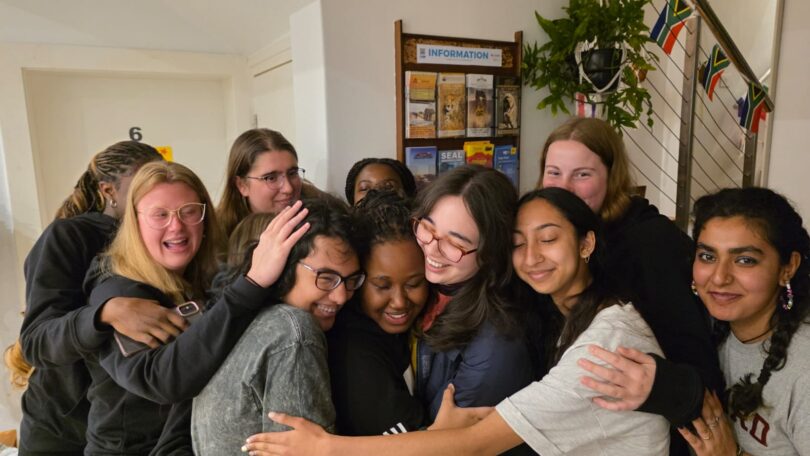
After a good, long think about my brief interaction at Cape Town International Airport, a trip down memory lane to visit some deep, buried, and sometimes very uncomfortable stories from my past that needed some reflection, and a conference in a city that gave me the opportunity to confront my ‘mixed’ feelings about myself, I found that the complexity and intersectionality of my race cannot be boxed into a singular ‘culture’ or pre-determined experience.
My experience in Cape Town showed me the amplified result of the segregation and stereotyping of people based on set ideas about culture and appearance.
Exposure to this issue gave me the strength to confront some uncomfortable memories of my own, and in learning from them, I have found not only comfort and stability, but also a sense of empowerment in my own race and identity.
Gemma Christie is a Correspondent with Youth Journalism International from England. She wrote this commentary, provided photos and made the audio recording.
Holly Hostettler-Davies is an Associate Editor with Youth Journalism International from Wales. She took the photograph of Gemma Christie at the airport.

Click on the logo below for more from YJI’s 2025 Global Conference in Cape Town: