
Cape Town, SOUTH AFRICA – When Yusuf Larney grew up in District Six more than six decades ago, he said his neighborhood included Muslims, Jews and Christians who enjoyed interacting with each other.
It didn’t matter if people were Black or white or how mixed a heritage they had, Larney said.
Listen to an audio recording of this story:
In apartheid South Africa, he said, the district showed the rest of the nation and the world beyond “that people, regardless of their race” or religion “can live together” in harmony.
Then it all came crashing down.
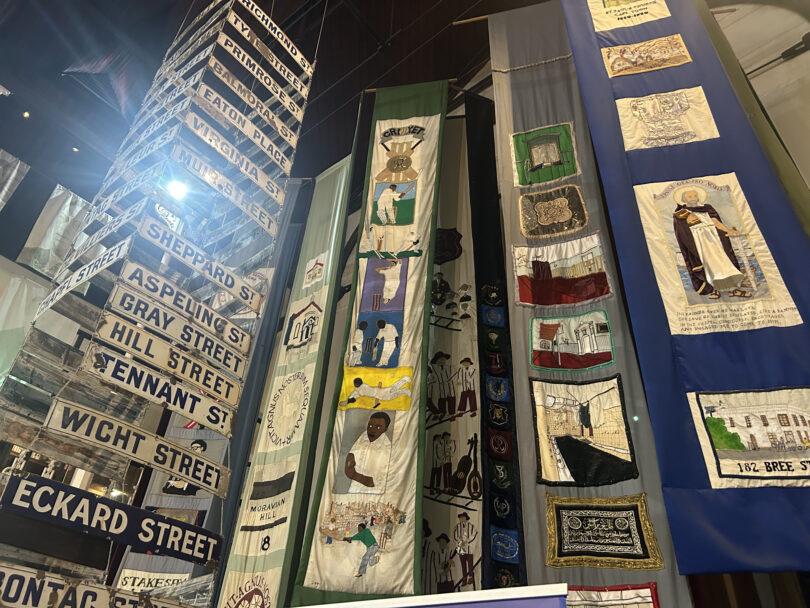
At the District Six Museum, the story of what happened is front and center, memorializing a place that exists largely in memory, shattered by an apartheid system that sought at every turn to separate white South Africans from Black and Colored ones.
Brent Solomons, a guide at the museum, said February 11, 1966 is remembered with bitterness as “the exact date in which District Six had been declared as a white group area” from which every Black or mixed-race person had to leave.
The government called the area a slum and insisted it had to be cleared and rebuilt, with mass evictions for 66,000 people who weren’t white.
In the eyes of those who lived there, the plan was simply a sham to take a wrecking ball to a cosmopolitan area that some saw “as a continent of its own,” said Larney, a historian and owner of the Cape Malay restaurant Bo Kaap Kombuis.
But they were powerless to stop a racist regime that refused to give non-whites any role in government.

A doll named Lucy
At age six, a dark-skinned District Six resident Francis McDonald got a doll from the Salvation Army. She remembered that it had fingers and blonde hair.

She named it Lucy.
For a dozen years, her much-loved Lucy was her favorite toy.
“That doll meant a lot to me,” McDonald recalled.
Then, at age 18, the government came with “a small vehicle” that wouldn’t hold even half her family’s possessions. It hauled them away – along with her entire family – to a distant township created solely for Colored people with dirt roads and no public transportation.
Their old home, where she’d spent her childhood, was bulldozed.
Among the items that McDonald couldn’t bring with her? Lucy.
As she stood in the museum, McDonald said that one of her neighbors saw her doll in the rubble and kept it until he could find her. It took a long time.
McDonald said she was 62 when the man brought the doll to her at a club for former residents of the district.
“I was in tears when I saw Lucy,” she said, though she’s not sure if she cried from happiness or sorrow. “It was a mix of emotions: love, anger and sadness.”

For all those years, McDonald said, she “felt like something was missing” from her life “and when I saw my doll, I found it. Everything changed.”
She decided to donate the doll to the museum, where it’s on display with a handful of other toys that somehow survived the years of displacement. McDonald said she looks at it occasionally.
What strikes her about it most, though, is how getting the doll back somehow cleansed away much of the pain of losing her home, her neighborhood and her friends.
Since the day Lucy showed up again, she said, she’s been able to “tell my story with no tears, no anger, no hatred, no judgment.”
“I can’t bring back the past,” McDonald said.
A museum holds memory of a community
It’s hard to imagine the injustice at the heart of the apartheid system imposed by South African whites from 1948 until the election of Nelson Mandela in 1994, the country’s first Black president.
During the apartheid years, Solomons said, everything from benches to beaches were accessible only to “certain people of certain race classifications.”
They would carry signs that said “Europeans only,” for example, so that everyone knew where they could go and what facilities they could use. Violating the rules led to harsh fines or other punishments.

But District Six escaped the worst of it for a long time.
“District 6 was another world within apartheid South Africa, because everybody lived together there. Everybody. There was no segregation. There were no divisions,” Larney said.
Then the government stepped in.
The District Six Museum helps bring that ugly past to life.
Through the museum’s powerful exhibits and the testimony of former residents such as McDonald and Larney, it’s possible to begin to understand the loss suffered by the people who lived in the area when the National Party government imposed segregation on the neighborhood.
Imagine if you and your family were forced to move to cramped and severely underdeveloped housing far from everything you knew, with your old neighborhood destroyed.
“Nobody left here without a tear,” McDonald said. “It was the saddest thing that I ever experienced.”
All you could do was watch as your once-happy family and your whole life was stripped away and your belongings loaded into the back of a truck that couldn’t even hold much of what you possessed.
“Once you leave your house, it will be destroyed directly with all your belongings will be in the rubble,” Solomons said.
That traumatic experience is laid out in painful detail at the museum, located in a former church that survived the devastation but lost most of its congregation.
The weight of injustice
Though South Africa today has no restrictions on where people can live, only a small number of former District Six residents have returned because just 4,800 have been able to prove they had roots there, according to the museum.

Some others have been compensated for what happened to them.
As the years pass, the “continent” of a bustling, diverse District Six increasingly fades from memory into history.
How does McDonald carry the weight of the discrimination that upended her life?
The short answer is: she doesn’t.
Instead, she tries to explain that people can show humanity even when they were not granted it themselves.
“I choose to carry the story with a smile,” McDonald said. “But you’ve still got that hurt in you.”
Ahmed Elkhamisy is a Reporter with Youth Journalism International from Egypt. Akhona Alwar is a Junior Reporter and Senior Illustrator with Youth Journalism International from South Africa. They wrote this story and Ahmed Elkhamisy contributed photos and made the audio recording
Dorothy Quanteh is a Reporter with Youth Journalism International from the United States. She contributed a photo for this article.
Gemma Christie is a Correspondent with Youth Journalism International from England. She contributed a photo for this story.

Click on the logo below for more from YJI’s 2025 Global Conference in Cape Town: