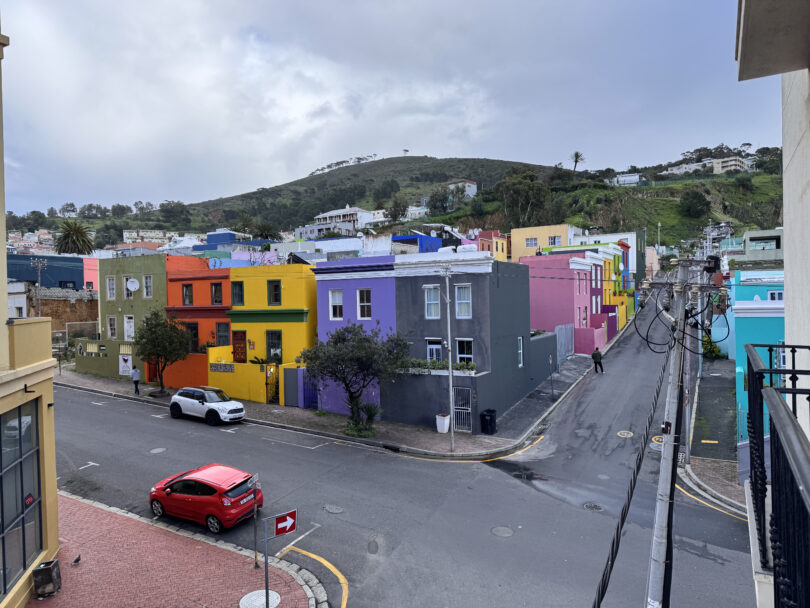

Cape Town, SOUTH AFRICA – The Muslim community has a long history in Cape Town, with the first mosque in South Africa constructed in 1795 in the Bo-Kaap neighborhood.
This mosque, known as Auwal Masjid, or ‘first mosque,’ was built by Tuan Guru, a Muslim man whose title translates to ‘Master (or Mister) Teacher.’
Listen to an audio recording of this article:
We visited the mosque, which has been designated as a national heritage site. Muslim presence in Cape Town extends even further back than just this mosque, but its presence today signifies its importance as a historical monument.
In South Africa, Muslims were referred to as ‘Cape Malays,’ the root word of which is Maleiers, we learned at the District Six Museum. These Muslims, who had ties to Southeast Asia, entered South Africa mostly through the slave trade. Islam spread even among the non-Asian slaves, and they settled mostly in Cape Town.

At Bo-Kaap Koumbis, a Malay restaurant in the Muslim-majority Bo-Kaap neighborhood, we spoke with one of the owners, a man named Yusuf Larney.
A Muslim South African with ties to India, Larney told us about the history of Muslims in Cape Town. He then explained that the Malay people are a “mixture of different cultures,” from which a “new culture starts to emerge.”
They spoke a language called Malay, according to Larney, which then became the de facto name for Muslims on the Cape – even though the main language of the region was Afrikaans. As early as 1815, Afrikaans was used by Muslims, with an Arabic script.
Muslims became a fixture of the Cape Town community, particularly in the diverse District Six.
At the District Six Museum, we learned the words of Vincent Kolbe, a former resident who said the “District Six environment was rich with immigrant communities of Indians, Jews … and Christians and Muslims.”
In 1904, a Muslim man, Abdullah Abdurahman, became the first Black person to be elected on the Cape Town Municipal Council as well as the Provincial Council, and he remained so until his death, according to information provided at the District Six Museum.
The Abdurahmans and the Gools were the most prominent Muslim families in District Six, with the marriage of Zainunissa Abdurahman to Abdul Gool linking them. Abdurahman also formed the African Political Organization, which quickly became the most important ‘colored’ political organization of its time.
Zainunnisa “Cissie” Gool was a prominent activist, and a beloved leader of District Six. She became one of the founding members of the National Liberation League, as well as its first president.
According to information at the museum, she was described as the ‘Jewel of District Six,’ and was elected as the president of the later Non-Europe United Front, as well as serving as a Cape Town City council member. Her brother, Goolam Gool, also contributed politically to multiple movements in Cape Town.
Dullah Omer, an anti-apartheid activist, and later also a spokesman for Nelson Mandela, was Muslim, we learned.
Another prominent figure was Johaar Mosaval, a Muslim South African from District Six who went on to dance with the Royal Ballet on international stages. These names are a few out of many presented at the museum that show how deeply integrated Muslims are in Cape Town.
Even in books, the Muslim influence on Cape Town is clear.
Richard Rive’s book Buckingham Palace, a fictional story about District Six (with elements of reality), describes different cultures living side by side. In the introduction to the book, writer Robin Malan said that “the easy interchange between Muslim and Christian is clear enough.”
Malan added that the communities were extremely integrated, and depicted as such in Rive’s book, with the “Muslim boy Armien attend(ing) church service.”
In Bo-Kaap, we saw the most pro-Palestine graffiti, but we spotted it elsewhere, too. On our way into town from the airport, we saw a mosque with pro-Palestine graffiti on it. It was surprising to see how even in South Africa, people stood with Palestine.

On our second day in Cape Town, we saw even more graffiti, as well as vehicles with pro-Palestine messages.
In the Bo-Kaap Museum, there was an entire exhibit dedicated to Palestine, showing how former President Nelson Mandela’s support extended into the present day.
Larney spoke passionately about pre-apartheid District Six, and how beautiful it was to see so much diversity. He emphasized the importance of community and tolerance.
“I come to you in peace, and it is from my heart,” he said. “We are all children of peace.”
The restaurant served Halal food, which means it is permissible to eat for Muslims, but we were shocked to see that this was not uncommon.
In Bo-Kaap Koumbis, we ate mainly Indian food, with a South African twist. Later on, we visited an Ethiopian restaurant, which also served Halal food. Other restaurants displayed their Halal certification, too.
We saw that most of the meat products in supermarkets were Halal certified. It was interesting to see how integrated Muslim culture was within Cape Town.

When we hiked near Lion’s Head – a mountain peak in Cape Town – we came across a large shrine, or kramet, for a Muslim man named Sheikh Mohamed Hassen Ghaibie Shah.
We did not find much information about who he was, but he was likely important to local Muslims. Through research, we found at least 20 other shrines like these for Muslim leaders in the surrounding hills.
It surprised us to see such a large Muslim presence in Cape Town. Not only was Halal food easy to find and mosques visible in the city, but historically, Muslims played a large part in making Cape Town what it is today.
Anya Farooqui is a Reporter with Youth Journalism International from Pakistan. Ahmed Elkhamisy is a Reporter with Youth Journalism International from Egypt. Together they wrote this article and Ahmed Elkhamisy made the audio recording.
Dorothy Quanteh is a Reporter with Youth Journalism International from the United States. She contributed a photograph to this article.
Norah Springborn is a Senior Correspondent with Youth Journalism International from the United States. She contributed a photograph to this article.

Click on the logo below for more from YJI’s 2025 Global Conference in Cape Town: