
Cape Town, SOUTH AFRICA – When we reached the Zeitz Museum of Contemporary Art African and learned that the museum wouldn’t open for another half hour, we went to check out a gallery called Southern Guild.
Inside the clean, white building were odd, abstract pieces of art that we had no real hope of understanding. It was a group exhibit called Thresholds, and it was a depiction of abstract “notions of place,” showing the artist’s feelings in relation to the land around them.
Listen to an audio recording of this article:
The gallery stretched from neon tubes on the walls to hazy, dreamy paintings. Some pieces included photographs, while others were canvases that we crowded around. After we had our fill, we raced back to the museum, eager to begin the rest of our tour.
Before the tour began, our guide, Richard Kilpert, gave us a brief but informative introduction to the history of the building. At 101 years old, it was originally made with 42 large concrete tubes and served as a storage space for grain.
Through the work of designer Thomas Heatherwick, the tubes were redesigned in the shape of corn kernel, and molded painstakingly by hand-chipping, giving the museum its unique and iconic aesthetic. The museum eventually opened in 2017.
Kilpert stressed that while the building is a beautiful historical site, he recommended finding the art beyond the building, and not letting the unique structure of the museum overshadow the exhibitions inside.

“Focus on the art,” he said.
Kilpert’s passion and knowledge about the museum made the brief introduction highly useful for our main tour around the museum, which was led by Esinam Damalie, a woman from Ghana.
We started by viewing an exhibition scheduled to open the day after our visit, which was made using work from a series of workshops open to teens aged 15 to 18. The pieces were unique and eye-catching but paled in comparison to the rest of the museum.
We saw exhibitions from a variety of artists, all focused on Africa.

The first exhibition we saw was The Other Side of Now by Tuan Andrew Nguyen, a Vietnamese-American artist.
Nguyen mixed both fact and fiction in his unique take on historical events, which he portrayed both through film and sculpture. We saw three films, each depicting the years between 1954-1972, showcasing the aftermath of the First Indochina War and Vietnam War on Vietnamese, Moroccan, and Senegalese people.
He painted a poignant and tragic picture of the disconnect between family and culture with his distinctive pieces, including photographs and sculptures to create an experience like no other.
We visited the temporary exhibition One Must Be Seated by Rita Mawuena Benissan, a Ghanaian artist who shed light on Asante customs, like the enstoolment of a potential chief.
The museum placed great emphasis on likening Benissan’s journey of self-discovery in her Ghanaian heritage to the enstoolment of a chief. This exhibition featured many objects, notably grand, beautiful umbrellas and smaller, more understated – but no less impressive – stools.
Benissan’s grandfather was a former chief in the Volta region of Ghana and this encouraged her to reconnect with Ghanaian heritage and explore chieftaincy. The exhibit included themes like hierarchy, wealth and matriarchy.
A film showed the process of consecration, as the King was trained by women, and when the incumbent King died, the next was chosen through the sisters and aunts in the family, who would choose the next king as one of their sons.
Damalie pointed out that “they depend a lot on women,” reinforcing the matriarchy of the Ghanaian community.
The visuals were bold, almost frightening. There was a recurring image of a blackened stool used for consecration and music and dance were incorporated to create a gripping film.
Nearby, we were exposed to a number of grand and intricate umbrellas, which were used in the Asantehene’s procession, traditionally held over the chief in a fluttering motion to form a dancing canopy to celebrate the enstoolment process.

Although many high-ranking officials would have umbrellas, no one would have the same fabric as the king. While many of the actual umbrellas were made of velvet and bamboo, Esinam told us that for economic purposes, the ones on show were not all made of these same materials.
Finally, the “Golden Stool,” or the Silka Dwa Kofi, is an impressive piece of symbolism for the governing of the Asante people.
But while it physically represents governance, it is also a spiritual and metaphysical symbol of the Asante people and their ancestors, whose spirits are now immortalized in the stool.
The stool marked the completion of the swearing process of the chief, with vows between the spirits and living being affirmed. It encourages people to imagine the past, present and prospective chiefs.
In comparison to the grandiose of the umbrellas, perhaps the singular and smaller stool was more understated. But upon learning its huge significance, instead it became perhaps the most impressive piece we saw in the exhibition.
Our next stop was Undersides, by Thomas Oswald Dennis. Here, the artist posed the question, How would you create the world?
With this riveting question at the center of his exhibition, Dennis created new and interesting ways to view our world. His interactive exhibition invited his audience to take part in connecting to their world.
The grandest of all these was his depiction of the night sky, with new names for every constellation. The entrance to this piece stuck in our minds. It said, “There is more than one night sky.”
Another intriguing piece was a room which shook with vibrations in an attempt to connect the audience to the very air around them.
In a soil column called “Xenolith (Letsema),” Dennis made a beautiful gesture of solidarity by encouraging museum staff to contribute to the work by making and bringing soil from their homelands.
One of the most interesting exhibits in the museum was the permanent collection, which was filled with different artists and experiences – a diverse depiction of African culture.
The museum offered a list of words with which to explain the exhibit, ranging from organic, uncanny, political, to queer, serial and camp. Each piece was an experience of its own, with these terms often intersecting in a single work.
A series of photos of queer Africans, all portrayed according to their own personal wishes and style, created a beautiful presentation of identity.
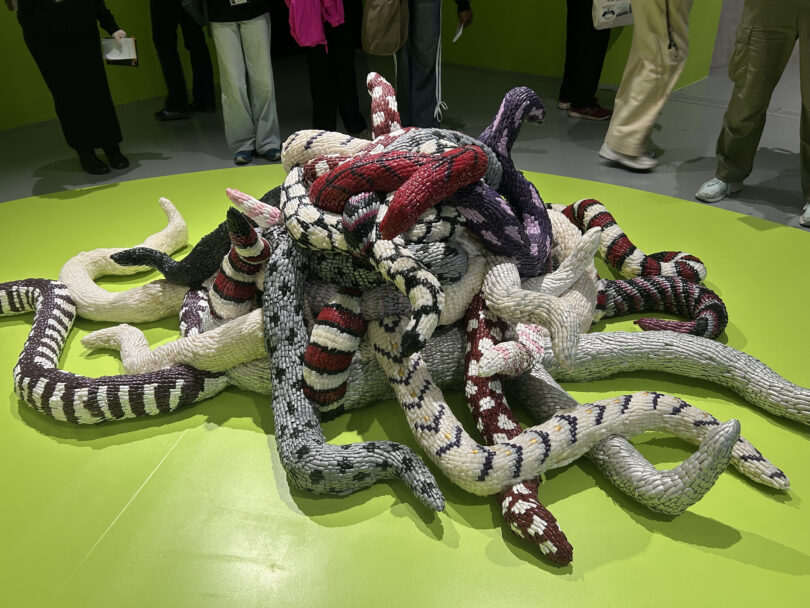
Another great piece was a mass of acrylic nails, in the shape of writhing tentacles – a commentary on women’s beauty standards and commercialism. All the work was bold and thought-provoking, if not always easy to understand.

The final exhibition we visited was Sala, and like the permanent collection, it was a group effort, with over 10 artists’ work on display.
One piece was a curtain-like sculpture, made of 130 beer bottles hanging suspended from rope in the center of the room, called “Divider.”
There was also a short film, Over the Rainbow, which depicted a dream-like grand return to Azania, a mythical land of milk and honey. Many of the pieces were photographs, depicting bold, abstract scenes and portraits. The general favorite was Edson Chaga’s interactive exhibit, where we were encouraged to take a large, printed photo each – all depicting interesting and colorful compositions.
Our visit to Zeitz-MOCAA was a striking experience. Walking into these exhibitions completely ignorant, we found that with the help of information both on the displays and through our guide, we were able to come close to understanding the complex and unique art that surrounded us.
Kilpert’s introduction to the history of the building and advice to immerse ourselves in the art rather than architecture of the museum was extremely valuable, and definitely enhanced our understanding and experience.
The hours we spent there seemed to fly by, and we would have loved even more time to fully appreciate the exhibits. The museum was an incredible experience, one we would love to revisit.
Gemma Christie is a Correspondent with Youth Journalism International from England. Anya Farooqui is a Reporter with Youth Journalism International from Karachi, Pakistan. Together they wrote this article.
Lina Marie Schulenkorf is a Senior Reporter with Youth Journalism International from Germany. She contributed a photo to this article.

Click on the logo below for more from YJI’s 2025 Global Conference in Cape Town: