
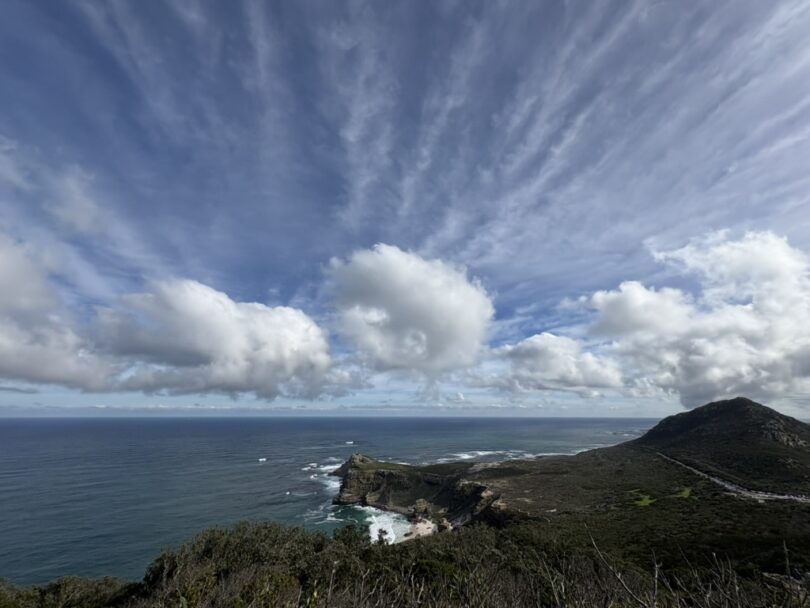

Cape of Good Hope, SOUTH AFRICA – In the span of one day, Youth Journalism International students at the 2025 Global Conference visited two “Capes:” Cape Point, a promontory on the Cape Peninsula, and the Cape of Good Hope.
To get to Cape Point, we rode the Flying Dutchman Funicular, a cable railway fitting up to 40 passengers per car.
Listen to an audio recording of this article:
According to Cape Point’s official website, ‘’It is believed to be the only commercial funicular of its type in Africa, and takes its name from the local legend of the Flying Dutchman ghost ship.’’
According to legend, the ship is doomed to sail forever after sinking off the coast of the Cape of Good Hope in 1641.
There are two lighthouses at Cape Point: one new, one old. After disembarking the funicular, visitors are funneled to multiple path options. One leads up to the old lighthouse no longer in use, while the other leads down a winding hike to the new one.

First, we went up.
We chose a great day to visit Cape Point; the light blue sky seemed to blend into the ocean.
And, though the funicular ride was interesting – its mechanical whir and steep slope reminiscent of a rollercoaster, just without the drop – the view from the old lighthouse was even more spectacular.
Suddenly, the walk up the stone staircase to the viewpoint was worth every tired step.

When we looked down at the soft blue waves cresting into mosaics of foam as they crashed against rocks in the distance, the ocean felt infinite.
On the platform at the top of the old Cape Point lighthouse, there was a pole displaying names of various cities and the distance from that point on the Cape. To Sydney, Amsterdam, New York, and even London, arrows displayed the precise direction and distance to each place.
There was other evidence of visitors in the form of scratched names on its stone walls and an assorted sticker wall.
Next, to view the new lighthouse, which is below sea level and a scenic walk from the new one, we trekked back down the stone staircase and took the other path.
Now, we seemed to be endlessly going down, first down a walkway and then more steps along a sometimes-paved, sometimes-dirt route.
This hike to the new lighthouse at Cape Point was intense. As we followed the path, students speculated about how much we would suffer on the walk back up the steep incline.
It was also precarious at times. For half of the trail, there are no handrails.
Though the view was often breathtaking as the sun’s rays gleamed against the ocean’s smooth surface, the fear of falling was all-encompassing, especially being so close to the trail’s edge.

Our path was full of cobblestones, rocks and an enormous amount of eland poop.
Elands are a large species of antelope native to east and southern Africa. Though the only one we saw over the whole day was so far away it was just barely visible even with the help of binoculars, the animals clearly left evidence of their presence on the trail.
So in addition to getting lost in the mesmerizing waves unfolding before us, our eyes stayed closely monitoring our feet so that we’d be ready to skirt any stray eland droppings.
In terms of wildlife, we also managed to spot a black lizard hiding between branches of a bush on the trail.

The anxiety of being on the edge paired with the challenge of avoiding returning home with a shoe smelling of animal poo was a difficult task. But being together made it bearable.
It was amazing to see the mix of sweat and determination on hikers’ faces: families, couples, and groups alike.
Since the many stairs that curved down to the new lighthouse were quite narrow, we often had to stop to let people go past.
Rushing past us came some American tourists, apparently as eager as we were to see the splendid view at Cape Point, complaining about all the photos we were taking.
But for many of us in the group, this was a once in a lifetime opportunity we were sure to seize and document.
Prior to Cape Point, we visited the Cape of Good Hope.
In U.S. schools, early geography lessons include a tale about how the Cape of Good Hope helped open up the world to interactions between different people.

Elementary students used to learn, incorrectly, that the Cape of Good Hope is the southernmost point in Africa. (It is not. Instead, Cape Agulhas has the claim to that title, according to our tour guide, Sheldon Peinke).
But the site is still significant.
It is true that explorer Bartholomew Dias proved to the world it was possible to sail around Africa and reach the Indian Ocean from the Atlantic via the Cape of Good Hope. For centuries, this cape continued to be a vital waypoint for exploration and trade overseas.
From this perspective, our visit – as a group of students coming together from around the world – seemed fitting considering that the Cape of Good Hope might be taken as an early example of globalization.
As a result, it was interesting to see a scene formerly only in textbooks unfold before us and imagine what those explorers might have seen in our place centuries ago.
Today, it is also home to complex, thriving communities of wildlife. Along the rocks at the Cape of Good Hope, past the shoreline and piles of kelp washed up on shore, was a blanket of egrets. Both black and white, at any given moment hundreds were in flight over the ocean.
Seals also found a home on the rocks and occasionally bobbed their heads as onlookers funneled their focus into the distance.
Even within the piles of kelp on the beach, small bugs weaved in and out as if traveling on a busy highway.
Tourists, waiting for their chance to take a photo next to a sign proclaiming, “Cape of Good Hope / The Most South-Western Point of the African Continent,” also found a temporary place among these interactions on the beach.
At both sites, visitors found a sense of accomplishment and a new perspective on Cape Town.
It is easy to understand why people from around the world make the effort each year to visit these capes in search of their connection to history and their ability to bring people together with stunning ocean views.
Anjola Fashawe is a Senior Correspondent with Youth Journalism International from London. She co-wrote this article, contributed photos and made the audio recording.
Annamika Konkola is a Correspondent with Youth Journalism International from the United States. She co-wrote this article and contributed photos.
Gemma Christie is a Correspondent with Youth Journalism International from England. She contributed video reporting to this article.
Tahiry Andrianotahiana is a Junior Reporter with Youth Journalism International from Madagascar. She contributed video reporting to this article.

Click on the logo below for more from YJI’s 2025 Global Conference in Cape Town:


A very impressive set of travel writing pieces from a group of young journalists who give hope to the world.
What Annamika glimpsed through the mist was the Cape Flats, a more than interesting area to say the least.
And I hope some time in their discussions was devoted to considering how article 19 – freedom of speech- is capable of being abused, and how journalists can sometimes exploit their positions of power to promote irrationality. A big subject!