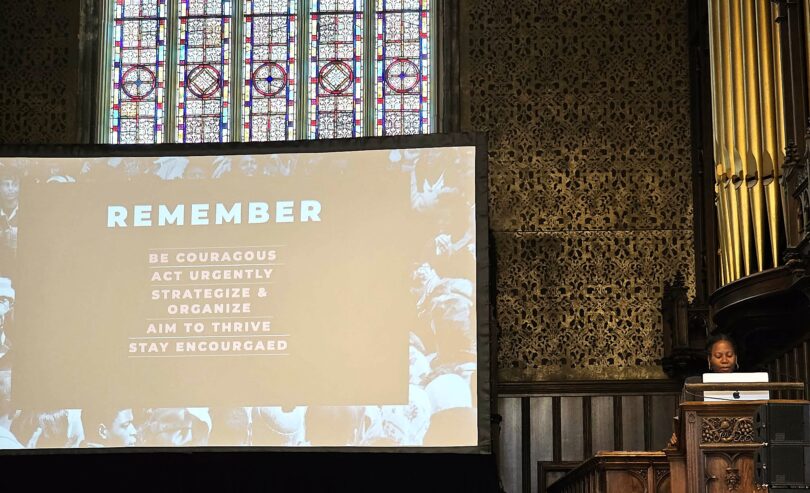
Lewiston, Maine, U.S.A. – Fear is not usually the emotion one celebrates on Martin Luther King Jr. Day. Yet it was fear – not hope or optimism – that took center stage at this year’s keynote at Bates College in Maine.
Listen to an audio recording of this story:
Philosopher and scholar Myisha Cherry, who delivered the keynote address, challenged the audience to see fear as a necessary companion to courage, drawing on King’s philosophy to argue that fear can motivate movements rather than sabotage them.
King found support in the community through the power of speeches, gospel songs, and speaking eulogies, according to Cherry.
Framed by this year’s motto of “Love, Anger, and the Struggle for Justice,” Cherry, who is an associate professor at the Department of Philosophy at the University of California, Riverside, invited listeners to reconsider which emotion truly moves people toward change.
Bates College President Garry W. Jenkins echoed these themes, noting that “Dr. King brought these themes – love, anger, and the struggle for justice – together in his writings.

“I would much rather spend my days filled with love instead of anger,” Jenkins said, “but we don’t always get to make that choice.”
Bates College hosted speakers, workshops, panel discussions and more on Monday in it annual observance of the national holiday that honors King, an American minister and civil rights icon who was assassinated in 1968.
“King reminds me that we should be courageous”, Cherry said, “ There are people who are loud or who have a lot of power, but as long as we are mastering and weaponizing our fears, we can thrive”.
Referencing King’s writings, Cherry presented two different kinds of fears – ‘normal’ ones that alert us to real danger and therefore mobilize us, and ‘abnormal’ ones that immobilize us.
She argued that the civil rights leader’s approach to fear offers a guiding framework for confronting injustice, one that acknowledges something scary without allowing it to become a barrier to action.
Normal fear is the fear of the unknown that we experience in life, according to Cherry, who said this is good because it keeps us on our toes, alert, active and motivated to fight for change.
Abnormal fear is driven by hate and ignorance, she said and is not healthy.
Cherry quoted King’s 1963 sermon “Antidotes to Fear:”
“The fear of darkness led to the discovery of the secret of electricity. The fear of pain led to the marvelous advances of medical science. The fear of ignorance was one reason that man built great institutions of learning,” King preached.
Fear has a target, Cherry said, fear can alarm us to danger and fear is a creative force.
Throughout her remarks, Cherry returned to the urgency that defined King’s time. With racial terror – including fire bombings, lynchings and other acts of hate – from white supremacist groups such as the Ku Klux Klan; the Red Scare and an economic recession there was much to fear.

But King saw this climate not as an obstacle, but as an opportunity, according to Cherry.
Rather than retreating after the partial success of the Montgomery bus boycott, King helped found new Black organizations and continued his advocacy for civil rights.
He rejected what he famously called “do-nothingism,” insisting that waiting for a better moment only perpetuates injustice.
For Cherry, this insistence remains deeply relevant today. Fear may be inevitable, but inaction is a choice.
This form of activism was an organized system of ideas and decision through the power of courage and bravery to fight against injustice.
As King said, “We have to stop wasting time, we need to act now.”
Carlos Fra-Nero is a Reporter with Youth Journalism International from Maine.
Lina Marie Schulenkorf is a Correspondent with Youth Journalism International from Germany.