Urbana, Illinois, U.S.A. – Before the age of online publishing and digital newspapers, print was an important mode of communication.
Listen to the author read this story:
Many modern forms of information sharing are linked to one invention: the printing press.
The Skeuomorph Press at the University of Illinois Urbana-Champaign allows all students and community members to actively work with a printing press.
The word “skeuomorph” means a real or virtual object that utilizes the design from an earlier object in history. Here, similar to the printing press, a skeuomorph reveals the links between historical context and modern invention.
The printing press stemmed from Johannes Gutenberg’s 15th century creation of movable type. Mass production from the printing press allowed for knowledge to be spread more efficiently and affordably. Readership increased with vernacular literature.
None of the success of the printing press was possible without the downsides of physical labor, rounds of copyediting, and material scarcity. Hands-on experience with a printing press reveals these obstacles.
The Skeuomorph Press offers a hand iron press from the late 19th century for public use.

So, how does a printing press work? I went to try the Skeuomorph Press and found out.
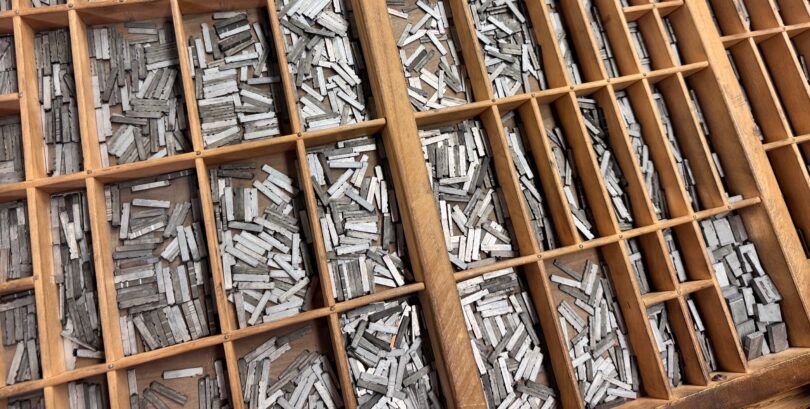
Before the actual printing part begins, we had to typeset the words to be stamped. A type is a framed metal letter where the letter is raised above the metal block.
Individual letters of type are gathered for every word being printed.

The set up of collecting type is similar to the arrangement of a keyboard or typewriter. This is where traditional phrases such as “mind your p’s and q’s” and “upper case and lower case letters” comes from.
There was an “upper case” location for capitalized type and a “lower case” location for all other type.
The type is then arranged, or composed, into a frame metal alloy held together by metal placeholders and string.
Keep in mind that to be printed correctly, the type needs to be placed backwards and upside down. We were taught to check the orientation of our type by taking a photo and inverting the picture.
Once the frame which contains sentences and paragraphs is built, the frame is set in the printing press. Evenness and spacing is important here so that the print is not off-centered.
Illustrations and drawings on type pieces may also be included in the printing press frame.

Next, ink is applied with much force to the type frame from every angle and direction. The typeman, the cloth frame, is lowered on top of the frame. Paper is set on top of the typeman.
The carriage of the printing press is then rolled underneath the main press mechanism. Once centered, a lot of force is required to pull the large handle which lowers the press onto the paper and against the inked type.
After holding the handle down for a couple seconds, we slowly release it. The carriage is then rolled out from under the press and the inked paper is removed carefully.

The inked paper is very wet and will need to dry on the rack for at least a day.
Only a single page or section of a page is completed at a time. This process must be repeated for the other side of the paper or on multiple pages for a whole newspaper.
The printing press requires immense labor to just print a single word.
Today, we can easily tap a space bar or type a key without giving it much thought.
But by actively using “skeuomorphs,” we better appreciate the evolution of our modern communication – and the many documents and pages made before printing got so much easier.
Norah Springborn is a Senior Correspondent with Youth Journalism International.