LONDON – Emerald Fennell’s Wuthering Heights is one of those films where the reputation arrives before you even sit down. I went in fairly blind. I shouldn’t admit it, but I have never read the book. From studying gothic literature at A-level, I knew to expect mania, decay and dark sexuality.
This is a film fully aware of its own intensity.
Listen to the author read this review:
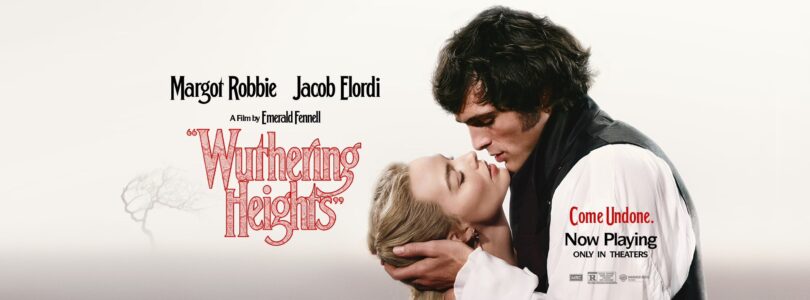
Margot Robbie as Cathy and Jacob Elordi as Heathcliff were the pairing I was most unsure about. I’d seen commentary suggesting their chemistry felt off, even “mother and son.” But surprisingly, the Australian duo feel authentic in their intimacy.
In the UK, the film is rated for age 15 and older, and absolutely pushes that boundary. Yearning and twisted love dominate the screen. Their relationship is obsessive and heartbreaking – they are broken characters you can’t help but pity. And yet it feels uncomfortable, especially given their sibling-like upbringing.
The love radiates, but so does the dysfunction.
The younger versions of Cathy and Heathcliff are cast beautifully. “Adolescence” star Owen Cooper brings a raw vulnerability to young Heathcliff, while Charlotte Mellington’s Cathy is sharp, fiery and emotionally intelligent beyond her years.
Their accents feel authentic, the attention to detail precise. Most importantly, their childhood bond feels real — intense, protective, slightly unhinged even then. That foundation makes the adult obsession feel earned rather than sudden.
Visually, it is unapologetically aesthetic. At times, the cinematography feels like a high-budget TikTok edit – Heathcliff riding away into a blood-red sunset is almost too striking – but I have to applaud the commitment.
Fennell leans all the way in. The film is decadent and drenched in color. Cathy’s beautiful, vivid ballgowns stand out against the Longley mansion’s abundance and excess, and even the walls of her bedroom, painted almost exactly the color of her own skin, down to the nerves, create an unsettling intimacy.
It’s visually rich – almost indulgent – yet always heavy with doom.
Costume design deserves serious praise. Robbie stuns in exquisite period dresses and deep red frocks that mirror Cathy’s emotional turbulence. The opulence never feels accidental – it amplifies her mood swings.
Alison Oliver’s Isabella adds an unexpected edge. She brings comic timing to a character who is, at her core, deeply insecure and slightly twisted. Watching her willingly allow herself to be degraded by Heathcliff is uncomfortable. She is vulnerable, desperate for love and craving control in the only way she thinks she can claim it. It’s disturbing, but compelling.
Of course, the backlash surrounding Fennell’s decision to cast Heathcliff as a white man lingers over the film. In the novel, he is described as dark and racially ambiguous, frequently beaten and treated as an outsider.
In 2026, altering one of the few non-white characters in the text is a sensitive and loaded choice. I came into the film aware of that controversy. Still, Elordi convincingly embodies Heathcliff’s torment – both wounded pride and obsessive love.
Yet I do not think this justifies whitewashing a character who could have been played by an equally talented actor who matched the description.
The soundtrack, curated by Charli xcx after her stellar musical year, elevates the film’s yearning.
“Chains of Love” works almost as a pop anthem for obsession, capturing the torment of two people unable to escape one another. The opening track, “House”, sets a gothic tone of despair from the outset, grounding all the decadence in something darker.
The film has also helped spark a resurgence of Kate Bush’s 1978 single “Wuthering Heights,” which has found its way back onto playlists, mine included. That addictive, high-pitched desperation feels newly relevant again, feeding into a wider generational rediscovery of gothic romance.
This film is decadent, intimate and unsettling and I couldn’t look away from any of it.
Anjola Fashawe is a Senior Correspondent with Youth Journalism International.