Copenhagen, DENMARK – Danish Prime Minister Mette Frederiksen’s left bloc failed to win a majority in Tuesday’s snap general elections, with the right bloc gaining.
Listen to the author read this story:
But it is still unknown how long it will take to form a coalition government, nor who exactly will be leading it.
As election results trickled in, it was clear that there was no clear majority bloc though a surge from the right was evident, leaving the non-aligned bloc party Moderaterne, led by Lars Løkke Rasmussen, a kingmaker with 12 seats.
Rasmussen wants dialogue from left to right, said Nanna Gotfredsen, a candidate from Rasmussen’s party, who said she expects him to do well.
Before a coalition can be formed, all the parties meet with King Frederik and share their opinions and nominations on which politician should lead the negotiations and what their priorities are.
The king announced Frederiksen as royal investigator with the whole left bloc backing her, according to the Royal House.
The majority of the right bloc came together to nominate Troels Lund Poulsen, leader of the center-right party Venstre and member of the outgoing three-party coalition, but the newest party Borgensparti, with four mandates, refused to nominate any member.
The king advised that a government to be formed with Social Democrats, Social Folkeparti, and Radikale Venstre, all left bloc parties.
Shortly after results came in Tuesday, Poulsen said it was time for change, ruling out collaborating on a coalition with Frederiksen.
Poulsen’s party lost all its mandates in Copenhagen, leaving Jan E. Jørgensen, who has been a member of parliament for 15 years, out of parliament.
Arriving at parliament just after 1 a.m., Frederiksen said, “I had hoped for a better result.”
But she said she is happy to see that Denmark still chose Social Democrats as the most voted party.
“Denmark needs a stable and reliable government,” she said.
Rasmussen, on the other hand, said he wanted to create a government with both the left and right crossing over the middle.
One of the politicians feeling the effect of the surge in the right bloc is Alex Vanopslagh, leader of Liberal Alliance, getting almost double the votes of Poulsen.
Another party feeling the effect is Danske Folkeparti, also part of the right bloc. Its leader, Morten Messerschmidt, got almost 1,000 more votes personally than Frederiksen, finding himself as the politician with most personal votes.
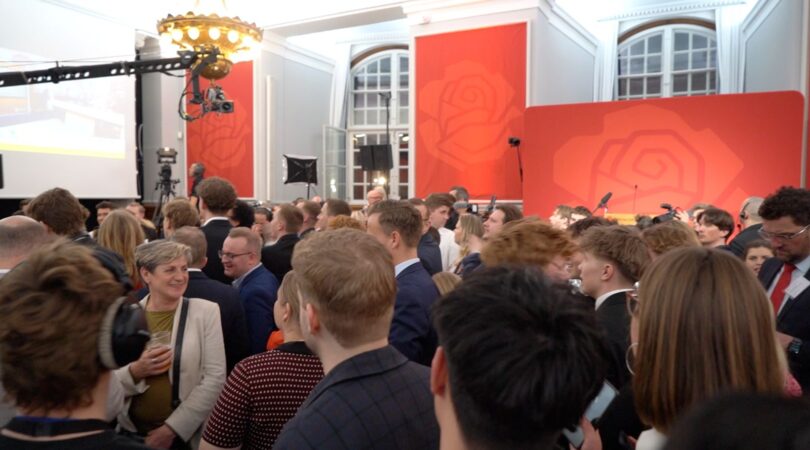
On election night, Mathias Larsen, Chairman for the Danske Folkeparti youth party in the region of Fyn, said he was there to celebrate the “perfect election” and that he would love to see Messerschmidt as prime minister.
In Vesterbro, a neighborhood in Copenhagen, Ålternativet, a left wing party, held their party, with a large youth turnout.
Karen Andreasen, a student, said she was there to see the vibe and hopes for a left government to be formed.
Noah Haynes is a Correspondent with Youth Journalism International.