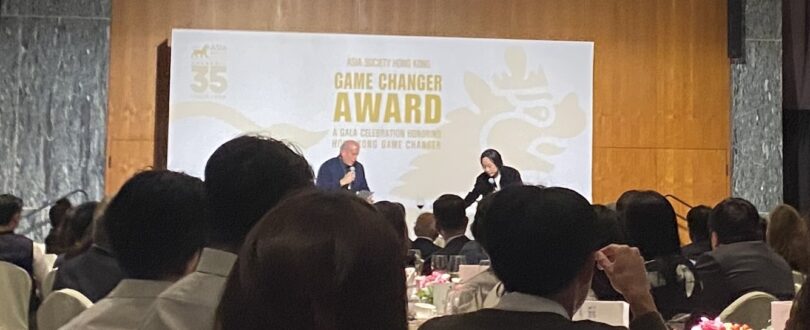
HONG KONG – Comedian Jimmy O. Yang, now known for television shows, movies and his own stand-up show, turned his back on the conventional route to success.
Listen to the author read this story:
Despite a stellar academic pedigree and family support that set him up for a business career, Yang risked it all for comedy.
At the Asia Society Game Changer Award dinner honoring Yang, the evening became more than a celebration of his achievements. Instead, Yang used the stage to reflect candidly on the winding journey that led him to Hollywood.
Yang, who graduated from the University of California, San Diego with a degree in economics, recalled taking a finance internship shortly after graduation. The experience, he said, left him feeling a profound sense of dread about the prospect of a traditional nine-to-five career.
Rather than presenting his success story as a smooth journey, Yang focused on the difficult years that followed his decision to pursue entertainment.
He shared that when he first landed his breakout role as Jian-Yang in the HBO series “Silicon Valley,” the job only paid for three days of work. With the $2,700 he earned, Yang bought a used 2006 Toyota Prius with more than 100,000 miles on it so he could drive for Uber between seasons to make ends meet.

Even more striking was his honesty about his parents. He recalled telling his father about the HBO contract and receiving not a celebratory, “I’m proud of you,” but a cautious, “Oh, okay, so you have an employment contract with HBO, which is a company. Good. Thank God.”
The room erupted in knowing laughter. It was such a perfectly Chinese response: the relief that there was finally a company, a contract, something tangible that resembled stability.
But Yang didn’t present his parents as villains. Instead, he described them as people who loved him in the only way they knew how: by worrying about his survival.
He talked about his father’s earlier warning that pursuing art was “like being homeless.” And he talked about the odd jobs that kept him afloat during those homeless-adjacent years, including a stint as a DJ at a strip club.
By openly discussing those experiences, Yang offered a version of success that acknowledged uncertainty and struggle rather than hiding them.
For many in the audience, it was liberating to hear someone who has ‘made it’ refuse to airbrush the years of near-misses, bad jobs, and pressure from parents.
Yang made success feel less like a distant, untouchable mountain and more like a long, winding road with plenty of potholes. He made success feel like a road that might occasionally require a used Prius and an Uber passenger in the back seat.
Although the night was meant to be about Yang’s success, he instead gave his audience something more valuable than permission to follow a specific dream. He allowed them to be honest about their own journeys and to understand that the path to somewhere meaningful and ‘successful’ rarely looks like a straight line on paper.
Sophia Ling is a Reporter with Youth Journalism International.