HONG KONG – Televisions flickered late into the evening as families here waited for the historic launch when Hong Kong’s first astronaut sped toward the stars.
Listen to the author read this article:
At 11:08 p.m. on Sunday, May 24, the countdown rang out and cheers erupted citywide as the spacecraft roared into the night sky.
Aboard was a woman named Lai Ka-ying – the first astronaut ever from Hong Kong.
For the 43-year-old mother of three, her blast into space on the Shenzhou-23 rocket was a moment she had never dared to imagine.
“As an ordinary native of Hong Kong, I never imagined I could join the astronaut team and be selected for this spaceflight,” she said at a news conference at the Jiuquan Satellite Launch Center just a day before her historic journey. “This precious opportunity was far beyond my wildest expectations.”
In Hong Kong, there’s no escaping Lai’s success. News reports about her background and new role as an astronaut – with television interviews she gave to various Hong Kong and Chinese media – abound.
Born in November 1982 and raised in Tsuen Wan in Hong Kong’s New Territories, Lai’s path to the stars was anything but predictable.
Her parents relocated to Hong Kong from Guangdong province before her birth, bringing with them a profound love for the motherland that would shape their daughter’s values. At age 21, Lai first learned of China’s manned space program when Yang Liwei flew into orbit aboard Shenzhou V, fulfilling China’s first crewed mission.
She went on to earn a doctorate in computer science from the University of Hong Kong. Then, choosing public service over high-paying investment bank offers, she joined the Hong Kong Police Force, where she specialized in digital forensics and cybersecurity and rose to the rank of superintendent.
Everything changed in 2022, when China opened astronaut recruitment to Hong Kong and Macau for the first time.
At the news conference, Lai said that saw the notice and thought, “Why not give it a try?”
She was selected from approximately 120 local applicants after a grueling three-stage process involving medical examinations, physical and psychological tolerance tests, and intensive evaluations.
Remarkably, Lai suffers from motion sickness – she is prone to carsickness and seasickness – but she never let that stop her.
She underwent 21 months of intense training, completing over 200 training subjects across eight major categories, accumulating more than 1,700 hours of preparation. The regimen included 72-hour sleep deprivation tests, 48-hour desert survival drills, six-day cave expeditions, and high-G centrifuge sessions, which were challenges that her police background helped her face with resilience.
Aboard the Tiangong space station, Lai serves as a payload specialist, and she is the first woman to hold this role in China Manned Space Agency history.
Her primary responsibility is operating the Multi-Spectral Imaging Carbon Observatory, an environmental science device developed in Hong Kong that detects where carbon dioxide and methane emissions are generated on Earth.
Lai will also conduct experiments covering space life sciences, materials sciences, microgravity fluid physics, aerospace medicine and new space technologies.
For all her courage, Lai remains deeply connected to her family. Her sister revealed in an interview that leaving her three primary-school-age children was the hardest part of the mission. Lai’s three children are now cared for by grandparents and other family members.
What her sister looks forward to most is Lai’s safe return, when the whole family can finally sit down together and share her favorite Hong Kong snack: egg waffles.
Lai’s journey has captured the imagination of young people across Hong Kong. On launch day, crowds packed the Hong Kong Space Museum, where many parents brought their children to learn about astronaut training and space station experiments.
As China advances toward lunar and deep-space exploration, many have expressed hope for more young people from Hong Kong and Macau will follow in Lai’s footsteps and join future astronaut selection.
Perhaps no words capture Lai’s achievement better than what she told Xinhua News.
“While the space station may seem remote, the dream of space is within reach,” she told the news agency.
Today, that dream has become a reality: for Lai Ka-ying, for Hong Kong, and for every young person who dares to look up at the stars and wonder.
Sophia Ling is a Reporter with Youth Journalism International from Hong Kong. She wrote this article and made the audio recording.
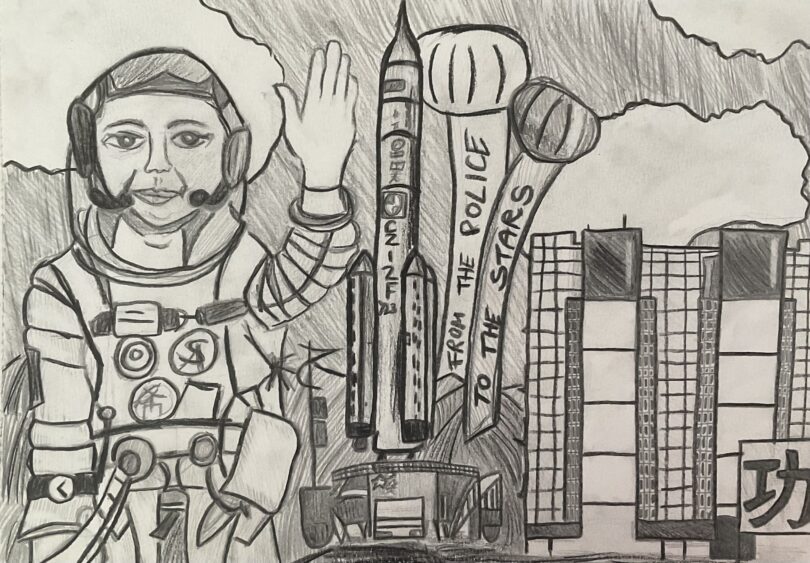
Milana Yarychkivskiy is a Junior Reporter and Senior Illustrator with Youth Journalism International from Germany. She made the illustration.