Patras, GREECE – After the July release of The Odyssey by Oscar-winning British director Christopher Nolan, it didn’t take long for theatres to start filling with eager fans.
Audiences showed up either because they admire Nolan’s movies – they sometimes win Oscars – or because they love the Ancient Greek period and Homer.
Listen to the author read this review:
I watched the movie in theaters alongside many other Greek people, curious to see how our land’s ancestry was being portrayed in Hollywood.
The last time a box office hit movie about Ancient Greece came out was in 2004 with the release of Troy, directed by Wolfgang Petersen.
It’s always the same: both directors cast famous actors and filled our screens with magnificent scenery.
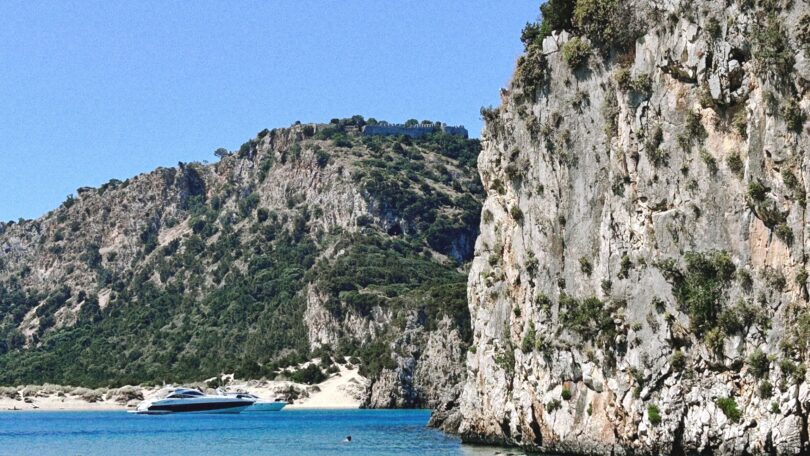
Nolan shot some of his scenes in Iceland, Malta, Scotland, Italy, Morocco and Greece. One of the scenes shot here was the cave scene when Odysseus and his crew met with the Cyclops.
It was filmed on the mountains near Voidokilia Beach in Pelloponisos, Western Greece.
For someone completely unaware of the actual history behind The Odyssey or Homer’s time in general, the new box office hit must have looked like a cinematic and storytelling masterpiece.
I will not elaborate on Nolan’s filmmaking skills nor on the actors and their work, as I believe they all did their best in terms of screenplay.
I have read plenty of good reviews on it and I also remember witnessing scenes – scenarios that as a Greek student I was taught in class – become a social media sensation, like when Odysseus strings the bow and shoots an arrow.
For us Greeks, The Odyssey isn’t just a myth, it’s a mandatory, 7th grade (or 1st gymnasium) school subject that we all have to study. We get graded on it and, at a more intellectual and intense level, take exams on it.

The first time I was introduced to Homer’s works was in kindergarten where a cartoon of Odysseus’ adventures was displayed to me and the rest of my class.
The first time I was introduced to Nolan’s films was in 2020.
Frankly, I didn’t enjoy watching The Odyssey and I won’t rewatch it any time in the future.
Initially, I felt dreadfully upset and misunderstood because of the way Nolan made Athena, the goddess of battle strategy and wisdom, appear.
Zendaya’s character looked more like one of the muses Homer was referring to on the very first rhapsody. It’s the opening line: “Andra moi (pronounced “mi”) ennepe, Musa” which translates to “Tell me Muse, of the man of many ways.”
Homer is referring to Odysseus while asking the muse to inspire him to write, or think, as initially The Odyssey wasn’t a traditional transcript or book, but a song (asma), passed down through generations.
Some classics intellectuals also suggest that Homer was blind, but we cannot know for sure, as historians didn’t exist until long after Homer died.

Goddess Athena, Calypso, even Circe, I suppose, were stronger, way more powerful and opinionated. I longed to see that on screen – three strong women playing their roles in such an important story.
Calypso wasn’t just a woman who was listening to Odysseus all those years, Circe was the daughter of Helios, the Titan God and Nymphe Perse (or Perseis) and her grandfather was Oceanus.
I don’t think she would have truly panicked when she saw the soldiers approaching her, despite knowing she had a very specific set of powers.
I disliked that the characters were so underestimated.
As for Goddess Athena’s portrayal, Nolan’s intention of portraying her as “grounded” or stripped from traditional mythical characteristics was groundbreaking, but some characters – especially goddesses – shouldn’t have to appear anything but respected in films of every culture and heritage around the globe.
I mistakenly thought that we lived in a world where the emphasis on empowering women was deeply esteemed, even by male film directors anxious about the opinions of male film critics.
Katja Palli is a Junior Reporter with Youth Journalism International.