Lewiston, Maine, U.S.A. – The Maine Museum of Innovation, Learning, and Labor, or Maine MILL, features a permanent collection that tells the story of local textile mills, Maine’s Franco-American heritage, and the cultural influence brought by Somali and Congolese immigrants in recent decades.
Listen to the author read this story:
Displays include a wide variety of motifs and intricate designs from the Bates Mill in Lewiston, which was particularly known for being a major national supplier of quality bedspreads.

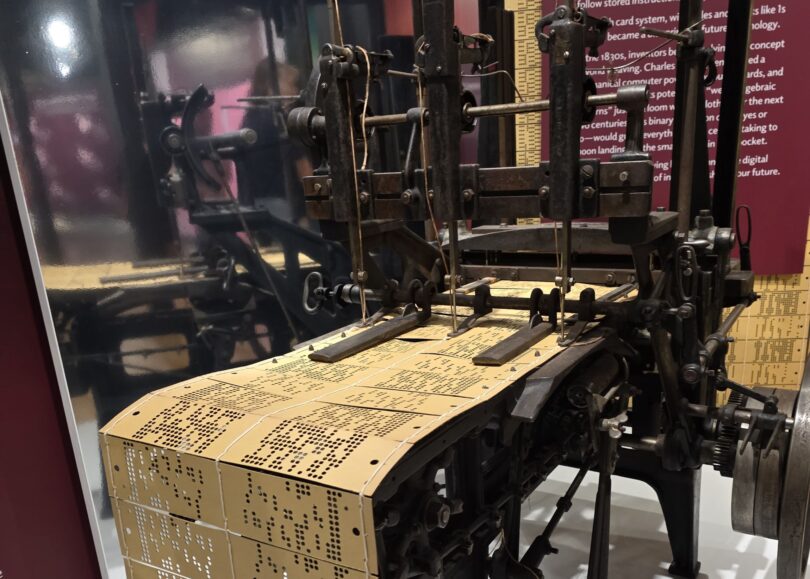
These bedspreads were produced using the Jacquard loom, developed in 1803 by French weaver Joseph Marie Jacquard. This innovative technology streamlined the creation of complex woven patterns on cloth, achieving results no prior mechanism could replicate.
The core component of the loom is a series of punch cards that direct the machine which pattern to weave, with each row on a card representing a single line of the design. In many ways, Jacquard pioneered the concept of computer coding long before modern computing existed.


The Jacquard loom at left is part of a centerpiece at the Maine MILL. At right, an old photo on display shows a worker with punch cards from one of the looms. (YJI photos)
While the automation of textile production revolutionized the industry, it also drastically reduced the need for manual labor, ultimately contributing to the industry’s eventual decline.
Interestingly, these weaving punch cards are directly related to the punch cards later used to program early computers.
Jacquard’s mechanism inspired further technological breakthroughs, including data storage on punched tape, which was used for railroad communications and tracking passenger destinations.
The museum’s exhibit served as a good reminder that the technology behind modern computing began not in a fancy computer lab, but on the factory floors of 19th-century textile mills.
Leith Chikh Rouhou is a Junior Reporter with Youth Journalism International.