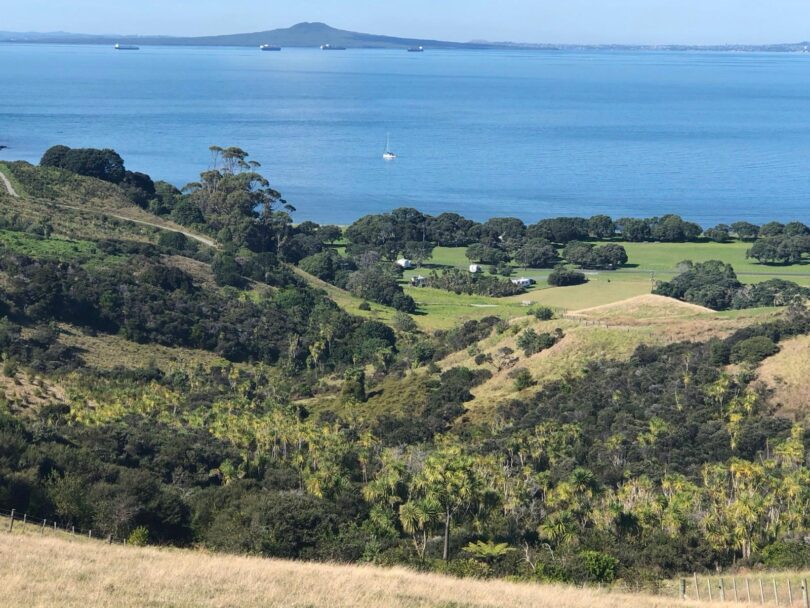
Waimakariri, AOTEAROA / NEW ZEALAND – Whangaparāoa is a small peninsula located an hour north of the bustling city of Auckland. It’s a sliver of green wrapped between sea, sky and fading birdsong jutting out from the warm Hibiscus coast.
Though I moved away a few years ago to New Zealand’s southern island, this warm and sunny place is where I spent my primary school years and where I still think of as my home.
Listen to the author read this article:
Most kids find the word ‘Whangaparāoa,’ which means ‘Bay of Whales,’ a mouthful to say in any given conversation, so everyone who’s anyone just shortens it to Whanga.’
So if anyone asked me, ‘Which high school do you go to?’ I and others would reply, ‘Just Whanga,’ and stretch out our school hoodies to show them.
Within Whanga’ lies Gulf Harbour, the final suburb before the Shakespear Regional Park that tops off the peninsula.

From any coastal vantage point in Auckland, one can see the elusive island volcano, Rangitoto, along the blue horizon. From its throne on the sea, the slumbering volcano can watch over the whales in the bay, the schools, the boats and what little of the native birds remain.
The volcano would remember the bird song that used to chorus from all along the Hibiscus coast, not just from the little speck at the tail end of Whanga’. And the volcano would be here, even if all the bird song faded to nothing under the pitter patter of ferrets and rats.

I remember vividly the hundreds of talks we children at Gulf Harbour School heard about the large steel fences wrapping round the regional reserve. I remember even clearer the long hike out of school in our small black uniforms between neighborhoods.
We marched through the beach at Okoromai Bay and over rolling paddocks before finally spraying the undersides of our shoes, then entering the bird reserve through the thick automatic gate.
All the while, we would scour the undergrowth for signs of kiwi, mātātā pūweto, korimako and all other native birds we memorized in school.

There were three main beaches in Gulf Harbour and around Shakespear park. The first was Army Bay, with black sand and an old army base. Then there was Okoromai Bay, where people would find fresh kina, tuangi and mussels at low tide.
And then there was Te Haruhi Bay, the only one of the three that was within the steel fences.

Te Haruhi Bay is where small blue penguins would appear and even smaller sharks could be found from time to time.
All kids knew the school-song ‘Te Haruhi e!’ before they could count one through 50. All kids knew that the kiwi bird was in danger before they knew that the world-class golf courses in Gulf Harbour would one day be converted into housing developments.
And all kids knew that while Rangitoto was seen as a dormant volcano, the day would come when it would awaken. We used to scare each other with fake news of the day it would happen.
I remember being told when I was around nine years old that scientists believed it would erupt over the next year. I would walk home thinking only of the distant island teetering on the horizon.
If one day, it does wake up from its slumber, I wonder if Rangitoto might wake to find the Bay of Whales empty of whales, and New Zealand – the land of birds – empty of birds.
I wonder, when I return when I am older, if I’ll still remember the trail from Gulf Harbour School down to the beach at Te Haruhi Bay.
I reckon if I still know the lyrics to the school song, I’ll still know the way.

Teia Viljoen is a Junior Reporter with Youth Journalism International.