Prague, CZECHIA – Anyone who has ever visited Prague has probably been on the Charles Bridge – an iconic landmark of the city with its imposing black and white statues and crowds of tourists at all times of day.
But those are copies.
Listen to the author read this article:
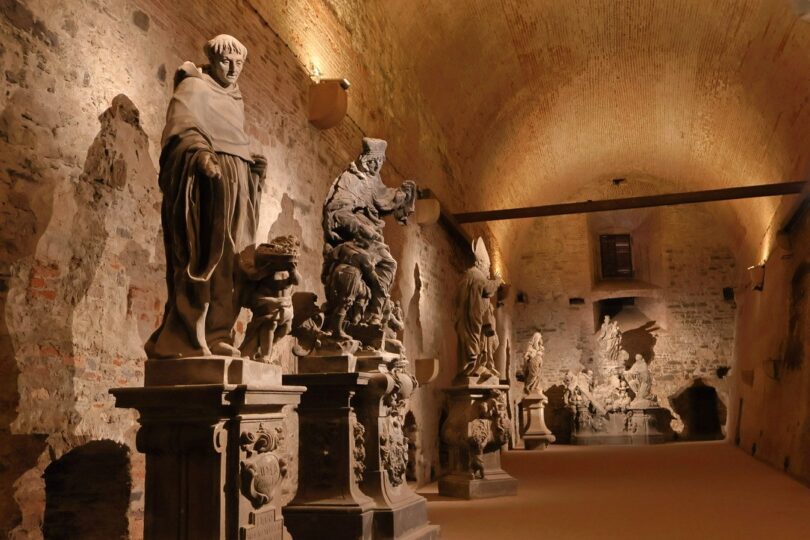
Not everyone knows that Vysehrad, a historic fort on the bank of the Vltava – the river that flows through Prague – preserves some of the original statues, mostly taken away from the bridge to keep them safe from damage.
The only way to see them is to take a guided tour to the Gorlice Hall, starting at the Brick Gate, a modest-looking arch in the Vysehrad fortifications.
After a brief historical overview of Vysehrad, the visitors are invited to walk into the Casemates – a labyrinth of narrow tunnels built for military purposes during the Austrian rule.
But they were never used directly in battle and, thanks to their permanently low temperature, later served as storage for goods during World War II.


(Sofiia Yakymenko/YJI)
The construction of the Casemates is far from flawless. The walls are filled with strangely shaped openings without a clear purpose – probably a misreading of the architectural plan.
The Gorlice Hall, the space where the statues are preserved, itself was not planned.
The Austrian architect was not at the construction site all the time. When he returned to Prague to check on progress, he found that the builders had put the fortification wall in the wrong place. To correct the mistake, another wall was built farther away, leaving a space between them that was later covered and became known as the Gorlice Hall.
When municipal authorities looked for a place to put the Charles Bridge statues to protect them from damage, this underground chamber seemed perfect.
But there was something they forgot about: the door.

The only way to bring the statues into the hall was through the small door at the top of the stairs.
While some statues fit in, others were too big to pass, and the authorities found nothing better to do than to cut the statues, bring them inside, and stick the parts together. Fortunately, they stopped after bringing six statues, and the rest are now in the National Museum in Prague.
In addition, while the chamber protects the sandstone statues from external weather conditions, its cold and humidity have raised conservationists’ concerns.
Although Gorlice Hall is probably not the best environment for the statues, walking into this huge underground space and tilting your head back to see the faces of the giant figures is an unforgettable experience.
Some of the statues seem to look down on visitors, as if trying to tell a story or give advice, and for a moment, it seems they are about to jump off their pedestals and walk out with the tourists to see the sun again.

Sofiia Yakymenko is a Reporter with Youth Journalism International.