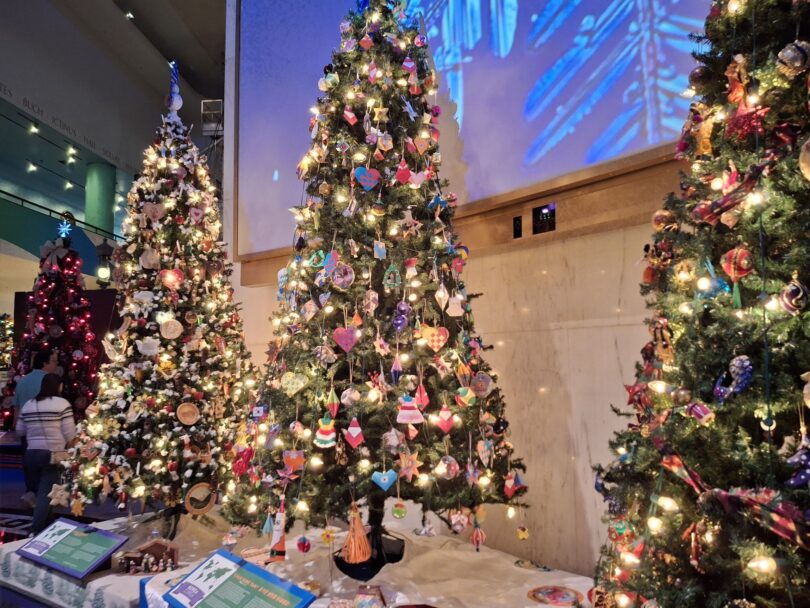
CHICAGO – Stepping into Chicago’s Museum of Science and Industry during the holiday season feels like entering a small, improbable world of wonder.
Listen to the author read this review:
Christmas Around the World and Holidays of Light, an 83-year tradition, attempts to gather global winter customs beneath one vast dome.
What began in 1942 as a gesture of wartime solidarity has grown into an exhibition of more than 50 Christmas trees, each decorated by Chicago-based communities showcasing their heritage through ornaments, colors, and familiar motifs.

At the center stands one tall tree, dusted with artificial snow while Christmas themed pop songs echoed through the hall.
Surrounding it, nation-themed trees lean into affectionate exaggeration: an Irish tree covered in shamrocks and flags, a Mexican tree bursting with mariachi dolls, a Russian tree adorned with matryoshkas and lacquerwork. Each display includes a short plaque explaining the country’s Christmas traditions in just a few sentences.
While the trees are festive and undeniably beautiful, visitors might expect more depth from an exhibition advertised as an educational journey through global holiday traditions. The displays are instantly recognizable but often rely on tourist-friendly stereotypes rather than nuanced cultural insight.

The German tree appears authentic at first glance, featuring nutcrackers, wooden ornaments, angels, and Santa figures. It could easily stand in many German living rooms. Yet for those familiar with the tradition, classical German elements are missing. There is no Erzgebirge folk art, no candle pyramids, no glowing Schwibbögen decorations – objects that define December in many German regions more than the tree itself.
More striking is the accompanying plaque, which contains a slight factual inaccuracy. It claims that Germans open presents “on Christmas Day,” when celebrations actually center on Christmas Eve, the night of Bescherung. Children wait behind closed doors until a bell signals that Santa Claus or Christkind – an angelic gift-bringer unfamiliar to many Americans – has visited.
Advent wreaths, St. Nicholas Day on December 6, and weeks of traditional baking shape the season in my native Germany far more than only Christmas markets and mulled wine alone.
Those seeking deeper cultural insight can still find it. Lithuania’s tree shimmers with geometric straw-inspired ornaments and explains the custom of placing straw beneath the Christmas tablecloth.
Iceland’s display also stands out, featuring the mischievous Yule Lads, traditional wool patterns, and the ominous Yule Cat.


Christmas Around the World and Holidays of Light is not a scholarly deep dive but a creative community mosaic.
It succeeds as a visually engaging stroll through beautifully decorated trees, even if it leans heavily on stereotypes.
The exhibition is worth seeing if you are already visiting the Museum of Science and Industry, but it is not compelling enough to justify a trip solely for this show.
Lina Marie Schulenkorf is a Correspondent with Youth Journalism International.