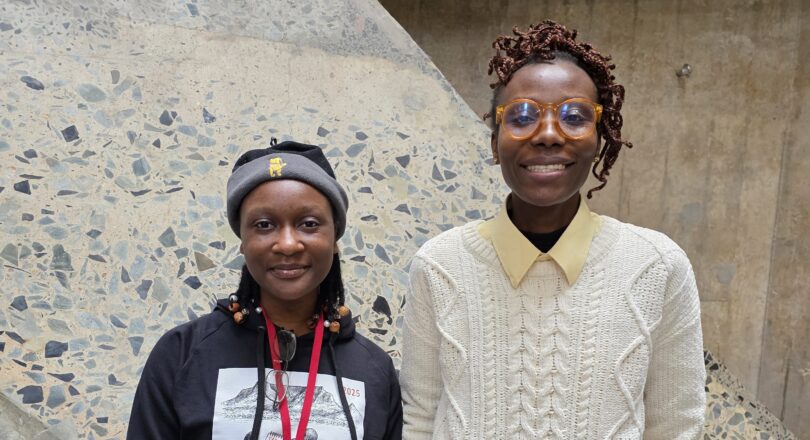

Cape Town, SOUTH AFRICA – Esinam Damalie has been “chasing” art since she was in primary school.
She said her love for art was heavily influenced by her family which have creative occupations.
“I come from the Volta Region of Ghana, home to the Ewe people, who are widely recognized for their exceptional craftsmanship and artisanal traditions. Growing up in that environment has certainly shaped my appreciation for hands-on creative work,” said Damalie, 32.
Listen to the author read this article:
She carried that interest from Ghana into her fellowship with the Zeitz Museum of Contemporary Art Africa (Zeitz MOCAA) and the University of the Western Cape.
Damalie wants to explore “how different places in Africa understand what’s both indigenous arts and contemporary arts.”
She graduated from Kwame Nkrumah University of Science and Technology with a Bachelor of Fine Arts in painting and moved to South Africa after being selected for the one-year fellowship established in 2022.
As a part of the fellowship, Damalie works at Zeitz where she is part of initiatives including anything from helping with exhibits to supporting fundraising efforts for MOCAA.
She also takes classes towards a postgraduate degree at the University of the Western Cape and does curatorial research for the museum.
Although she works across mediums and experiments with a variety of art styles, Damalie has been particularly interested in using hair in her artwork in the past year.
“I make sculptures,” she said. “My main themes are usually around the history of the hair and the hair culture of Africans.
“So looking at the length, hair, the different histories of hair, how I’m able to use the material to make sculptures.
“I am manipulating or working with hair fibers or even fabrics and threads to make [these] sculptural pieces,” she said.
Adjusting to South Africa has taken some time, but is necessary in order to create art Damalie said.
“As an artist, I understand how to compromise and make sacrifices,” she said. “While I understand that this is a different space, I know why I am here and what I want from here.”
Damalie’s research reimagines museum education using “radical” methods and keeps the African diaspora in focus.
“I am looking at how we can educate people when they come into the museum using alternative ways of learning,” she said.
“There’s a need for this kind of work to be done by someone to ensure that people have an understanding of how to use education with the museums to interact, to form communities, and to do many beautiful things.”
Dorothy Quanteh is a Reporter with Youth Journalism International from the United States.
Click on the logo below for more from YJI’s 2025 Global Conference in Cape Town: