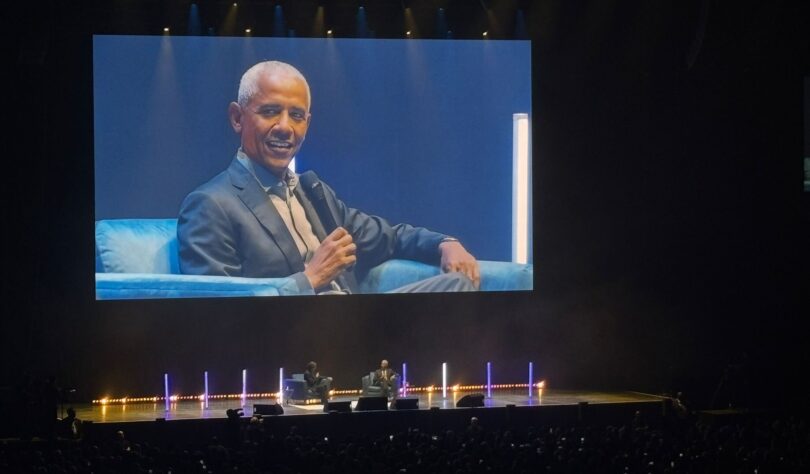
LONDON – Former U.S. President Barack Obama told a London audience that the world is living through a period of “profound change and enormous uncertainty,” with democracy under strain from both authoritarian tendencies and the disruptive force of technology.
Listen to the author read this story:
In conversation with British historian and writer David Olusoga at The O2 arena in London on Wednesday, Obama reflected on life after the White House.
Since leaving office in January 2017, Obama has devoted himself to the Obama Foundation which he and former First Lady Michelle Obama founded in 2014 to “inspire, empower, and connect people to change their world.”
In 2018, the Obamas also founded Higher Ground Productions, an American production company that has already collected three Emmys.
Obama said the mission is “to build the next generational leaders … the kind of values-based leadership that ultimately will be our salvation.”
Discussing these experiences was a reminder that his focus has shifted from campaigning to cultivating.
But it was his diagnosis of politics that resonated with the audience the most.
(Story continues after the photo.)

America stands at an “inflection point,” he said, a fork in the road that he noted is also mirrored in the UK. Obama warned that violence emerges “when whatever systems we’ve built to mediate our differences break down.”
The post-war consensus, born from the ashes of global conflict, was always a “fragile experiment” and Obama explained that complacency allowed disillusionment to fester.
Obama contrasted two stories of America: one rooted in “blood and soil” and another in the promise of equality.
He remains a believer in the “better story” of America, the one founded on equality and possibility.
“I believe in American exceptionalism,” he said, but not as superiority. Instead, Obama defined it as “this incredible set of documents that begins with the premise that we are equal.”
This idea is what has attempted to unite “people coming from every corner of the globe” under shared principles, he said, though only after civil wars, lynchings and marches have those promises been forced to inch closer to reality.
Obama reminded the audience that the desire to restrict “we the people” to “just some people, not all people” is a recurring feature of American history, one that the current president, Donald Trump, has made starkly clear.
That contest, Obama suggested, is not unique to the U.S. He said that “the same phenomenon” is evident in the UK and across Europe. The challenge for progressives is not simply to resist authoritarian instincts, but to ask why the earlier vision lost traction.
As Obama put it, people hold “both stories inside of them,” and the side they embrace depends on whether government delivers the life they want – in particular, dignity, jobs and healthcare – or whether anger is channelled toward scapegoats.
“If someone comes along and says it’s immigrants’ fault, it will activate that side of the brain that says maybe that’s the case,” Obama explained.
From there, Obama turned to the forces accelerating those divisions. The breakdown of trust, he argued, is not only political but also technological.
Social media, once hailed as a tool for connection, has become, in his words, “such a bummer,” reshaping politics and society by rewarding outrage over accuracy. Algorithms driven by engagement have fuelled fear, division and misinformation.
He also sounded the alarm on artificial intelligence, describing it as akin to electricity but introduced “in ways that we are not fully appreciating.”
Although he rejected dystopian visions of “bowing down to our computer robot masters,” he warned of the “weaponization” of AI by governments and non-state actors. The danger is not sci-fi dystopia, but the manipulation of truth itself.
That, Obama suggested, is the thread connecting political polarization, social media’s toxicity, and AI’s disruptive potential. We are living in a world where trust collapses if facts themselves become negotiable.
“Integrity and honesty matter,” Obama concluded. “If we’re for truth, then we have to abide by that view when it doesn’t help us win an argument.”
Holly Hostettler-Davies is an Associate Editor with Youth Journalism International.