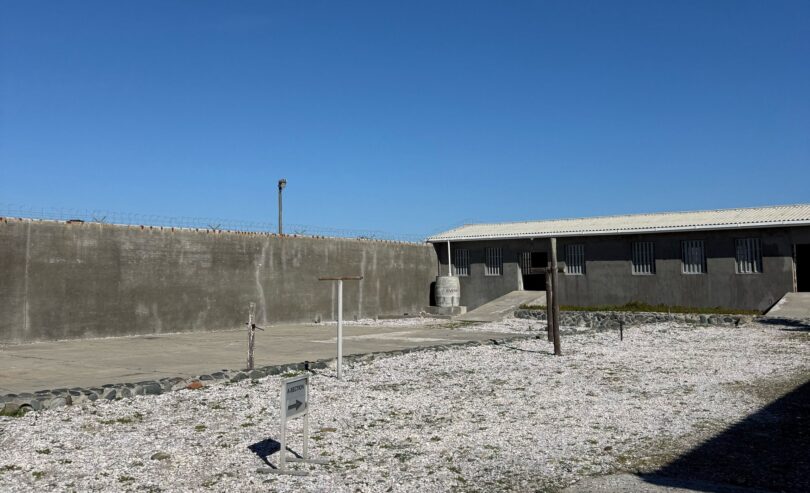
Robben Island, Cape Town, SOUTH AFRICA – As I stepped off the ferry onto Robben Island, a sudden feeling of uncertainty fell over me.
Listen to the author read this article:
Before visiting the island with my school, I knew nothing about the island’s history – only that it was a prison that held many prisoners over several hundreds of years.

My school’s tour around Robben Island was led by a man who was a former prisoner there. He had been sentenced in the ‘80s for fighting against the racist apartheid system.
Under apartheid, the South African government restricted where Black and “coloured” South Africans could live, work, study and travel, and denied them meaningful political power.
Robben Island’s most famous prisoner was Nelson Mandela, who had been charged along with other anti-apartheid leaders with sabotage and conspiracy to overthrow the government.
In 1964, Mandela and seven other defendants were sentenced to life imprisonment. Our tour guide said Mandela famously told the court that he was prepared to die for the ideal of a democratic and free society.
He left the island in 1982 but remained incarcerated until 1990.
In 1994, he was elected president of South Africa in the nation’s first democratic elections. He was 75 years old.
As we explored Robben Island, I realized that this was not a normal prison.
Political prisoners like Mandela were forced to do difficult manual labor. Maybe the most notorious was working in a quarry on the island.
Racial segregation was a constant theme at the Robben Island. Black prisoners, for example, received shorter trousers rather than long trousers, a distinction that was deliberately degrading.

But Robben Island was also used as a place of quarantine long before political prisoners were banished sent to the island. The most famous example of this was the establishment of a leprosy colony on the island in the 19th century.
People suffering from the disease were brought to there to protect the public’s health, keeping those with leprosy isolated. The banishment of those with leprosy reflects the social hierarchy and prejudice mindset of the 19th century.
Our tour guide explained the psychological side of being sent to Robben Island for leprosy: imagine being diagnosed with a poorly understood disease and then being told that you had to leave your family and live on an island away from society.
Robben Island is a powerful symbol in South Africa. The government intended it to be a place of isolation, but the prisoners overthrew this idea and turned it into a center of political education and resistance.
So many famous voices came from Robben Island. Visiting such a potent place is truly inspiring.
Summer Lee is a Junior Reporter with Youth Journalism International.