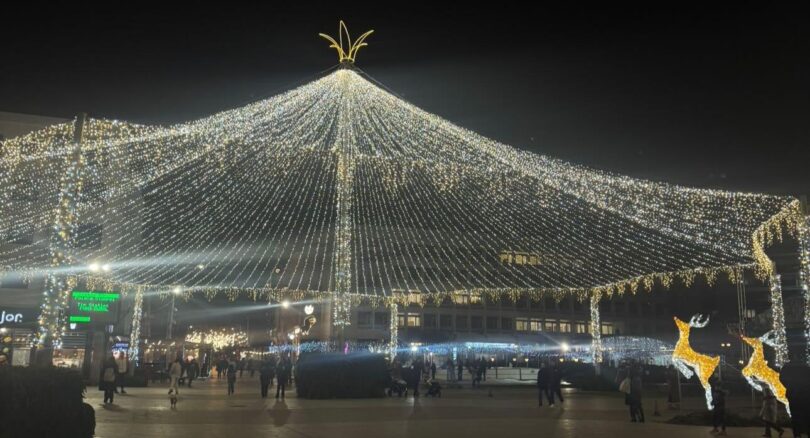
Suceava, Bucovina, ROMANIA – For most of my childhood, I truly believed that every country in the world celebrated Christmas in the same way.
Listen to the author read this article:
I thought everyone knew what colindatul, or caroling, felt like: that pure, innocent happiness when a stranger smiles at you after your song and when you get some candy or money.
Only later did I learn that this tradition, so normal to me, is one of the most beloved parts of a Romanian Christmas.
No matter where you go, Romanian houses around Christmas have the same unofficial menu.
You’ll always find sarmale, which is rice, vegetables and meat wrapped in cabbage leaves; boeuf salad (a homemade dish with chicken, vegetables and mayonnaise) decorated with a thin mayonnaise dressing in little patterns on top.
And cozonac, a sweet bread with chocolate and nuts is popular. There is usually another family specialty, too, different from home-to-home.
Most families decorate their Christmas tree around Christmas Eve, but my family always gets really excited and ends up having the whole house decorated by December 1st, Romania’s National Day.

Here, Christmas is tied to faith, especially because most of the country is Orthodox Christian.
For many families, the days before Christmas are slower and more careful.
There’s the Nativity Fast, when people try to eat simpler food, but also to be calmer, kinder, and more present.
Even as a child, I knew that Christmas was something you prepared yourself for.
Christmas Day itself is peaceful. After church, families gather, food finally appears on the table and the house is full.
Even for those who aren’t religious, the holidays still have a lot of meaning.
You can find comfort in routine and familiarity.
Faith doesn’t have to be part of it for Christmas to feel meaningful.
And this is why I love the holidays in my country, because everyone – no matter of their origin or beliefs – stops and becomes kinder and more united.
Patri Stan is a Junior Reporter with Youth Journalism International.