
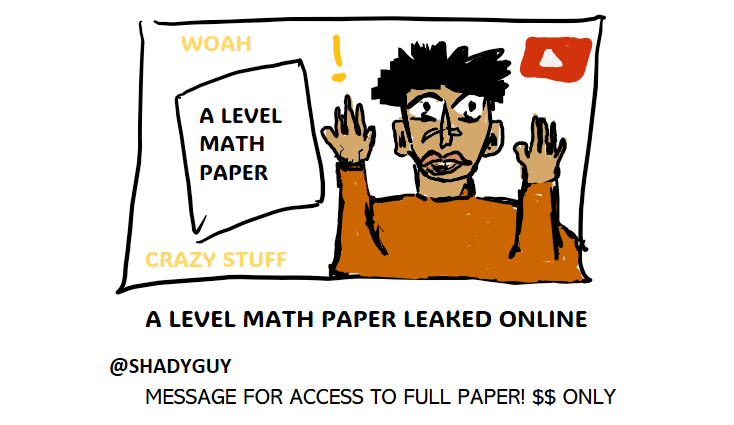
Karachi, PAKISTAN – Students preparing for international exams are outraged by the repeated widespread illicit leaking of test questions – which jeopardizes their scores and possibly, future university acceptances.
Listen to the author read this story:
The UK-based Cambridge exams, which are standardized tests similar to the SAT, are routinely taken by high school students in Pakistan and other countries.
Students in Pakistan, which is part of Cambridge’s ‘Zone 4’ examination sector, prepare rigorously for these tests, known as O and A Level exams, short for “ordinary” and “advanced” levels.
This exam season – which runs here from about May through June – was particularly stressful due to the high number of questions that leaked online before the test day.
Since these exams are graded on a curve, when some students have access to the questions, the threshold by which a grade is marked as an ‘A’ is much higher.
The board of Cambridge International Education only takes action when a large number of questions are leaked.
In the case of the first year A Level math exam, the board issued a retake, as both papers one and two were shared online. The entire paper could be found on Reddit, YouTube, and other online spaces. With the retake, students were only graded on one paper – this meant that if they did not perform well in those topics, their grade was likely to be lower.
Although only A Level papers were leaked, younger students felt the impact, too.
Aleena Ali, a student in Karachi who has just entered her first year of A Level courses, said she feels “stressed” for the year ahead.
The system has “lost all credibility because of how often it leaks,” said Ali.
Despite not being personally impacted by these leaks, she said that it had impacted many people she knew, saying that “it makes it hard for people who actually studied. It can mess with university admissions.”
Ali, whose courses include many popular subjects, said she “would not be surprised” if there was a leak that included the exam questions for her tests.
Exam boards need to take more preventative measures, she said, to find the causes of the leaks and strengthen their security.
The system, Ali said, is “not how it should be.”
For most students, these leaks make an already difficult time worse, especially since these are the grades that determine where many will go to university.
Hareem Ahmed is a law student at the University of Southhampton in the UK. During admissions time, she worked with university-bound students in the UK as a Clearing Hotline Officer.
As Ahmed explained, ‘clearing’ is a system used by UK universities to fill spots in undergraduate courses and is open to students who did poorly in some of their A Level exams.
“Universities set much lower grade requirements through clearing,” Ahmed said, adding that it is the way a majority of the students she works with enter universities.
“It really opens your options, so that’s why (the admissions process) seems less daunting in the UK.”
In Pakistan however, students face a lot more pressure, Ahmed said.

“I have not seen students here in the UK working as hard,” Ahmed said.
She is unsure about the Cambridge system, Ahmed said, as “it doesn’t truly represent its students, but I don’t know a better way. It has problems for sure.”
This is not the first time that exam questions have been ‘leaked.’
The problem, according to Ahmed, “has been getting worse.”
It appears to be a consistent pattern, as questions for some of the most important Cambridge math exams have been leaked for three consecutive years.
Ahmed was upset for students.
“To see an exam get leaked, it’s very disheartening,” she said. “It’s insulting to their hard work and the integrity of the exams.”
But she remains hopeful that students will persevere, regardless of their grades.
Ahmed reminds students that a bad grade does not define them.
“It’s not the end of the world, as much as it seems in the moment,” she said.
Anya Farooqui is a Correspondent with Youth Journalism International.

Amazing reporting Anya!