
Cape Town, SOUTH AFRICA – South Africa offers a vast array of wide-ranging species within its national parks and protected spaces, including elands, whales and baboons.
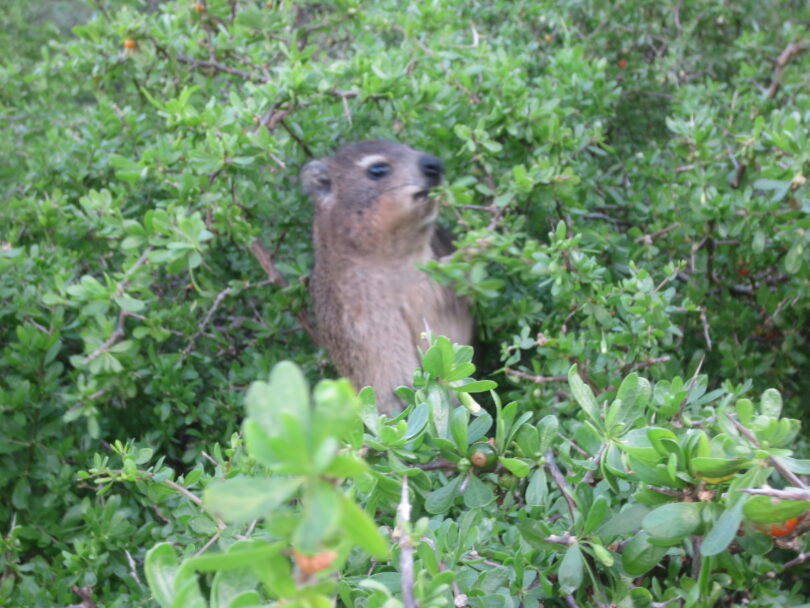
Students at Youth Journalism International’s 2025 Global Conference saw tourists within 10 meters of an eland grazing along a pedestrian path at Cape Point, inside Table Mountain National Park.
Listen to an audio recording of this article:
Elands are massive South African antelope that can weigh up to 800 kilograms. It appeared unfazed.
Though they are herbivores and might otherwise be wary of human intrusions, elands have no natural predators and tourists are a common occurrence in their habitat. Last year, over 1.7 million tourists visited Table Mountain National Park according to JP Louw, a spokesperson for South African National Parks.
According to Charles Owies, a park ranger at Table Mountain National Park, elands’ immunity to predation also means their populations are managed from the bottom-up selection because their numbers are only limited by scarcity of grazing material.
If the eland population within a specific region of the park becomes too large for the vegetation to support, their population growth will slow or stop.

Where the eland was grazing at Cape Point, the population is not yet close to reaching that level, Owies said.
But at a nearby site called Buffelsfontein River, that did happen. According to Owies, eland numbers grew to a level the ecosystem could not support. In that case, the ecosystem would be out of balance, vegetation health would suffer and some elands would have starved as they compete with members of their own species for the scarce resources.
That might seem harsh, but wildlife professionals have a different perspective.
For Owies, the best solution for managing South Africa’s wildlife is interfering as little as possible.
One analogy he gave was of a human spotting a turtle in the middle of the road. Naturally, Owies said, they would move the turtle to the other side. In the human’s mind, they think they have just saved that turtle from a car.
But according to Owies, that is not the correct response.
“They think they’re doing a good thing, but they’re not,” he said. “The turtle might have just spent two or three weeks going to the river.”
Turtles collect water in their shells for use on hot days. When the human picks it up to move them, “They think the water coming out of their shell means they’re peeing,” he said.
But it’s not. It’s the water they just spent weeks collecting and bringing back on their journey.
“Now they need to cross the road again,” Owies said, to go back to the river and reaccumulate the water the human just poured out of their shell.
As a result, from a park ranger’s perspective, human interaction – no matter how well meaning – often means unintentionally disrupting ecosystems or harming the environment.
Thus, for South Africa’s national parks, the chosen approach is “little to no human interaction to balance the ecosystem,” Owies said.
Another example of how human interactions affect wildlife in the ecosystems surrounding Cape Town manifests in the whale populations in the deep, crystal-blue waters off its coast.

Frequent whale species include the humpback whale and southern right whale, which can be seen between June and December when water temperatures are warmer.
Calves have not yet developed a thick layer of blubber, so their mothers bring them to these waters to protect them from the cold, according to Owies.
As a result, human actions such as pollution and boating traffic that reach Cape Town would affect whales when they migrate to waters off coastlines close to highly-populated regions.
Baboons are also clearly affected by human interaction.
Evidence of this was in Simon’s Town, where baboons seemed completely integrated into society.
We saw a baby baboon rifling through a trash can and adult baboons ambling across walls directly adjacent to local shops and cafes. Pedestrians and bikers passed within an arm’s length. Since people aren’t able to do anything about them, baboons and humans seem to coexist.
But while human intervention in the park isn’t common, there are certain instances Owies described when the park needed to step in. One particular baboon, Owies said, would consistently take clothes off tourists.

Even then, the park’s chosen intervention was rehabilitation of the baboon by moving it to Buffelsfontein River and monitoring how it was interacting with its new environment.
If an animal has difficulty in that new ecosystem, they would be moved to a different location.
In this way, though imperfect, their actions adhered to the principle of minimal interference.
The future for humans, elands, whales, and baboons alike involves interaction with other species.
In Cape Town’s national parks, where elands graze, whales swim past and baboons roam, the future depends on coexistence and a willingness to respect nature’s careful balance.
Annamika Konkola is a Correspondent with Youth Journalism International from the United States.
Shiara Naveen is a Senior Reporter with Youth Journalism International from the United States.
Lina Marie Schulenkorf is a Correspondent with Youth Journalism International from Germany.
They wrote this story together and Lina Marie Schulenkorf also made the audio recording.
Dorothy Quanteh is a Reporter with Youth Journalism International from the United States. She contributed a photo to this story.

Click on the logo below for more from YJI’s 2025 Global Conference in Cape Town: