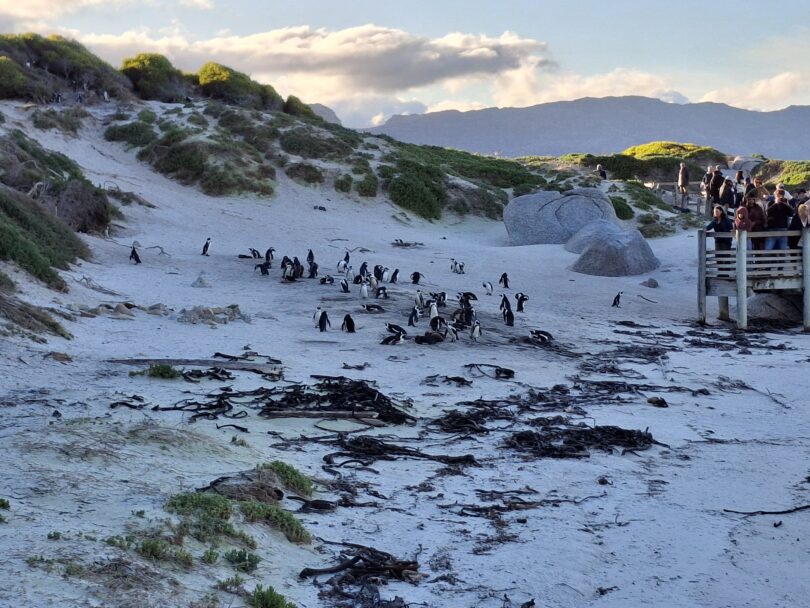

Boulders Beach, Simon’s Town, SOUTH AFRICA – They waddle, they charm and they draw smiles from tourists at Cape Town’s famous Boulders Beach, but behind the endearing appearance of the African penguins lies a far grimmer reality: these iconic seabirds, beloved by many, are teetering on the edge of extinction.
Listen to the author read this story:
In 2023, the International Union for Conservation of Nature added the African penguin to its Red List as ‘critically endangered,’ officially classifying the species as threatened with extinction.

Their primary food sources, including sardines and anchovies, have brought them into direct conflict with local fishermen, while climate change and overfishing have impacted the availability of the essential fish food.
When Youth Journalism International students visited Boulders Beach and saw African penguins in their natural habitat during the 2025 Global Conference in Cape Town, signs at the site indicated that the birds were in trouble.
According to a statistic published on the website of the Basel Zoo in Switzerland, there were still about 15,000 breeding pairs of African penguins in 2018. By 2023, that number had dropped to just 8,750.
The zoo warned that African penguins could vanish from the wild by 2035.
Animal welfare organizations like BirdLife South Africa or Southern African Foundation for the Conservation of Coastal Birds and others accused the South African government of not doing enough to save the species.

Kate Handley, executive director of the Biodiversity Law Centre, is among the critics.
“It is absolutely essential that the South African government takes proactive, precautionary measures to protect our country’s enormous biodiversity, preserve endangered species and prevent extinction,” Handley said in a statement published on the center’s website earlier this year.
In response to the conflict between the fishing industry and the existence of these penguins, the two bird conservation organizations brought it to court and found a compromise through a settlement in March.
Alistair McInnes, head of BirdLife South Africa’s seabird conservation program, explained the broader impact.
“In this case, the primary concern was to improve the chances of preserving Africa’s only penguin species, but the result of these closures will also benefit other marine predator species as well as the livelihoods of many people who benefit from fair and prudently managed marine ecosystems,” McInnes said in a joint statement released by BirdLife South Africa and the Southern African Foundation for the Conservation of Coastal Birds.

The agreement includes the creation of no-take zones for a 10-year period around key penguin breeding colonies and restrictions, but does not ban fishing around other important areas. According to National Geographic, a no-take zone is “an area set aside by a government where no extractive activity is allowed.” It prohibits the removal of any resource.
At the time of the settlement, two fishing industry groups, the South African Pelagic Fishing Industry Association and the Eastern and Southern Cape Pelagic Association released a statement to the Guardian.
“The perception that the fishing industry is the primary cause of the decline in the penguin population is a false one. We are especially pleased that this settlement will now allow scarce resources to be used constructively to scientifically determine the principal factors causing the decline in the penguin population and to ameliorate those where possible,” the organizations told the Guardian.
Nicky Stander, head of the conservation department at the South African Foundation for the Conservation of Coastal Birds, is also quoted in the joint statement released in March with BirdLife South Africa.
“We must continue to advocate on the basis of our scientific research and implement effective conservation strategies to ensure that African penguins can continue to thrive in the future,” Stander said.
Lina Marie Schulenkorf is a Correspondent with Youth Journalism International from Germany. She wrote this story, contributed photos and made the audio recording.
Shiara Naveen is a Senior Reporter with Youth Journalism International from the United States. She contributed a photo to this article.

Click on the logo below for more from YJI’s 2025 Global Conference in Cape Town: