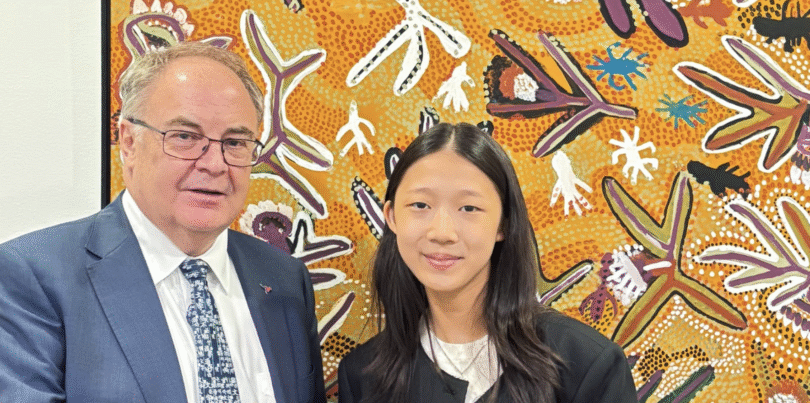
Seoul, SOUTH KOREA – After school, he would drift from one friend’s house to another, where their welcoming mothers would often invite him to stay for dinner, ultimately broadening his palate, indirectly visiting multiple cultures.
Having grown up in the Australian capital of Canberra, Jeff Robinson was exposed to an international diplomatic community and environment that helped shape his worldview.
Listen to the author read this story:
“I found it very interesting to meet people all over the world,” said Robinson. Robinson wanted to do something international and to see the whole world.
This ultimately led him to become the Australian ambassador to South Korea.
Building bridges: The role of diplomacy
“My children always thought I came to my office and only drank coffee,” said Robinson, who explained his diplomatic job.
“It is certainly part of my job, but we look at the interests of Australia and concerning Korea, vice versa,” he said.
Diplomats like Robinson try to help their country, but also “try to bring people together to develop cooperations that benefit both sides, which is fundamentally what we do.”
All diplomats are, of course, employed by the particular country’s government; but good ambassadors nevertheless “act as a matchmaker,” Robinson said. “People-to-people links are really, really important.”
Robinson first came to work for his country in South Korea in 1984. At that time, “I didn’t study at a Korean university, but I had a lot of Korean friends in my Australian university,” said Robinson.
The 1980s were a pivotal period for South Korea, marked by rapid economic growth and significant political developments. Especially in 1988, South Korea hosted the Summer Olympics.
“It was an exciting time to be [in South Korea],” Robinson said, for his very first diplomatic posting.
Then, 18 years ago, in 2007, he came back to South Korea as deputy ambassador, and last year, in 2024, he became the Australian ambassador to South Korea. For Robinson, it has been nearly 40 years of diplomatic service.
Robinson said being the ambassador is both hard and “very satisfying.”
An upgrade to the old South Korea
During his time in South Korea, Robinson has seen a lot of changes.
“Nowadays, most people have cars, but back in the day, few people had cars,” said Robinson. “Many were poor.”
South Korea has now become a very wealthy and advanced society in a relatively short period. South Korea “has all of the things that are associated with an advanced society,” the ambassador said.
Korean friends in Robinson’s age group think that young Koreans today don’t understand what it was like back then and don’t appreciate our world today.
But Robinson does believe that young Koreans do appreciate what most of them have.
“Young Koreans like you grew up in a wealthy country while your harabuhji (grandfather), during his career, became increasingly wealthy,” said Robinson, addressing a Youth Journalism International reporter.
Korea has “changed in so many ways, economically, politically, culturally, and socially,” said Robinson, who said he was pleased to see that journey in his own experience.

Australia and South Korea
The first ever recorded contact between South Korea and Australia took place in 1889.
Joseph Henry Davies, a missionary, was the first Australian to come to Korea, which was then one country, Robinson said.
“He placed himself in Busan and rode a pony. Unfortunately, he quickly died after,” said Robinson, six months after his arrival. The missionary group he represented in Australia decided that they should put more effort into engaging with South Korea.
Not so long before, Korea had been closed off to typical Western countries.
“They [the missionary organization] initially sent three women,” said Robinson. He said Isabella Menzies was one of them and came to South Korea around 1885.
Some of them, like Menzies and two other Australian women missionaries, set up a modern high school for girls.
“In those days, girls generally didn’t go to school,” said Robinson.
On March 1st, 1919, Menzies and others encouraged female teachers and students to protest in support of Korean independence.
When the Ministry of Patriots and Veterans Affairs formally recognized those first three women missionaries as Korean patriots because of their support for the nation’s independence, Robinson accepted the award on their behalf.
Australia was one of the first countries to send military forces in support of the establishment of the Republic of Korea.
One of Menzies’ nephews, Robert Menzies, became the Australian prime minister in 1950.
“You could imagine, though there’s no record, the young Robert Menzies, Australia’s then prime minister, sitting at the feet of his auntie hearing Korean people’s aspirations for independence,” said Robinson.
Menzies and other missionaries were “basically kicked out of Korea,” Robinson said, after Japan and Australia went to war in World War II. In 1942, the women left Korea and returned to Australia.
A family legacy
Two other Australians found love and a way to help after coming to South Korea in 1905.
Mary Kelly and James Mackenzie met and married in South Korea, eventually having five children.
“Leprosy was quite common in those days. Those who had leprosy were often ostracized by their communities,” said Robinson.
James Mackenzie, who was a doctor, set up a hospital to look after people who were suffering from leprosy. Not only were those who had leprosy ostracized, but also their children.
This led Mary Mackenzie, a nurse, to set up a home for the children of leprosy patients to give them a chance and teach them practical work skills.
“The Mackenzies made a big impact in Korea’s early days,” said Robinson.
Two of their daughters carried on their parents’ work in the medical field after studying in Australia. Helen Mackenzie became a doctor and Catherine Mackenzie became a nurse. Both tried to come to South Korea but weren’t allowed to until 1952.
Helen Mackenzie set up a maternity hospital called Il-Shin-Bu-In Hospital (일신부인병원), which Robinson said is “still a quite famous hospital in Busan.”
In the past, most South Korean women gave birth at home, and infant mortality rates were high.
Catherine Mackenzie trained Korean nurses, including in midwifery.
“This helped people give birth, and infant mortality rates dropped quite low,” said Robinson.
She also wrote the first guidebook for midwives in Korea to help train them. The sisters ended up working in Korea until 1970, when they retired and returned to Australia.
Australia’s military influence in South Korea
Australian military officers Major Stuart Peach and Squadron Leader Ronald Rankin also played a major role in South Korea’s history just after WWII.
The division of Korea into North and South was supposed to be temporary. After the Japanese surrender after WWII, the Soviet Union took control of the North and the U.S., the South. The capital, Seoul, is in the South.
Australia played a critical role in the United Nations Temporary Commission on Korea, which was examining the future of the Korean Peninsula, as part of Australia’s active involvement in the formation of the United Nations.
According to Robinson, Peach and Rankin visited Korea in May 1950 and inspected the military deployments along the border between the North and the South. So when the war broke out on June 25th, 1950, they had already sent a report to the UN Security Council in New York.
The “Peach-Rankin Report,” Robinson said, was critical because it confirmed that the North started the invasion. “These Australian officers confirmed in a very clear way that it was North Korea’s aggression towards the South, and that provided the basis of the UN Security Council to form the UN Command to come to the assistance of the Republic of Korea.”
This alerted everybody that North Korea had attacked and led to Australia deploying 17,000 troops to the Korean War as part of a UN effort.
South Korea encourages foreign Korean War veterans to return to the country, said Robinson, adding that most of Australian veterans are in their ‘90s.
Robinson recalled one veteran who had been reluctant to return to a place that was impoverished and at war. But the man did come back and was happy to see the success of modern-day South Korea.
Economic development
South Korea’s economic development started during President Park Chung Hee’s term of office. The country needed energy and resources and at the time, its only assets were its people. The president decided that South Korea should have a steel industry.
The international steel community said that a poor agricultural country like Souith Korea did not need a steel industry, said Robinson.
But Australian companies export energy and resources to supply the steel industry. This is a “hugely valuable relationship between [South] Korea and Australia,” said Robinson. “Both countries have to reduce carbon emissions,” said Robinson. Robinson said he is excited about future prospects of building relationships.
Joint military exercises
Joint military exercises began in 1950 when Australia provided military forces to help protect South Korea from North Korea, which was under UN command.
“We love to do military exercises in our land because there is a lot of space,” Robinson said. The joint military cooperation, Talisman Saber, was originally only for the U.S. and Australia. But an invitation was extended to South Korea and 16 more countries. Last year, South Korean soldiers and two aircraft participated in the joint military operation. So Australia and South Korea’s military are working more closely with each other.
When he worked in the embassy 18 years ago, Robinson said, Australia buying equipment from South Korea was unlikely, but now Australia looks at South Korea as important for increasing its military capability, with Korean companies like Hanwha manufacturing in Australia.
South Korea’s popularity grows
K-pop, K-drama, and K-film have had a positive impact on South Korea’s soft power. Robinson said his friends in Australia did not know where South Korea was in the past. But now, amongst Australia’s foreign ministry, it is one of the most popular postings.
And, Robinson said, “There is a large Korean community living in Australia.”
The embassy works to encourage people to get together. Robinson said he wouldn’t have come to Korea if its people weren’t so friendly and accommodating.
“A lifelong interest and passion in Australia-South Korean relations was generated,” said Robinson.
If they visit Australia, most South Koreans tend to go to Melbourne and Sydney, but Robinson said it would be great for people to visit the smaller places since Australia is a huge country with lots of different climates.
“As an ambassador here, I heard many people say they studied in Australia and it was wonderful, or they had their honeymoon in Australia and it was fantastic. Those kinds of opportunities can be very powerful,” said Robinson.
Advice for youth
Robinson said life can seem challenging in South Korea due to its competitiveness. Everybody wants to go to prestigious universities, seize huge opportunities, and take responsibilities, he said.
“But clever people like you should know that the world is a very exciting place,” Robinson said.
Robinson says it’s all about deciding what you’re going to do and what your life is going to be. Robinson suggests thinking very carefully about how your job has a big impact on your lifestyle, but he also said there are multiple pathways to success.
“I find Koreans do see the whole world as an opportunity, and I think that’s fantastic,” Robinson said.
Josephine Yein Lee is a Senior Reporter with Youth Journalism International.