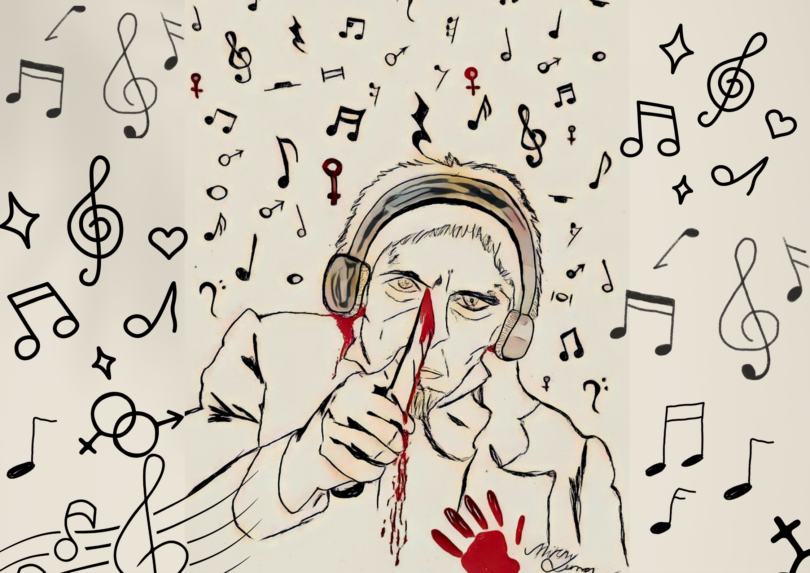
ISTANBUL – If you ever want to understand how teenage boys learn what power looks like, don’t start at home or in a classroom. Open YouTube, scroll on Tiktok and check the top artists on Spotify.
Across the globe, trap and similar musical genres dominate playlists.
Listen to one of the authors read this story:
Their message is the most important part: money proves worth and control proves masculinity. Women are portrayed as trophies, temptations or problems to be “handled.”
This is not an argument that music single-handedly creates misogyny. Culture is way more complex than that.
But when artists get away with spreading messages such as these, young boys think that this “masculinity” is normal.
In Romania, one of the most influential youth genres is manele, a Balkan-influenced pop-folk style blending Turkish, Romani, Arabic and electronic elements.
The lyrics of manele are often about wealth, status, loyalty and romantic drama. Over the past decade, manele has merged with trap influences, including luxury cars, dominance, and misogyny in the message.
One of the most known manele artists is Tzancă Uraganu, often described by fans as “one of the greats” of the genre.
He has approximately 907,500 monthly listeners on Spotify and around 1.72 million subscribers on YouTube, where his music videos frequently gather millions of views.
Teenagers actively consume and circulate his content on TikTok and Instagram.
During an appearance on “Un podcast mișto” (“A cool podcast”,) he was asked whether he considers himself a violent man.

“When a woman screams a lot or has a jealousy crisis, you might give her a slap to wake her up, to control her,” he responded on the podcast. “Things like that happen.”
Under the clip, many commenters reacted not with concern, but with amusement or approval:
“So many sensitive people in the comments 😂”
“If I were in your place, I would’ve done the same.”
“A little factory reset 🤣”
At nearly a million monthly listeners and over a million YouTube subscribers, these statements are part of a public script about masculinity, one in which dominance is praised and empathy is a weakness.
In Turkey, rap has always been in the music but with the new rappers, the lyrics have become more misogynistic.
A song called ‘‘CISTAK’’ by Era7capone, Batuflex and Narco became famous in 2024. Some lyrics from this song talk about how the girls who think this song is sexist and don’t like it will like it when he gives them money.
Or, the singers talk about how they had intercourse with a women in a very inappropriate manner, which makes the women seem like an object and not a human being.
Listeners played “CISTAK” more than 218 million times. When it was famous, a lot of people – especially men – opened this song on full volume, rolled down the windows and screamed this song in their cars.
A famous female artist named Aydilge made a video criticizing how these songs associate women with money, brands and smoking things while also degrading the women’s bodies and portraying this as something cool.
And even with this, there are still many people online thinking these lyrics are normal and fun.
With many artists like lvbel C5, Blok 3 also emerging ande becoming number one hits, they are being praised and becoming more and more popular thus being in many billboards. This is becoming an endless cycle. The more money they make the more popular they get, the more popular they get the more money they get.
A highlight was when Ivbel C5 was a guest star on “O Ses Türkiye,” Türkiye’s version of “The Voice.”
“O Ses Türkiye’s” year-end show is popular with television audiences. Many famous singers and actors who were the main stars of the year get together and each sing as a competitor.
Lvbel C5 was also a guest star there where he sang two songs of his which see women as objects.
Many teenagers later posted memes stating how it was the first time their parents or family members got to see and hear the songs, thus making it more popular.
If a show that had 7 million views in Türkiye allows this kind of disrespect and misogyny to spread inside the country, surely younger boys may think of this as a thing they are allowed to do.
When women artists wear anything less than what the regulators want, they get severe restrictions in their career and daily life.
This brings up the question of how a woman’s wardrobe can impact society so negatively but the hate words used in lyrics against women – who make up more than half the society – are somehow okay.
The problem of misogyny in music isn’t limited to Romania and Türkiye. It’s everywhere.
Lina Köksal is a Correspondent with Youth Journalism International from Türkiye. She co-wrote this story.
Naz Mergen is a Correspondent with Youth Journalism International from Türkiye. She co-wrote this story and made the audio recording.
Patri Stan is a Junior Reporter with Youth Journalism International from Romania. She co-wrote this story.
Nicole Luna is a Senior Correspondent with Youth Journalism International from Brazil. She made the illustration at the top.
See more of Youth Journalism International’s ongoing series on toxic masculinity. Click on the image below: