Lagos, NIGERIA – For over a century, the Uruamudhu community in Ozoro, a town in Delta State, southern Nigeria, has celebrated the Alue-Do festival, a fertility festival where childless couples seek blessings from their deity and families gather to give thanks.
Listen to the author read this story:
It is not a widely known festival. Outside of the Isoko Local Government Area, most Nigerians have never heard of it.
But within Uruamudhu, the festival has been an annual “celebration.”
This year, the world heard about it as reports calling it a “rape festival” circulated widely when viral videos of women being openly harassed sexually in the streets of Ozoro community circulated the internet in March.
These disturbing videos which showed how different groups of young men took advantage of the festivity to grope, inappropriately touch and strip women half naked, stirred conversations and public outcry from concerned citizens, with many tagging the event a “rape festival.”
Youth Journalism International interviewed two young women who were harassed at the festival who described what happened on the condition that their surnames be withheld.
A tradition that not everyone knew about

The core aspect of this festival, which lasts several days, is spiritual. Families who have struggled with years of childlessness come seeking divine intervention and those who received blessings in previous years return in gratitude.
Part of the festival involves women staying indoors during the specific window set aside for the purification exercise. The male residents of the community throw sand at or flog any woman seen outside during that window.
For local people, this is understood. But Ozoro is also a university town.
The Southern Delta University is situated in Ozoro, which brings students from across Nigeria, many of whom speak no Isoko and/or don’t have prior knowledge about Isoko customs and traditions.
Historically, the town crier’s announcements about the festival have been made only in the native language, which leave students and non-indigenes unaware of the warnings.
In March 2026, that communication gap came with consequences.
Accounts of assaults
Victory, a student at Southern Delta University, who asked to be identified by only her first name out of fear of reprisals, recalled how the day unfolded. According to her, warnings did circulate, but not through proper channels.
“They posted on the school blog that everyone should be indoors before seven,” she said.
The announcement, made on the morning of the event, carried no mention of what would happen to anyone who stepped outside.
“They never made mention of them harassing girls, stripping girls naked, or even raping girls,” Victory said. “They didn’t mention it, but it still happened.”
Even that warning did not reach everyone. It was not posted on a general platform or through the official school memo system, meaning a significant number of the student population never saw it at all.
Blessing, another woman who was studying at Southern Delta University, said she stepped out from her home and was harassed by more than one man.
The men tore her clothes and dragged and flogged her, she said. Somehow, she managed to escape them and flee to safety.
Lisa Amaechi, born and raised in Lagos, had studied at Delta State University in Abraka, and was already familiar with the festival culture of the region.
“A lot of festivals would normally happen among the Urhobo people of Delta State,” Amaechi said. “There’s the Oria festival, Abraka festival, Eku festival, then the Ozoro festival, each trending due to one issue or the other.”
Amaechi described a pattern she has observed: cult violence at some, business owners being penalized for staying open at others.
The Ozoro festival, Amaechi said, was trending because local youth took advantage of the festival to harass women.
Videos from the festival go viral
Many Nigerians got wind of this practice when the disturbing videos went viral.
Victory watched the posts spread in real time.
“We started seeing posts of harassing girls, raping girls. Anyone they meet outside, they would just harass, torture, rape, all those kinds of things,” Victory said.
The moment the news went viral, the atmosphere on campus changed.
“Everybody was running,” Victory said. She herself left town the following day.
Though Amaechi wasn’t directly affected, she said she was shaken by what she saw.
“Emotionally disturbed? Yes, I was, especially after seeing those videos,” said Amaechi. “No one should go through it. No one deserves that at all.”
She also added that the festival was not announced in advance unlike in Abraka, where such events are publicized up to a month ahead.
“This was announced that very day,” Amaechi said.
The festival was scheduled to begin at 7 p.m., but the harassment started before then.
More significantly, the activity had never before reached areas near the university.
“This time it did,” Amaechi added, “and to me, that was just an advantage the youths in that community took to do what they did to those students.”
As the scale of what happened became clearer, formal responses began to pile up. Victory said her university acted on it.
“My school wrote a petition because some of my schoolmates were victims,” Victory said.
Anthony Uvietobore Ogbogbo, the king of the Ozoro community, publicly denied any prior knowledge of assaults at the festival.
Community leaders deny knowledge
Leaders in Ozoro, including the king, complained that the outrage was an attack on their culture and customs.
Edu Ideba, a gender rights and social justice advocate in Lagos, Nigeria, said it wasn’t outsiders who criminalized the festival in Ozoro.

“It wasn’t people from other states or parts of Nigeria who invaded the community,” Ideba said in an interview over text with Youth Journalism International. “We were simply going about our day when videos and eyewitness reports from right inside Ozoro started circulating. What happened is that a few people with clear heads saw those videos and recognised that what was playing out was not okay.”
For meaningful accountability to happen, Ideba said, the traditional leaders in Ozoro must first accept that something went wrong.
“The narrative that ‘outsiders are criminalizing our culture’ is gaslighting and blocks progress,” Ideba said. “The Delta State government did condemn the incident and called for an investigation, and several arrests were made. But real change requires collective action from community leaders and dwellers, not just waiting for the governor to intervene from Asaba.”
Ideba said that when social activists see something wrong, they point it out, naming the laws that are being broken and explaining why those actions constitute assault.
“It’s like when someone has been abused but lacks the understanding to describe it as rape or sexual violence, someone who knows better then comes to explain, ‘What happened to you without your consent is called this, and it is wrong.’ That’s what we’re doing here,” Ideba said in the interview.
Delta State has the 2020 Violence Against Persons Prohibition Law, Ideba said, which criminalizes rape, sexual assault, harassment and other forms of gender-based violence.
“We’re not saying the culture or its purpose is criminal,” said Ideba, who founded the Bonnicare Foundation to support rural communities. “We’re saying the actions that occurred during its celebration, the assaults and violations of basic human rights, are criminal and cannot be excused as tradition.”
While police and local officials said no one had reported being raped at the festival, Ideba said Nigerian institutions have a “well-known pattern of denying what’s visibly happening.”
But a larger issue, according to Ideba, is that many survivors of sexual abuse don’t report the crime.
“Some are afraid, others have seen previous cases go nowhere, and many simply don’t know the proper channels or steps to take,” she said. “They may destroy evidence by bathing or burning their clothes with good intentions, not realizing how it affects their case. There’s also the culture of silence in many communities, especially around issues tied to tradition.
“The absence of formal reports doesn’t mean there were no victims, especially when the incidents were captured on video for the world to see,” said Ideba.
Arrests and online backlash
Bright Edafe, the Delta State Police public relations officer, posted on X that some key persons in the community were arrested in connection with the incidents.
“The community head and chief organizer of the event, one chief Omorede Sunday and four other suspects from Oramudu quarters in Ozoro have been arrested,” Edafe posted. “The CP [Commissioner of Police] has ordered that they should be transferred to State CID with immediate effect. The CP vows that anyone involved will be arrested and brought to justice.”
There were harsh comments online.
A social media account with the name Benkingsley Nwashara, posted on X: “Delta State Governor should cancel this Ozoro festival entirely and save their women from this sort of sexual harassment happening every year. Any culture where people can’t maintain basic decency should never be allowed to continue.”
Another X user with the username Tyson.nie posted: “The fact that people are being warned to ‘stay inside’ instead of the criminals being rounded up tells you everything you need to know about the state of security. This is a massive failure of local leadership. Ozoro deserves better than this nightmare.”
What about the future?
The incident led to female students leaving the Southern Delta State University campus to avoid harassment.
For things to be better at future festivals, according to Ideba, structural change may be needed.
“We must first ask, ‘Are women even at the decision-making table in this community?’ Some places have local bylaws and structures that include women leaders and youth leaders who can speak up. If that doesn’t exist here, that’s a fundamental structural problem that needs to be addressed first,” Ideba said.
While many Nigerians have moved on, conversations about the matter occasionally continue. The issue of insecurity remains as does the fact that regard for the constitution and human rights continue to plummet in Nigeria.
Victory Kalu is a Reporter with Youth Journalism International from Nigeria. She reported and wrote this story.
Chibuike Chukwuka is a Junior Reporter with Youth Journalism International from Nigeria. He contributed reporting.
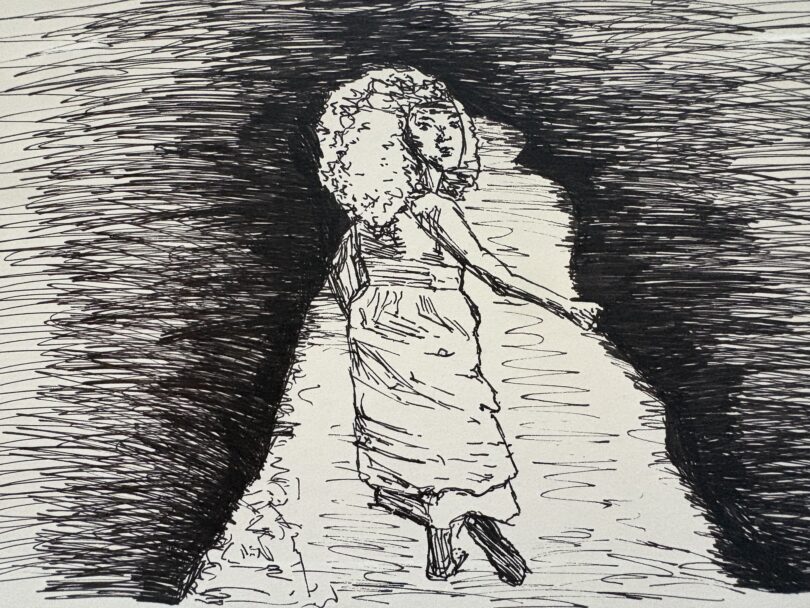
Elodie Cockerell is a Senior Illustrator with Youth Journalism International from England. She made the cover art.
Click on the image below to read more from Youth Journalism International’s ongoing series on toxic masculinity: