

Cape Town, SOUTH AFRICA – Visiting Kirstenbosch National Botanical Garden, even in the middle of South Africa’s winter, was like walking into a living textbook on biodiversity.
The eastern foot of Table Mountain forms a lush backdrop against clouds and soft mist for Kirstenbosch’s unforgettable density of life.
Listen to the author read this article:
Each slope, bed, and canopy layer illustrate how, more than ever, plant diversity matters.
Kirstenbosch is part of the Cape Floristic Region, a UNESCO World Heritage Site and the smallest of the world’s six floristic kingdoms. The region covers about 90,000 square kilometers – less than 0.5% of the African continent – yet holds nearly 20% of Africa’s flowering plants.
Many of those species are found nowhere else, and many are threatened with extinction. Walking in with that knowledge, the botanical gardens were distinctly more than just “a park with cool plants.”
When we visited Kirstenbosch as part of the Youth Journalism International 2025 Global Conference, we had the opportunity to see a living archive of evolutionary experiments, concentrated into one relatively small corner of the world.
Even in winter, when I would normally expect quiet, the fynbos walk was busy with detail. Though not the vibrant, riotous rainbow of their springtime state, the remaining flowers were intricate and graceful.

Kirstenbosch also made it easy to see why botanical gardens matter on a global scale. In addition to being a carefully curated landscape and must-see heritage site for visitors, Kirstenbosch is acclaimed for conserving biodiversity in its gardens, according to the South African National Biodiversity Institute.
Rare and endangered species, especially those with limited natural ranges in the Cape Floristic Region, are maintained here as living collections. That means there is a safety net if wild populations crash. Plants could still be studied, propagated, and, in some cases, reintroduced.


Similarly, long-lived collections in botanical gardens allow scientists to monitor how plants respond to pests, disease, and shifting temperature and rainfall patterns.
Botanical gardens also have a key role in visitor education.
From informational signs, brochures, and being inspired to research more after walking through the garden’s themed sections, I learned that the fynbos family includes proteas, restios, heaths, buchus, and that many of these groups have evolved in lockstep with fire and local pollinators.

As our walk continued, silvery leaves captured the light. Rust-red stems wove their way through deep green shrubs.
Proteas stood out like lanterns – black-bearded protea, broad-leaf protea, Bredasdorp protea, conebushes and pincushions, each tagged with names by the botanical garden that rooted them in specific habitats.
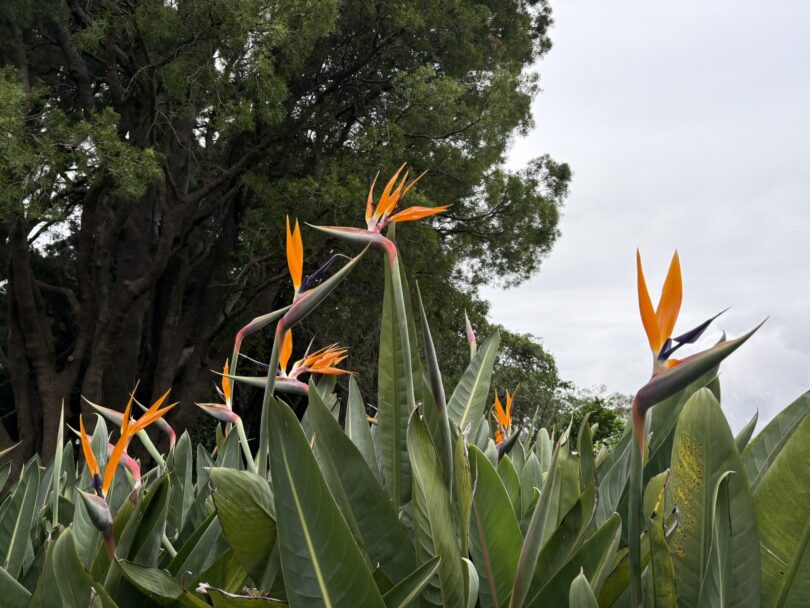
Restios formed sculptural clumps that hinted at tough adaptations to their environment. Birds of paradise carried their orange-yellow-blue blooms like bright signatures against all that green and grey.
The Centenary Tree Canopy Walkway – nicknamed the Boomslang, or tree snake – was also a highlight because it gave a different perspective on biodiversity by lifting us into it. The steel-and-timber structure begins unobtrusively at ground level, then rises along a gentle curve until it reaches 11.5 meters above the forest floor.

The walkway winds through an arboretum of more than 450 tree species from across southern Africa, many relatively young and some naturally occurring on the site.
Up in the canopy, I could look down on the layered structure of the forest.
Signs along the Boomslang described “life in the tree canopy” as its own ecosystem. Leaves and branches provide nesting sites and shelter for birds, from sunbirds to owls. Caterpillars, grasshoppers and beetles feed on foliage, while spiders stretch webs between twigs to catch flying insects.
Geckos hide under bark during the day and hunt at night. Boomslang snakes, perfectly at home in this elevated world, hunt birds, eggs and frogs among the branches.
Standing on the walkway, I saw that biodiversity stacks vertically, in addition to being spread out horizontally across the landscape.
Other sections of the garden showed how biodiversity connects to human history and culture.
The Useful Plants Garden and displays on indigenous ground covers highlighted how plant biodiversity has enabled a range of current and historical uses, including in traditional medicines, dyes, mats, and teas.
In the bonsai area, a 160-year-old wild olive was symbolic of a story of loss and recovery. Once nearly dead under choking Port Jackson (an invasive species), it was dug out with very little root, stayed dormant for two years, then slowly revived.
When its potential as a bonsai emerged, it was trained into its current shape and later exhibited at Kirstenbosch as the Peace Tree in 1994, commemorating Nelson Mandela’s inauguration.
In the pond below, a Cape kurper fish gliding through the water added yet another native species to this network of stories.

Each of these sections are framed by the sheer scale and variety of Kirstenbosch itself. The garden has been growing, conserving and displaying South Africa’s indigenous flora since 1913, and its map alone hints at a series of linked worlds: formal lawns, the Mathews Rockery with desert and arid flora, cycads representing some of the planet’s most endangered plant lineages, the Fynbos Walk that is most colorful from June to October, and trails that step seamlessly into Table Mountain National Park.
The gardens are very large and meticulously maintained, yet full of hidden pockets including shady nooks under trees and unexpected viewpoints.
It would be easy to become pleasantly lost here for an entire day.
On a personal level, this visit shifted my sense of scale. Before Kirstenbosch, terms like “floral kingdom” and “endemic species” lived mostly in articles and lectures for me. Walking through the garden in winter, I began to link those ideas to real plants and real places by observing the stiff architecture of restios, the twisted trunk of a bonsai olive that nearly didn’t survive, and looking out for birds and insects along the way.
The grandeur of Kirstenbosch has inspired me to seek out a botanical garden in every new area I visit, as a small infusion of a reminder of the world’s biodiversity.

I only saw a fraction of what Kirstenbosch offers, visiting in only one season. There are other months when different proteas flower, other fynbos shift into brighter color, and new sets of species will take center stage.
When I have the opportunity to visit again, my only wish will be more time to explore everything.
Annamika Konkola is a Correspondent with Youth Journalism International from the United States. She wrote this article, contributed photos and made the audio recording.
Holly Hostettler-Davies is an Associate Editor with Youth Journalism International from Wales. She took the photo of Konkola in the garden.
Shiara Naveen is a Senior Reporter with Youth Journalism International from the United States. She contributed video reporting.
Anya Farooqui is a Reporter with Youth Journalism International from Pakistan. She contributed video reporting.

Click on the logo below for more from YJI’s 2025 Global Conference in Cape Town:


Could we see some metrics for Kirstenbosch? Do they support this sunny report?