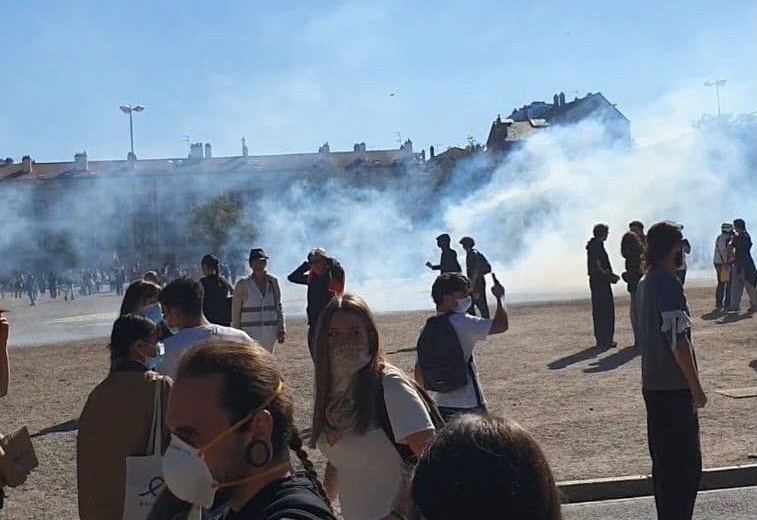
Nancy, FRANCE – A wave of student protests and school blockades in France with youth demanding improvements to education is continuing with no end in sight.
Listen to the author read this story:
Demonstrations began Sept. 18 in the Paris suburb of Créteil before spreading out all across France. The protests are mainly carried out by lycéens, or high school students aged 16 to 18.
The main reason for the demonstrations are the severely bad conditions in which many students – notably those in lesser privileged areas of France – have to study: run-down buildings, a teacher shortage leading to more than 30 pupils per class and long class days that stretch from 8 a.m. to 6 p.m. are some of the protesters’ main issues.
Lucile L’Aot, an 18-year-old political science student at Université de Lorraine in Nancy, said she faced similar conditions during her high school years, including long working hours and problems with the way the school was run.
In Nancy – which has more than 55,000 students – the protest became very popular in October.
Story continues after video from protest in Nancy:
L’Aot took part in the protests as a way of showing solidarity with the pupils, she said.
The French police have used teargas grenades against the students, including at times when the protests are peaceful.
During the demonstration, L’Aot faced violence from the police, she said and witnessed other protesters subjected to violent treatment.
Some of the police behavior was “illegal,” L’Aot said, adding, “Many of them do not have to be afraid of legal consequences.”
Of the members of the General Inspectorate of the National Police, or the “Police of the Police,” 70% are police officers.
“That would make a fair judgment complicated,” said L’Aot.
After violent encounters with police, students are often left alone to rely on help from other demonstrators. After protests, the streets were in chaos, with garbage bins burned and other facilities destroyed.

In the center of Nancy, police teargassed students at close range – sometimes right in their faces. In order to keep safe, protesters found shelter in shops, since the whole city center of Nancy was affected by teargas attacks.
As a foreign student in Nancy, I was surprised by the gravity of the demonstrations since we have not had a similar movement in my country of Germany in the last few years.
But our school systems differ greatly and French students face much harder conditions than German.
My university, Sciences Po, had a planned closure for one day in solidarity with the protesters, and many students decided to support the lycéens and go on the streets with them.

Throughout France, protests were rather peaceful at first but progressively began to include arson and attacks on individuals and the police.
In Nantes, a city in the west of France, rioters set a school building ablaze on Oct. 1, which left the school entrance destroyed.
The demonstrations are expected to continue and it is unclear how the French government – which has seen seven different education ministers in three years – will react.
Florian Gashi is a Reporter with Youth Journalism International.