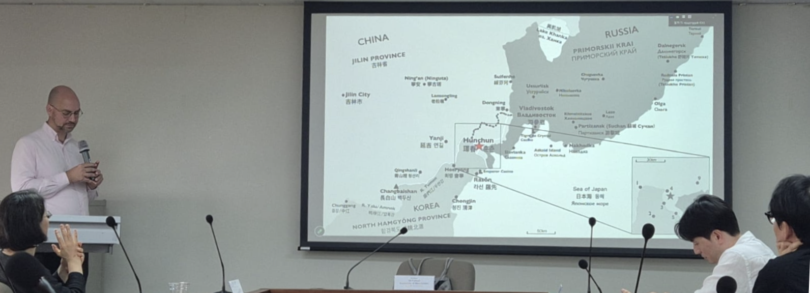
Seoul, SOUTH KOREA – Ed Pulford, an anthropologist at the University of Manchester, stood in front of a room full of curious people like me at Seoul National University’s Kyujanggak Institute for Korean Studies.
He was there to answer the question: What if the border between China, Russia, and North Korea wasn’t really about space, but about time?
Listen to the author read this article:
Pulford was there to give a lecture and share his insights on the interplay of time and politics along the borders of China, Russia, and Korea, drawing on his book, “Past Progress: Time and Politics at the Borders of China, Russia and Korea.”
Prof. Hyang Jin Jung, a leading scholar at Seoul National University’s Department of Anthropology, moderated the lecture as well as the discussion.
“Even as anthropologists, we are very often confined to the frames of national societies,” Hyang said, “but Professor Pulford has extensively researched how geopolitics and global and national histories and ideas and local cultures intersect in everyday life and people’s life trajectories in borderlands.”
According to Seoul National University, the Kyujanggak Book Talk Series was established by the institute’s International Center for Korean Studies to invite international and domestic scholars to introduce their recent publications to a wider audience.
Its core purpose is to bridge different academic communities and share fresh, global perspectives on Korean history, culture, and society.
Pulford’s book and talk focus on a corner of the world most people never think about: the “Tumen Triangle,” where China’s Jilin Province, Russia’s Primorsky Krai, and North Korea’s North Hamgyong Province meet.
Pulford’s research centers on Hunchun, a Chinese border city of roughly 200,000 people in the Yanbian Korean Autonomous Prefecture, where he did much of his fieldwork about a decade ago, during his PhD studies.
That fieldwork unfolded in the shadow of a plan that never quite worked out.
The Tumen Triangle initiative, first floated in the early 1990s to turn the region into a booming trading hub for Northeast Asia, later rebranded as the Greater Tumen Initiative in the mid-2000s.
As Pulford put it, none of it has really “borne much fruit” – it’s simply one of several cross-border cooperation schemes here that keep promising a bright future that never quite arrives.
That gap between promise and reality is really what Pulford’s talk was about.
He showed old propaganda posters from the Soviet Union, China, and North Korea, all sharing the same idea: that socialism was a train speeding toward the future with communism as its final stop.
Pulford called this pattern “Socialist forwardism.”
One Soviet poster showed a train literally running on tracks labeled with dates, heading to a station called “Communism.”
A North Korean poster showed a crowd charging forward under the banner of ‘강성대국,’ which in Korean means “a powerful and prosperous nation” rallying toward the new century’s advance.
But right across the border in Russia sits Kraskino, a small, quiet Russian town in noticeable decline.
Pulford described it as “regressive” compared to the flashier “futurist” and “modernistic” side in Hunchun, in China.

Photos of Kraskino’s crumbling Russian houses and empty roads sat next to shining pictures of Hunchun’s neon lights, showing how differently “progress” and “the future” can look depending on which side of the border you’re standing on.
Pulford also talked about how the past sometimes gets rewritten to fit into political stories.
He described how anti-Japanese guerrilla fighters in the 1930s and ’40s – those who would later found socialist states in China and North Korea – drew on a much older regional trope: the noble, virtuous bandit hiding out in the forest, familiar from Chinese classics like The Water Margin.
He drew his own comparison, too, noting that his hometown of Nottingham has its own version of that same figure: Robin Hood.
Pulford also brought up monuments like the Wangjaesan Grand Monument in North Korea and old martyrs’ steles in Yanbian, China, arguing that these giant stone reminders quietly shape how people see the region’s past.
What made the talk remarkable wasn’t just the history, but Pulford’s own memories.
His fieldwork stories came through in the slides, too: photos of rotting villas, empty train platforms and old propaganda posters.
Even secondhand, it made a border most of us have never seen feel oddly close.
Two academics also responded to the talk. June Hee Kwon, an associate professor of cultural anthropology at California State University in Sacramento, joined remotely.
Kwon praised the book for “provincializing” the very idea of progress; treating it not as a universal truth but as something lived differently depending on where, and under which political system, a person grew up.
Remarks by Alek Sigley, a PhD candidate at Stanford University researching North Korean film, literature, and everyday life, focused on how Pulford uses this small border region to say something about the bigger picture.
Sigley pressed Pulford on a striking detail from the trip to North Korea: Chinese tourists calling what they saw “feudal,” a word loaded with its own socialist-era baggage, and what it means for a country to be criticized, ironically, in the very language of the ideology it claims to uphold.
Pulford closed by returning to the idea that opened his talk: progress isn’t really a straight line. History, he suggested, doesn’t move cleanly from past to future.
Instead, it loops back on itself, gets reused and rewritten.
It was a fitting echo of Pulford’s own final chapter, “History’s Lines and Loops,” and it left the room with a simple but lasting question: whose version of “progress” are we actually being sold?
Josephine Yein Lee is a Reporter with Youth Journalism International.