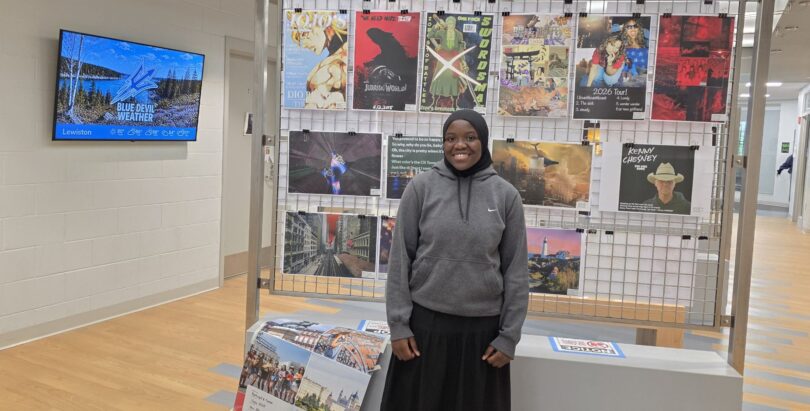
Lewiston, Maine, U.S.A. – From a refugee camp in Malawi to Tennessee and Maine in the United States, Bridgete Muronda has seen many places and still wants to see more.
Listen to the author read this story:
America, where she moved more than a decade ago, has given her more opportunities and education and has made her feel seen and recognized, Muronda said.

“Back home in Africa, there’s a lot of places that you don’t really get acknowledged. You just go to school and they just see you as a student. But here, it’s like, you can get recognized for being excellent,” Muronda said.
Muronda, 17, was born in a refugee camp in Malawi and moved to the U.S. when she was about three.
Having lived in America most of her life, she doesn’t remember much about the camp, only key details like her uncle’s store, where he sold milk, bread, and candy.
Even though she doesn’t remember a lot, Muronda still thinks of Africa as home and wishes to go back and see how Malawi is now.
Life before coming to America
Even though Muronda has lived in the U.S. most of her life and is a citizen, she still refers to Africa as home. Her parents tell her stories about the environment in Malawi and their lives there, but they like America, Muronda said.
Both of Muronda’s parents grew up in Congo but moved to Malawi.
Her mom lived in Malawi with her best friend and worked at a mall. In the refugee camp in Malawi, finding food was a challenge for her parents since there were many people there who needed food, Muronda said.
When asked about the war in Congo, Muronda said, “It’s like an ongoing war, like there’s always something going on.”
Even now, there’s still conflict going on. Muronda’s grandparents are still in Congo and are in danger from the conflict, which has gotten really bad, but they can’t move out of there, she said.
“In Congo, they speak Lingala, French, and Swahili. The common ones are Lingala and French. Swahili is not really common. And so my family comes from that small percent that speaks Swahili. And also in Congo, the population is mostly Christians. There’s barely Muslims. I think it’s like 2% Muslims. And my family also came from that 2%,” Muronda said.
Even though they weren’t like most people, everybody there is welcoming no matter what you are, Muronda said. Sometimes, people ask where she’s from.
“I used to tell them that I’m Congolese, but I was born in Malawi.”
Muronda said she likes the culture and the spirit of the Congolese people.
When asked if she knows anyone from Malawi in America, Muronda said, “For a long time, it was just me. I never heard anybody say, ‘I’m from Malawi,’ but throughout the years I’ve heard people like at the high schools, say they’re from Malawi.”
Coming to America
Being an American is nice, Muronda said, because you get many opportunities, but it still comes with its flaws.
“The flaws, like for me, because I am African American, some people don’t really like consider me American because I am an immigrant.”
She said she feels bad when people don’t consider her an American because, at the end of the day, they’re the same people, and they believe in the same things.
In Malawi, people speak Chichewa, which is a very laid-back language, Muronda said. She used to speak Chichewa, but when she moved to America, Muronda had to learn English and Swahili, which all of her family members spoke.

Over time, Muronda has forgotten Chichewa, her home language.
In 2013, Muronda and her family moved to Tennessee.
When asked about the reason for moving, Muronda said, “Just for better opportunities to get us out of the environment there because Malawi is a poor country.”
Coming to America was a long process for Muronda’s parents.
Her father moved to America first, and then he filled out the papers for Muronda and her mother to come.
The whole process of getting America to allow them to come took about a year or two.
Her mom’s best friend, whom she lived with in Malawi, got sent to Australia instead of America, but they’re still very close and talk on the phone about their lives, which are way better now, Muronda said.
When Muronda moved to the U.S., she and her family lived in Tennessee for one year, and Muronda describes Tennessee as a really good place, saying that they lived near the city and had many places to go.
In Tennessee, they stayed at family members’ house for two weeks until they were able to find an apartment near them.
Muronda has never been back to Tennessee, but is planning on visiting this summer.
After a year or two in Tennessee, Muronda and her family moved to Maine, so her dad could pursue his dreams of being a truck driver and for other opportunities here.
“We didn’t have anybody here. So we stayed at a family’s close friend’s house until we found an apartment here,” Muronda said.
It took them a couple of months to find a place to live. Muronda’s favorite thing about Maine is going to the city of Portland. “I really like the vibes there,” Muronda said, “the people and the culture there is really nice. They have really good places to hang out.”
Muronda doesn’t see herself staying in Maine, but she said she sees herself coming back. She wants to be a travel nurse and see more places, maybe even visit where she used to live and bring her skills there.
Muronda got to be a part of a program at the Lewiston Regional Technical Center which lets high school kids learn skills and gain experience that can help them with their future jobs. She recently finished and got her Certified Nursing Assistant certificate, which is something that she wouldn’t have been able to get in Malawi.
“In Malawi, I would still go to school and stuff, but I just wouldn’t have the same opportunities as here,” Muronda said.
Noga Segal is a Reporter with Youth Journalism International.
Read more from the YJI series American Reflections: Young voices on an old promise by clicking on the image below: