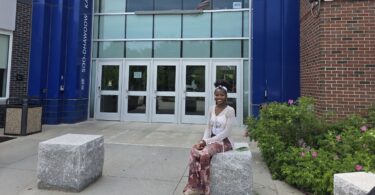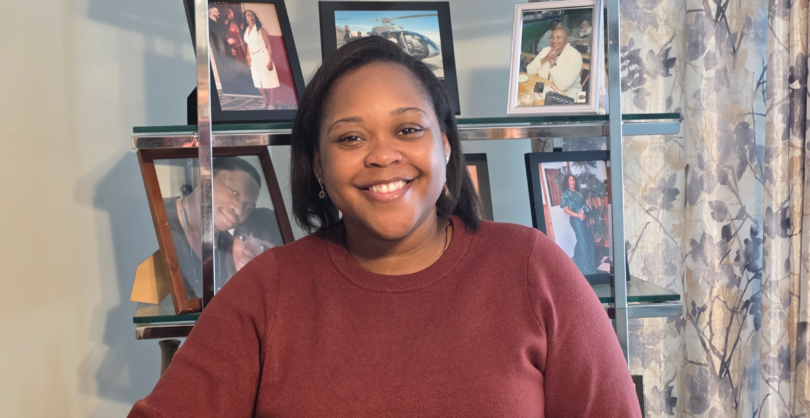
Lewiston, Maine, U.S.A. – Despite the challenges that she’s faced as a Congolese immigrant to Maine, Bright Marshall said she loves her life here.
“I remember we came with like literally just a suitcase each and a few dollars,” said Marshall, 28.
Listen to the author read this story:

Marshall was seven when her family fled the Democratic Republic of Congo for a better, safer life.
With her mother and two older siblings, Marshall spent about a decade in South Africa before seeking asylum in the U.S. in 2016, just after she finished high school.
The biggest hurdle?
“Figuring out what your next step is,” said Marshall. “What do I do, now that I’m here?”
What it means to be an American
Life doesn’t discriminate, said Marshall. Everyone faces challenges.
“You have to figure out how you’re going to respond to what life throws at you,” she said. “You can let it destroy you, or you can use it as fuel to build yourself back up.”
The struggles that immigrants face, said Marshall, leave them with a different perspective.

“Being American means a lot more to immigrants than it does to Americans,” Marshall said. “And it’s because we have to fight for it.”
She explained.
“When you’re used to something and you have it in your possession and you don’t have to think about it, you get comfortable. And you don’t necessarily see what it means or you don’t see its abundant value.”
A lot of people come to America to chase the American dream – to have a better life, an opportunity to work and to have a home, said Marshall.
After being displaced, fighting to start over, making a new home in America has more meaning, she said.
“So for me, being an American means everything because I feel like I can breathe finally,” she said. “I feel like it’s the life I was supposed to live.”
Leaving Congo and the kindness of strangers
As a schoolgirl in South Africa, Marshall faced a language barrier. While learning English, she felt like an outsider, and didn’t feel comfortable interacting with other children.
But one girl, who tried hard to befriend Marshall and include her, changed her circumstances.
“I will always remember her,” said Marshall.
The South African girl’s actions were part of a pattern of empathy that Marshall and her family experienced as they made their way to America.
“As uncomfortable and new and tricky as our beginning was, we also met with a lot of kindness and a lot of support,” Marshall said.
After arriving in America, they first lived in Buffalo, New York. There, a family contact connected them with someone in Portland, Maine, who offered to host them while they found their own place.
“I remember getting on the bus in Buffalo,” Marshall recalled. “I think it was in October, and it was so beautiful to drive from New York to Maine. Absolutely stunning. I will always remember that.”
According to Marshall, displacement became an overwhelming theme.
In the beginning, Marshall said, displacement was negative – the family was seeking safety and better opportunities. Now, she said, her perspective is different.
“As a 28-year-old adult, I view displacement as a positive thing because it has brought me to where I am and made me who I am,” she said. “I’m willing to put up with a lot for what I have now because I know the alternative.”

The big picture
Marshall mentioned that she finds it comical to watch the news and see people so divided.
“I’m, like, you’re missing the big picture,” said Marshall, and “completely missing everything” that it means to be American.
“America is so powerful, and being American, living in America and all of that, I think we can all agree that it’s important to all of us,” Marshall said. “So how do we work together for this important thing that matters to all of us?”
She sometimes catches herself complaining about “first world problems,” Marshall said, because she’s grown used to a life of convenience.
“You have to remember that there are some people who don’t have this and who struggle for the basic meal that you’re eating,” she said.
What’s to love about Maine
During her first Maine snowfall, Marshall said, her apartment temporarily had no heat and it was a cold night. She said she remembered staring out the window and watching the snow fall, crying because she was so cold and uncomfortable.
“I was not happy at all,” she said, “but if I didn’t stick with it at that time, I wouldn’t be where I am today.”
Now, when she returns to Maine after traveling outside the state, she sees the sign that says, “Welcome to Maine.”
“There’s no other feeling like this,” said Marshall. “And maybe it’s because Maine is my home.”
After living for a short time in Portland, the family moved to Lewiston, where a family friend gave them a temporary place to live until they found a more permanent home.
The family connected with Lewiston’s French Canadian community through a program at the Franco Center, where French speaking locals practiced their language skills with French speaking immigrants. They made friends there and connected with a local church.
“If my family and I didn’t give Maine a chance, we would not have built the life that we have built here,” said Marshall, who earned her associates degree in business administration from Central Maine Community College.
After nine years in Lewiston, Marshall now lives in Cushing, Maine, with her husband.
“I genuinely love living in Maine. I feel like there are so many opportunities,” said Marshall, who said she is exploring more outdoor activities. “I love the peace that exists in Maine.”
Maine gets dismissed, said Marshall, because people think it’s just small towns with nothing much to do.
“People don’t know what’s in Maine,” said Marshall. “They have no idea. Maine summers make up for the rest of the year because they are so incredible.”
One criticism of Maine that Marshall mentioned is the state’s lack of diversity. While she said it’s no one’s fault, she said that she wants her future children to experience different cultures.
“I so desperately would want them to have the same exposure that I had growing up, of different people, different stories, experiences and all of that,” said Marshall.
She’s already thinking of how to make that happen.
“All of my experiences have taught me a lot, namely resilience,” Marshall said. “When you’re forced to start over and you don’t have any other options but to build yourself back up, you have to learn resilience. You have to learn how to do it.”
Read more from the YJI series American Reflections: Young voices on an old promise by clicking on the logo below: