
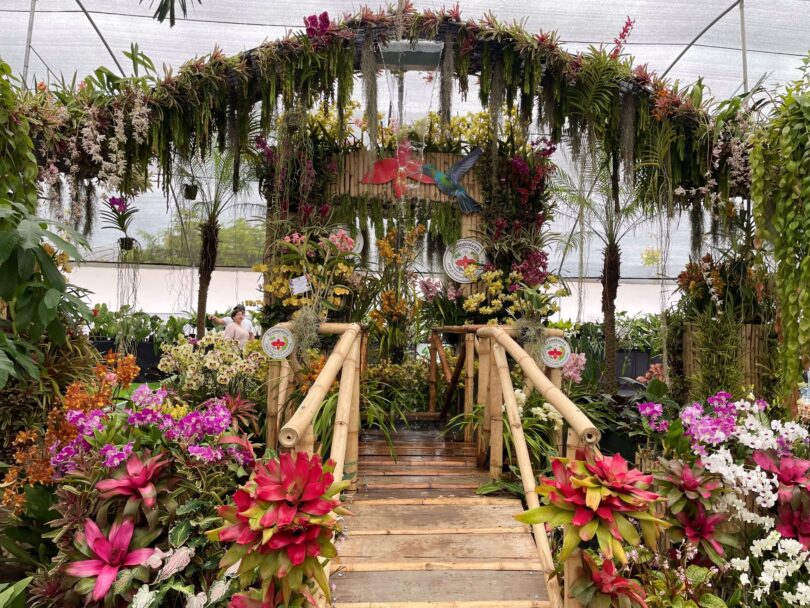
Guayaquil, ECUADOR – A new plant fair featuring a wide range of tropical flowers and greenery offered residents here a way to build community and get closer to the biodiversity surrounding their city, organizers said.
Listen to the author read this story:
Selvatica, a late July fair dedicated to plant lovers, was the creation of Tonio Iannuzzelli and Silvana Parodi, in collaboration with Ecuadorian orchid grower Ecuagenera.
In previous years, Ecuagenera held open houses where visitors could see and purchase plants at discounted prices.
This year, Ecuagenera added Selvatica to its open house in Guayaquil.


At left, a Phalaenopsis orchid in bloom. At right, Aroids from a business based in Azuay. (Renato Santana/YJI)
More than 30 small businesses and agricultural companies from different parts of Ecuador took part in the four-day event. There were aquatic plants, aroids, carnivorous plants and products related to botany.
In addition, Ecuagenera’s open house had more than 25,000 orchids on display, along with other tropical plants, including aroids and bromeliads.
Iannuzzelli and Parodi said the goal of the fair was to familiarize people with endemic plants – those that are native to the country and may only grow there – and to value Ecuador for its biodiversity.
As Parodi explained, there are a lot of imported species used for gardening, and using more native plants would help raise awareness of Ecuador’s own flora, contributing to conservation.
Founded in Ecuador more than 30 years ago, Ecuagenera is known for its orchids and other tropical plants.
According to the company, Ecuagenera helps protect over 2,700 hectares of habitat on Ecuador’s Pacific coast, its mountainous central Highlands, and the Amazon rainforest.
The company mostly exports its plants to Asia and Europe, and has nurseries in Germany and the United States.

According to Ecuagenera spokesman Andrés Ramón Reinoso, the company is currently working with Nicola Flanagan, an international expert in vanilla research.
Two new species of vanilla were recently discovered in Ecuador, and Ecuagenera’s purpose is to achieve an export-quality product, Reinoso said.
He highlighted the role that Ecuagenera has in collaborating with conservation and scientific research, and their strategic alliances with various universities and institutions.
According to Reinoso, the company has a large laboratory where researchers work on plant tissue culture and orchid reproduction.
“What people get when buying from us is a piece of us,” he said, referring to the care that is put in every specimen.

But where did the idea of Selvatica come from?
In the past, Iannuzzelli – a landscaper, biophilic designer and plant collector – took part in PRU Market, Parodi’s pop-up market in Guayaquil.
Iannuzzelli suggested to Parodi that they create something similar to her market, which includes stalls from several small entrepreneurs. But rather than general merchandise, Iannuzzelli said they should build something plant-themed. It could help businesses connect with more clients and, most importantly, strengthen the plant-lover community in Guayaquil.
Parodi contributed her networking skills and pop-up market expertise, Iannuzzelli brought his knowledge of the plant market and Ecuagenera provided the space.

Asked to name one idea that came from the inaugural plant fair, Parodi and Iannuzzelli both said Selvatica created community.
In Guayaquil, a city that sometimes feels like it is drowning in cement, people of all ages were able to connect through their love for nature.
One of the businesses at the market was centered on native trees.
“The idea is to raise awareness and give back to the city what we have taken away to build our houses,” Iannuzzelli said.
That goal takes on particular significance in Guayaquil. As Ecuador’s largest city continues to expand with large real estate projects, the dry tropical forests characteristic of the area and the endangered species that live in them are threatened, environmentalists have said.
Many urban residents have limited awareness of the ecosystems that remain within the city and the threats they face.
Native flora and fauna have seen their habitats cut into pieces by road construction, so it is not unusual to occasionally hear about an ocelot or a possum being run over by a car, as research from Guayaquil University shows.

The goal of Selvatica was to activate the local economy while also raising awareness of native species.
As people tried to sell their products at Selvatica, there were conversations between business owners, clients and others just visiting the fair.
Something as small as an orchid can open a conversation between two people.
From there, the spark of community ignites, connecting humans with each other and with the natural world surrounding them.
Renato Santana is a Reporter with Youth Journalism International.
Amazing Renato! You did great on the interviews and collecting photos!