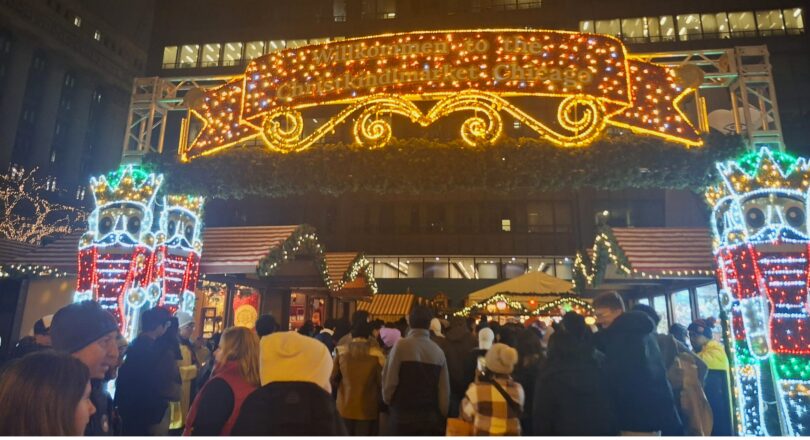
CHICAGO – When I went to Chicago, I was ready for an American Christmas – giant inflatable Santas, peppermint-flavored everything, and Mariah Carey echoing from every Walgreens.
Listen to the author read this article:
What I did not expect was to be ambushed by … my own culture.
Or at least by a full-scale German Christmas market, an official partner market of the Nuremberg Christkindlesmarkt, no less, meaning this wasn’t some random imitation, but the real deal with paperwork.
Now, I grew up in Dresden, home of the Striezelmarkt – one of the oldest and prettiest Christmas markets in Germany, so yes, I’m biased, and no, I will not apologize.

My childhood Decembers were filled with roasted chestnuts or almonds (gebrannte Mandeln), Ferris wheel rides above glittering rooftops, and the slow transition from the children’s drink Kinderpunsch to mulled wine, which every German teenager understands is basically a rite of passage.
Dresden also sits near the Ore Mountains, birthplace of the handcrafted wooden Christmas art that is both meticulously made and priced like you’re also buying the craftsman’s mortgage.
And of course, Dresdner Christstollen – the dense, raisin-y Christmas loaf we defend with religious intensity.

So imagine my face when I turned a corner in downtown Chicago and saw a bright red sign shouting “Christkindlmarket Chicago!”
My first thought: Oh no. They copied Nuremberg’s thing.
Second thought: Wait – they didn’t copy it. They’re partnered.
Third: Hold on … the actual Nuremberg Christkind has been here? In Chicago?
For context:
The “Christkind,” literally “Christ Child,” is not a child at all. It’s a symbolic gift-bringer – traditionally an angelic, golden-haired figure – who brings presents on Christmas Eve in many German families.
It’s Santa’s quieter, more ethereal cousin, but with an angelic white gown embellished with lot of gold. You might say the marketing game’s a bit stronger than jolly old St. Nick’s.
Back to Chicago.
I had come looking for an American holiday moment and instead got a German identity crisis.
And to be fair: a lot of it was shockingly accurate.
Not “American theme park Germany,” but genuinely German Christmas market accurate.
The smells, the crafts, the food – honestly, swap out Windy City’s skyscrapers for a medieval square and I’d have believed them.

Half the stalls sold Glühwein, or mulled wine. That’s actually a very accurate simulation of German Christmas markets, where mulled wine is slowly devouring every other slightly interesting booth like a warm, cinnamon-scented parasite.
There were handcrafted ornaments from the Erzgebirge mountain region – one stall even had the name of my hometown on it, nearly sending me into a sentimental spiral.
And of course, pretzels. Not very Christmassy, but Americans see dough in a twist and think “Germany,” so I’ll allow it.
And then there were the beer tents.
Which … listen. Unless you’re in Bavaria, beer tents are not really a Christmas thing. But Americans associate Germany with beer the way Germans associate America with peanut butter, guns, and enormous pickup trucks, so I understand how we got here.
The final blow: lederhosen.
In December.
In Chicago.
On someone who definitely did not board a flight from Munich that morning.
Germany is more than beer, pretzels, and leather shorts – but I have to admit, the Chicago market captured our clichés brilliantly. It was like watching my own culture put on an Oktoberfest costume for Christmas.
A little wrong, a little right, deeply funny, and somehow still endearing.
So yes, I went to Chicago for an American Christmas. Instead, I got Germany with skyscrapers.
And you know what? I’ll take it – just maybe with one fewer Glühwein stall.
Lina Marie Schulenkorf is a Correspondent with Youth Journalism International.