Burbank, California, U.S.A – The creative space once occupied by Walt Disney – the famous American pioneer of modern animation and storytelling – is today just as it was when he left it 60 years ago.
Listen to the author read this story:
Entitled Suite 3H, the space is where Disney worked from 1940 until 1966. It’s part of the corporate headquarters for The Walt Disney Company, set on 51 acres of land in the mountainous terrain of Burbank, California.
On a recent tour, I learned a lot about Disney and his work.
Thanks to Dave Smith, the preservation of Disney’s office is close to identically as he left it – from the exact tilt of books on the bookshelf to each of his meticulously placed ashtrays.
Smith, the founder and chief archivist of the Walt Disney Archives, spent more than a year researching all Disney publications and productions and built the Disney Archives.
In 2015, the Walt Disney Archives and Disney studio craftsmen assiduously restored this creative center to exactly the way it was left in 1966. Tour access is available only to members of a Disney fan club called D23 or through a Disney employee.
Walking through the space today provides a sense of inspiration to all who enter.
From a young age, Smith yearned for Disney’s autograph. When he finally met the creator in person, Disney didn’t have the pre-made autographs he typically carried.
But he promised Smith that he would deliver one to his home. When Smith received the autograph in the mail, it became his prized possession. Smith decided that he would make a promise in return: he would create the first official archive collection.

A grand piano sits in the center of the room, commanding a welcoming and creative presence.
Here, Disney hosted creative sessions with composers, which invited collaboration into the company’s musical storytelling process. Song was important to Disney – not only did it add another layer of beauty to films, but it often served as a driving force of the story itself.
Specifically on Friday afternoons, Disney set aside time to experiment freely, testing musical ideas without limitation.
On these days, some of the most widely recognized Disney songs were born. Two of the most frequent visitors were the Robert and Richard Sherman, two brothers who were the composers of “Feed the Birds” from the iconic 1964 film Mary Poppins.
To the right of the piano is a couch where Disney would meet with people across all sorts of company projects from park plans to television shows.
Hanging above the couch was a gold bird cage with a mechanical singing bird automaton that Disney purchased during a trip to Europe and which inspired the creation of Audio-Animatronics.
It also influenced Imagineer Marc Davis and his “Bat in a Birdcage” gag for The Haunted Mansion ride that features a glowing-eyed bat.
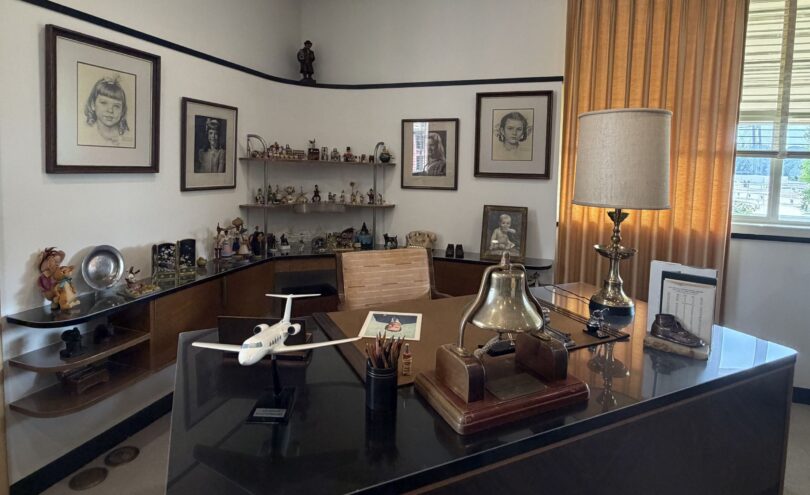
Disney’s love for travel also shined through his office. Story-triggering figurines that he collected and brought back from his travels lined his desk as they sparked inspiration for Walt. His interest in transportation was also apparent in the many model planes displayed throughout the room.
Throughout the tour, sunlight filled the office. The executive and creative offices were deliberately built in the shape of the letter “H” to maximize window space and natural light.
In the adjoining room, conceptual sketches of the Disneyland park were pinned up on the bulletin boards that covered the walls.

This room primarily served as a space for brainstorming and development meetings. Even the kitchenette played a role, allowing creativity to flow longer, as guests could grab a bite to eat during discussions that often stretched on as ideas bounced back and forth.
Disney’s office was a precursor for the kind of innovation and collaboration that companies still strive for today. But more than that, it served as a blueprint for fresh ideas.
From the piano where some of Disney’s most memorable songs were born to the birdcage that helped inspire Disney Imagineering, every detail reflected the founder’s belief in blending creativity with possibility.
And how fitting that Smith, who once treasured an autograph from Walt Disney, would be the one to preserve this space.
Standing in that office recently, it was clear: this isn’t just where Disney worked – it’s where his way of thinking continues to live on at the company, creating the happiness that Disney radiates day after day.
Lia Arnold is a Reporter with Youth Journalism International.