Karachi, PAKISTAN – At any given hour in Karachi, a café is full.
Not just occupied, but buzzing with human activity. The air hits you first. Warm, rich, layered with the deep roast of freshly brewed espresso.
Listen to the author read this article:
The lighting is dim and golden, as soft music hums beneath the murmur of conversations. Ceramic cups clink. Someone laughs. And for just a moment, the city outside, chaotic and relentless as it always is, simply doesn’t exist.
Over the past year or two, Karachi’s coffee culture has grown into something impossible to ignore, and even harder to escape.
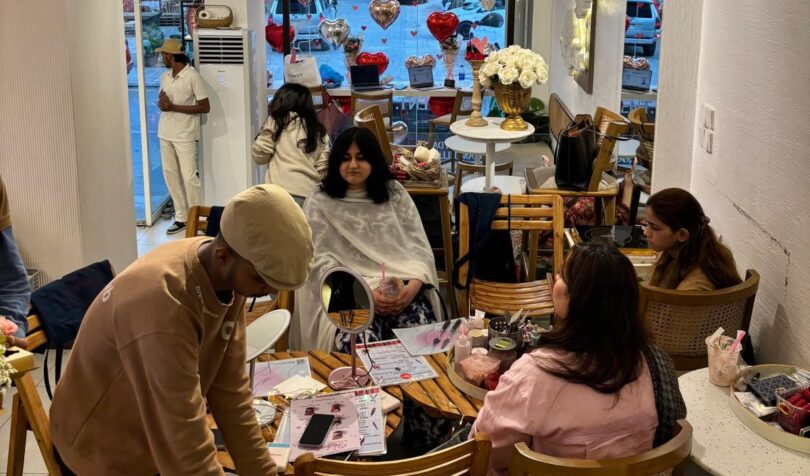
Walk into any café along Karachi’s buzzing strip on Khayban-e-Bukhari, and you’ll find the same monotonous scene. Teenagers hunched over laptops, friends playing board games, and influencers angling their phones for the perfect shot.
Welcome to Karachi’s coffee revolution.

Ellas, Shake & Bake, Sync, June, Luna. The names roll off the tongues of Karachi’s youth like a second language.
New cafés appear constantly. Some sit directly beside their competitors, offering nearly identical menus. Yet somehow, all of them stay full.
It is a cycle driven by demand. And right now, the demand is limitless.
At the center of it are youth. Teenagers have turned cafés into something more than just places to drink coffee – a third space. Not home, not school, but somewhere in between, where being productive and being social blur into one.
It’s a place to study without the monotony of your bedroom wall, to meet a friend without the formality of a restaurant, to sit with a board game and simply exist in the company of friends.
For many, going to a café feels like doing something. Even sitting there, doing nothing. It gives a false sense of satisfaction of being productive without the effort.
Some are studying, others are catching up with friends, and a few are in casual meetings.
Increasingly, groups gather around small tables, leaning over board games, laughing, competing and passing time together. Many coffee shops now offer free access to these games, turning what could have been just another commercial space into something more communal.
Social media has only intensified this coffee craze. Every corner is designed to be photographed, every drink designed to be shared.


Influencers collaborate with brands, pulling curious followers through café doors. In Karachi, if someone says a place is worth visiting, people show up.
And people respond to it. Very quickly.
A single recommendation, a trending reel, or even a passing comment, “This place is really good’’ is often enough to bring in a wave of customers. In a city where novelty can feel limited, cafés offer something new, something to try, something to post.
But beneath all this coffee chaos, there is a quieter reality that is easy to overlook.
One evening at an outdoor matcha stand, I watched as a young homeless girl and her little brother approached a table where customers had left their unfinished drinks. As it was being cleared away, they desperately asked the server if they could have what was left.
It was a small moment, but it lingered.
Because while some people move from café to cafe without thinking twice, others are simply trying to access whatever remains. The same drink that is casually abandoned by one person becomes something worth asking for, even begging for, to someone else.
The quote “One person’s trash can be another person’s treasure” truly made sense in this moment.
It is a reminder that this coffee culture, as vibrant as it is, is not shared equally.
An iced latte is not for everyone. It is priced and marketed towards a very specific audience, primarily middle and upper-class teenagers.

Chai, on the other hand, remains what it has always been: accessible, familiar and universal. It exists in homes, on small street stands, across all ages and income levels. It remains the drink of the people.
Coffee and chai now coexist in Karachi, but they don’t always speak to the same Karachi.
Coffee in Karachi has become more than a drink. It reflects a city that is shifting, becoming more modern and globally influenced.
And yet it also highlights spaces that feel open to everyone, but aren’t.
Whether this is a passing phase or a permanent shift is still unclear. Perhaps some cafés won’t survive the fierce competition. But the culture itself feels like it’s here to stay. It has seeped into daily routines and the city’s overall identity.
Karachi is modernizing, and its youth are leading the way, one cup at a time.
Zara Irani is a Junior Reporter with Youth Journalism International.